← Back to whitepapers

White paper · March 2026

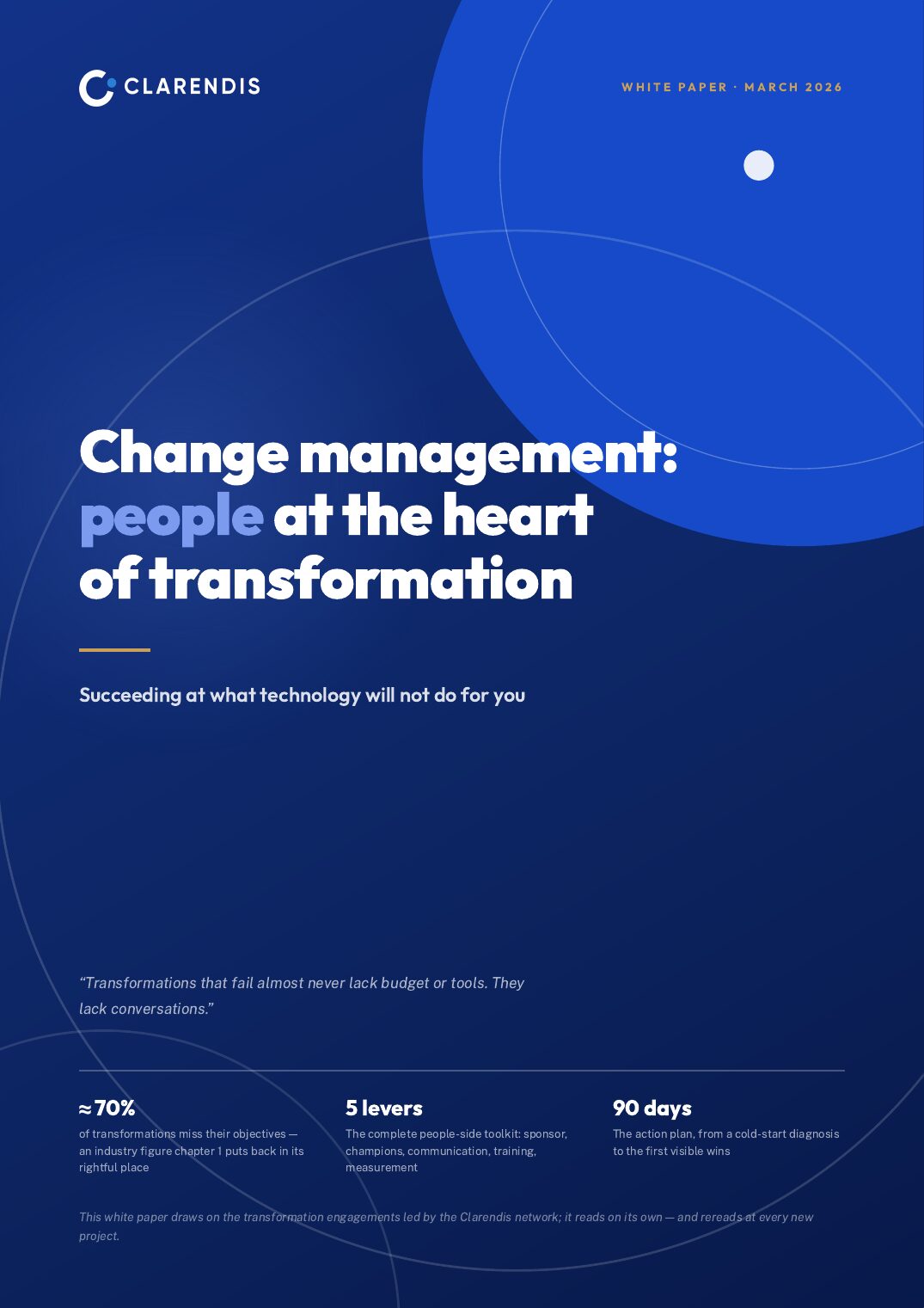
White paper — Change management: people at the heart of transformation

Change management: people at the heart of transformation. 39 pages to succeed at what technology will not do for you — with no conflict of interest: Clarendis sells no proprietary method, no certification, no adoption software.

  • The stakeholder map and the impact map — who is affected, and by what exactly
  • The maturity grid and the one-page diagnosis
  • The five levers: sponsor, champion network, communication, training at the point of need, adoption measurement
  • The 90-day action plan — listen, equip, embed — with its five-number dashboard
Cover of the white paper
White paper · March 2026
White paper — Change management: people at the heart of transformation

Read the opening pages

The 39 pages of this white paper. The first 11 are readable in full; the rest is sent by email.

Page 1 of the white paper “Change Management: Putting People at the Heart of Transformation”
Page 1

White paper · March 2026

Change management: people at the heart of transformation

Succeeding at what technology will not do for you

“Transformations that fail almost never lack budget or tools. They lack conversations.”

≈ 70%

5 levers

90 days

of transformations miss their objectives — an industry figure chapter 1 puts back in its rightful place

The complete people-side toolkit: sponsor, champions, communication, training, measurement

The action plan, from a cold-start diagnosis to the first visible wins

This white paper draws on the transformation engagements led by the Clarendis network; it reads on its own — and rereads at every new project.

Page 2 of the white paper “Change Management: Putting People at the Heart of Transformation”
Page 2

Contents

Foreword 03 Executive summary — the document in ten statements 04 Your reading path 06 1 The resistance misunderstanding The real track record of transformations · Why “people resist change” is a lazy diagnosis · What inaction costs · The conviction that changes everything 07 2 What change really does to teams The change curve, without the folklore · Absorption capacity · The four needs to serve · What breaks in practice 12 3 Diagnose before you act The stakeholder map · The impact map · The maturity grid · The one-page diagnosis 17 4 The people-side toolkit: five levers, not one more The sponsor · The champion network · Communication that answers questions · Training at the moment of need · Adoption measurement 22 5 The blind spots Middle managers · Multi-project saturation · Remote work · After go-live · Weak signals · The five-question test 27 6 The 90-day action plan Where are you starting from? · D1-D30: listen and map · D31-D60: equip and enrol · D61-D90: anchor and measure · The five-number dashboard 32 Moving to execution 36 Appendices — Glossary, references, about Clarendis 37

Page 3 of the white paper “Change Management: Putting People at the Heart of Transformation”
Page 3

Foreword

We spend our days inside transformation projects: new tools, new processes, new organisations. And we keep making the same observation: the technical side of these projects is better and better mastered, the human side less and less budgeted. The data migration is planned to the week; the support of the three hundred people who will live with the result is improvised. Then everyone is surprised that the tool is delivered and nothing changes.

This white paper was born of that observation. It sells no proprietary method, no certification, no adoption software: Clarendis is a digital-steering consulting network, and our business is making transformations succeed, not selling their accessories. What we describe here is what we practise: a simple people-side toolkit, sized to the reality of the company, steered with the same rigour as the technical workstream.

One point of intellectual honesty, which holds for the whole document: change management is a field saturated with spectacular figures and four-letter models. We cite the classic references where they illuminate, we flag industry figures for what they are — orders of magnitude — and we have kept only what genuinely helps you decide on a Monday morning.

How to read this document. The chapters stand alone. If your project is starting, begin with chapter 3 (the diagnosis) and the plan in chapter 6. If your project is stalling, chapter 5 (the blind spots) will probably tell you where. Each chapter closes with the same panel, what this changes for you, written for three readers: the CEO, the CHRO, the front-line manager. It is deliberately the same subject seen from three angles, because transformations most often fail where leadership, HR and field management do not work together.

Enjoy the read — and the conversations.

Cédric Guittard

Anna Hoang

cedric.guittard@clarendis.com

anna.hoang@clarendis.com

for the Clarendis team

Page 4 of the white paper “Change Management: Putting People at the Heart of Transformation”
Page 4

Executive summary

The document in ten statements. Each is developed in the chapter indicated.

1

2

Transformations almost never fail technically. The tool is delivered, the process documented, the org chart published. What fails is adoption: the gap between what is deployed and what is actually used. (Chapter 1)

“People resist change” is a lazy diagnosis. People resist loss, uncertainty and the disregard of their expertise — three things that can be treated. Resistance is information, not an obstacle. (Chapter 1)

3

4

The change curve is real, but it is not a fatality. The performance dip that follows every cut-over is reduced by anticipation, training at the right moment and an explicit right to err — not by motivational posters. (Chapter 2)

An organisation's absorption capacity is finite. Every team can only digest a limited number of simultaneous changes. The question is not “is this project good?” but “what is this team already digesting?”. (Chapter 2)

5

6

No toolkit without a diagnosis. A stakeholder map and an impact map — two one-page deliverables — are worth more than any generic communication plan. Who loses what, who gains what, who blocks what: everything starts there. (Chapter 3)

One visible sponsor is worth ten project managers. The factor most correlated with success is an active, visible, constant executive sponsor — not a name on a kick-off slide. The role is written down, scheduled and measured. (Chapter 4)

Page 5 of the white paper “Change Management: Putting People at the Heart of Transformation”
Page 5

7

8

Communication that works answers questions; it does not announce ambitions. “What changes for me, when, and who helps me?” — until those three questions have answers, nobody hears the rest. (Chapter 4)

Middle managers are blind spot no. 1. They are asked to carry a change they are subjected to themselves, with no dedicated time and no answers. Equip them before everyone else — or they will become, rightly, the first filter of scepticism. (Chapter 5)

9

10

What is not measured degrades in silence. Adoption is steered with five numbers, collected monthly, like any production indicator. Gut feeling does not replace measurement; it complements it. (Chapters 4 and 6)

Change does not end at go-live — it starts there. The three months after cut-over decide everything: close-range support, irritants treated, real wins celebrated. The support budget must survive the move to production. (Chapters 5 and 6)

Where to start, depending on your situation:

The project has not started. Chapter 3 (the one-page diagnosis), then the 90-day plan in chapter 6: your absolute priority is to listen before announcing, and to name the sponsor before the vendor.

The project is underway and the mood is tightening. Chapter 5: the blind spots are where your setup is lying to you. Then chapter 2, to requalify what you have been calling “resistance”.

Go-live is behind you and adoption is flat. Chapter 4, lever 5 (measurement), and chapter 6, D61-D90: anchoring is a workstream in its own right, not a warranty phase.

Page 6 of the white paper “Change Management: Putting People at the Heart of Transformation”
Page 6

Your reading path

Three waymarked itineraries. The “What this changes for you” panels, at the end of each chapter, are written for your seat at the table.

CEO CEO 25 minutes

CHRO CHRO 1 hour

MGR Manager 45 minutes

01 Executive summary

01 Chapter 2 in full (the curve, absorption, the four needs)

You are the one everyone asks. Your path:

02 chapter 1 (§1.3: what inaction costs, and the decision that falls to you)

02 chapter 3 (the two maps: your toolbox)

01 chapter 2 (what your teams are living through — and you with them)

03 chapter 4, lever 1: your sponsor role, in black and white

03 chapter 4, levers 2-4 (champions, communication, training)

02 chapter 5, §5.1 (your situation, named without detour)

04 chapter 6, §6.4 (the five numbers to put on your agenda).

04 chapter 5, §5.2 (multi-project saturation, your watchtower)

03 chapter 4, lever 3 (the answers to your team's questions)

You will know what the project expects of you, and how to check it is really moving.

05 chapter 6 in full — the plan is yours, with the project lead.

04 the six “Manager” panels, at the end of each chapter.

What you came here for

Need

Where

In what form

Understand why it keeps jamming

Chapters 1-2

The real track record, the mechanics of “resistance”, the curve and absorption capacity

Ready-to-use tools

Chapter 3

Two one-page maps, a maturity grid, a model diagnosis

A complete, right-sized toolkit

Chapter 4

Five levers, each with its deliverable, its owner and its classic mistake

A plan executable tomorrow

Chapter 6

90 days in three phases, and the five-number adoption dashboard

Page 7 of the white paper “Change Management: Putting People at the Heart of Transformation”
Page 7

Chapter 1

The resistance misunderstanding

1

Before talking method, we need to face the track record — and dismantle the most widespread and most wrong diagnosis in the field: “people resist change”.

1.1 The real track record of transformations

You have read the figure a hundred times: “70% of transformations fail”. Handle it with care: popularised by John Kotter's work in the 1990s and echoed by the big consultancies, it aggregates studies with very different scopes, and “failing” covers everything from outright abandonment to simple delay. What is robust in the figure lies elsewhere: in a majority of cases, the gap between the announced ambition and the observed result is massive — and that gap is almost never technical.

Look at your own projects of the last five years. Was the tool delivered? Almost always. Was the process documented? Generally. The awkward question is the third one: is what was deployed actually used, as intended, by the people intended? That is where the modern failure lives: no longer the project that collapses, but the project that lands in indifference — the tool bypassed by unofficial spreadsheets, the process “applied” on paper and ignored in fact.

This form of failure has a formidable property: it is silent. No steering committee ever declares “adoption has failed”. Six months later, the benefits promised in the business case are simply not there, and the context takes the blame. The first reflex of serious steering is therefore to define, at framing stage, what “succeeding” means in terms of usage: who uses what, how often, with what measurable result. Chapter 6 turns it into a dashboard.

Page 8 of the white paper “Change Management: Putting People at the Heart of Transformation”
Page 8

1

Chapter 1 — The resistance misunderstanding

1.2 “People resist change”: autopsy of a lazy diagnosis

It is the most spoken sentence in transformation committees, and the most convenient: it moves the problem from the project to the people. Field observation says otherwise. The same “resistant” employees adopt a personal smartphone, a banking app or a social network in days. Nobody resists change in general; everyone resists precise things — and those things have names:

What gets called “resistance”

What it really is

What treats it

“They're dragging their feet”

Fear of a real loss: devalued skills, reduced autonomy, expert status reset to zero, sometimes a threatened job

Name the loss honestly, and say what compensates it — or own it

“They're negative”

Uncertainty: nobody has told them what changes for them, when, and who will help them

Concrete answers to the three questions of chapter 4, before any ambition-speak

“They criticise everything”

The felt disregard of their expertise: the solution was designed without them, and it breaks things that worked

Involve them where their objections are information: the field is often technically right

“They have no time”

Saturation, literally: the change lands on top of an already full workload, with nothing removed

Dedicated, arbitrated, visible time — not “commitment” demanded on top of everything else (§5.2)

This table changes the function of resistance: it stops being an obstacle to defeat and becomes the project's best sensor. Where there is protest, there is an unnamed loss, an unanswered question, an ignored expertise or an unarbitrated workload. A serious change effort does not silence these signals: it collects them, qualifies them and treats them — exactly as a technical team treats defects.

Silence, conversely, is the real alarm. A team that no longer asks questions has not bought in: it has decided that asking is pointless. Indifference costs more than opposition, because it never shows in the committees.

Page 9 of the white paper “Change Management: Putting People at the Heart of Transformation”
Page 9

1

Chapter 1 — The resistance misunderstanding

1.3 What cut-rate change support really costs

Change support is almost always the first line sacrificed when the budget tightens, because its absence is invisible at go-live. It shows afterwards, on four cost items that nobody ever traces back to the project:

The productivity dip that drags on

The silent return to the old world

Every cut-over creates a dip (chapter 2). Without support it is deeper and above all longer: weeks of double entry, workarounds and “how did we do this before?” that appear in no business case.

The unofficial spreadsheet, the double bookkeeping of habit, the “mandatory” tool fed minimally for form's sake. You then pay for two systems: the new one in licences, the old one in hidden time.

The wear of key people

The credit spent for the next project

The same field experts absorb every project, with no recognition and no relief. One day they stop compensating — and that is often the day they leave, taking the memory of the processes with them.

Every botched transformation makes the next one more expensive: “we've already given” is the costliest sentence in an organisation. Trust is a capital spent project after project.

The order of magnitude to remember is not a magic percentage of budget: it is a rule of proportion. The more the change touches the daily habits of many people, the higher the human share of the budget must be — an ERP change touching three hundred daily users deserves support as serious as the technical build; an expert tool for twelve volunteers does not. Sizing honestly is what the chapter 3 diagnosis makes possible.

The conviction that structures this document

Change management is not a support function of the project: it is half the project. It is framed, budgeted, steered and measured with the same rigour as the technical workstream — same committees, same indicators, same standards. Everything else in this white paper is the application of that sentence.

Page 10 of the white paper “Change Management: Putting People at the Heart of Transformation”
Page 10

1

Chapter 1 — The resistance misunderstanding

1.4 What the literature says that is useful — on one page

The field overflows with models. Three references are enough to work with, provided you take them for what they are: reading grids, not recipes.

Reference

What it brings

Its limit in practice

Lewin (unfreeze, move, refreeze)

The founding idea: a change has three phases, and the last one — restabilising — is work in its own right, not an automatic consequence

Modern organisations never really “refreeze”: changes come in chains (§5.2)

Kotter (8 steps, Leading Change , 1996)

The sense of urgency, the sponsor coalition, the quick wins: three ideas chapter 4 applies as they stand

Designed for top-down transformations; less suited to continuous, distributed change

ADKAR (Prosci)

The right unit of analysis: the individual. Awareness, desire, knowledge, ability, reinforcement — five states diagnosed person by person, team by team

Can degenerate into an assessment bureaucracy; the spirit matters more than the form

What these three grids share — and what this document takes on board: change is worked before, during and after; it is carried at the top and supported at individual height; and anchoring is the most neglected phase. You do not need a certification to apply this. You need an honest diagnosis (chapter 3), a right-sized toolkit (chapter 4) and steering that lasts (chapter 6).

What this changes for you

CEO

CHRO

MGR

CEO. Require every transformation business case to carry a costed adoption section: who will have to change their habits, how many people, with what measurable usage target. A project that cannot answer is not ready to be funded.

CHRO. Requalify “resistance” in every governance body: each time it is invoked, ask which of the four causes of §1.2 is at play. That single reflex turns complaints into an action plan — and repositions HR as the project's partner.

Manager. Your teams are neither negative nor fragile: they are reacting normally to real losses, real fog and real workloads. Your first tool is the question “what worries you concretely?” — asked early, one to one, and followed by action.

© Clarendis — March 2026 10

Page 11 of the white paper “Change Management: Putting People at the Heart of Transformation”
Page 11

1

Chapter 1 — The resistance misunderstanding

Chapter 1 in three takeaways

≈ 70%

4

½

The industry figure — read it as an order of magnitude of disappointment, not a statistic

Real causes behind “resistance”: loss, uncertainty, ignored expertise, saturation

Change management is not a support function of the project: it is half the project

The unofficial-spreadsheet test

A free and infallible adoption indicator already exists in your company: census the unofficial spreadsheets and channels that duplicate your official tools. Each one is the fossil of a transformation whose adoption failed — and the list of their owners is your best list of people to interview in chapter 3. Redo the census a year after each project: it is the ultimate arbiter.

© Clarendis — March 2026 11

The remaining 28 pages are in the complete document.

Download the white paper
Page 12, blurred — available in the full document
Page 12 · in the full document
Page 13, blurred — available in the full document
Page 13 · in the full document
Page 14, blurred — available in the full document
Page 14 · in the full document
Page 15, blurred — available in the full document
Page 15 · in the full document
Page 16, blurred — available in the full document
Page 16 · in the full document
Page 17, blurred — available in the full document
Page 17 · in the full document
Page 18, blurred — available in the full document
Page 18 · in the full document
Page 19, blurred — available in the full document
Page 19 · in the full document
Page 20, blurred — available in the full document
Page 20 · in the full document
Page 21, blurred — available in the full document
Page 21 · in the full document
Page 22, blurred — available in the full document
Page 22 · in the full document
Page 23, blurred — available in the full document
Page 23 · in the full document
Page 24, blurred — available in the full document
Page 24 · in the full document
Page 25, blurred — available in the full document
Page 25 · in the full document
Page 26, blurred — available in the full document
Page 26 · in the full document
Page 27, blurred — available in the full document
Page 27 · in the full document
Page 28, blurred — available in the full document
Page 28 · in the full document
Page 29, blurred — available in the full document
Page 29 · in the full document
Page 30, blurred — available in the full document
Page 30 · in the full document
Page 31, blurred — available in the full document
Page 31 · in the full document
Page 32, blurred — available in the full document
Page 32 · in the full document
Page 33, blurred — available in the full document
Page 33 · in the full document
Page 34, blurred — available in the full document
Page 34 · in the full document
Page 35, blurred — available in the full document
Page 35 · in the full document
Page 36, blurred — available in the full document
Page 36 · in the full document
Page 37, blurred — available in the full document
Page 37 · in the full document
Page 38, blurred — available in the full document
Page 38 · in the full document
Page 39, blurred — available in the full document
Page 39 · in the full document
Share this white paper