← Back to whitepapers

White paper · Enriched edition · October 2026

White paper — Zero penalties, no respite: e-invoicing, enriched edition

Zero penalties, no respite. E-invoicing 2026-2035, enriched edition, 49 pages. Written after six weeks of real-world application: what broke, what did not, and the answers to the two questions our readers asked most — “where exactly are my invoices now?” and “the French tax authority was breached, is this safe?”.

  • Where your invoices actually are: the real journey of a received invoice, in plain language, and what to check every week
  • Security and trust after summer 2026: the facts of the DGFiP breach, what it does not cover, and the real risk of credible supplier fraud
  • What the first weeks taught: the blockages observed, and what businesses still without a platform must do now
  • Zero penalties in 2026, but no respite: why suspended penalties are not an exemption, and what 2027 will require
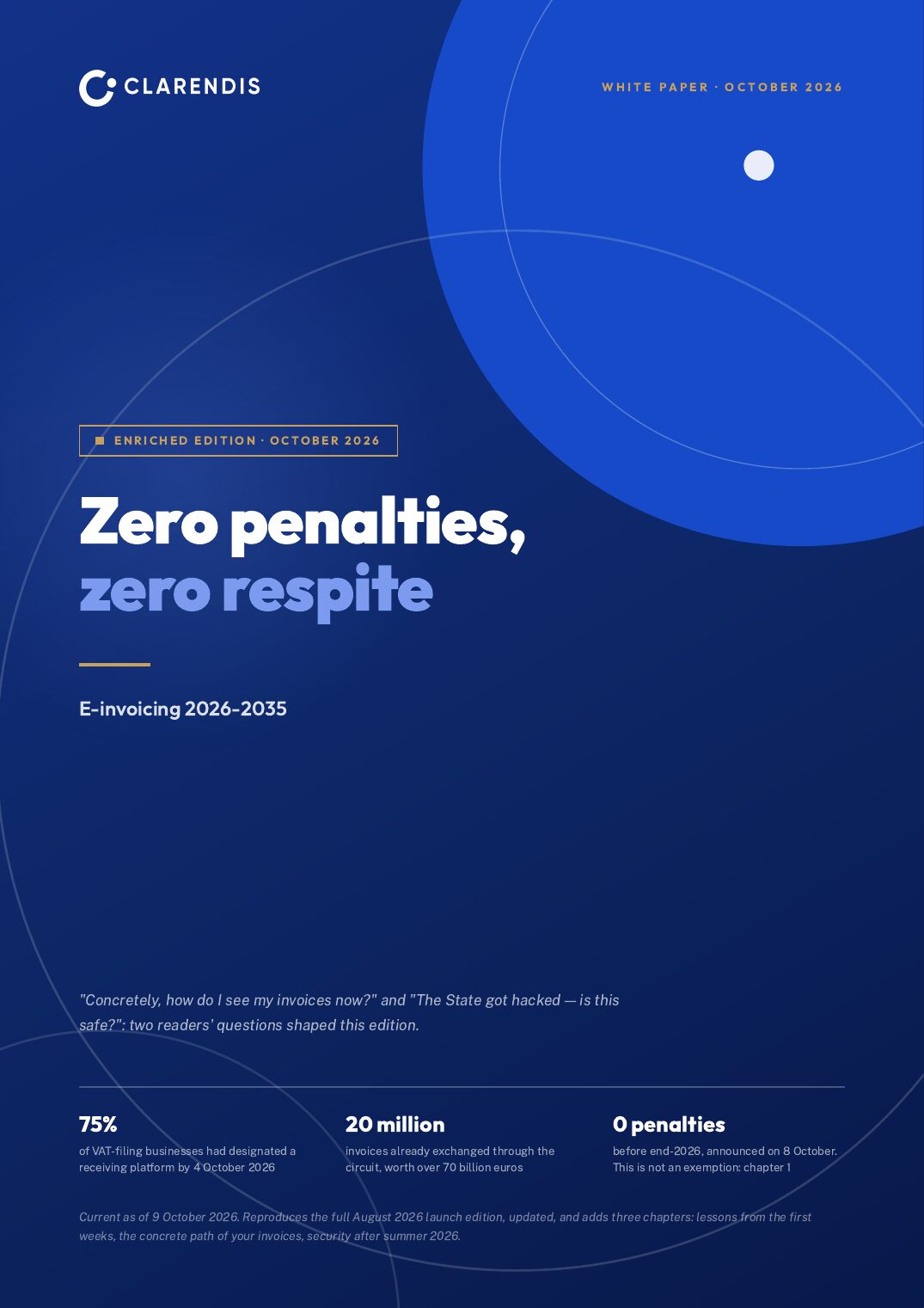
Cover of the white paper
White paper · Enriched edition · October 2026
White paper — Zero penalties, no respite: e-invoicing, enriched edition

Read the opening pages

The 49 pages of this white paper. The first 14 are readable in full; the rest is sent by email.

Page 1 of the white paper “Zero penalties, no respite: e-invoicing, enriched edition”
Page 1

White paper · October 2026

Enriched edition · October 2026

Zero penalties, zero respite

E-invoicing 2026-2035

"Concretely, how do I see my invoices now?" and "The State got hacked — is this safe?": two readers' questions shaped this edition.

75%

20 million

0 penalties

of VAT-filing businesses had designated a receiving platform by 4 October 2026

invoices already exchanged through the circuit, worth over 70 billion euros

before end-2026, announced on 8 October. This is not an exemption: chapter 1

Current as of 9 October 2026. Reproduces the full August 2026 launch edition, updated, and adds three chapters: lessons from the first weeks, the concrete path of your invoices, security after summer 2026.

Page 2 of the white paper “Zero penalties, no respite: e-invoicing, enriched edition”
Page 2

Contents

Foreword 03 Executive summary: the document in ten statements 04 Your reading path 06 1 What September changed rewritten From the summer's misunderstanding to October's suspension · What is enforceable · Penalties suspended, not lifted · The good-faith file reframed 07 2 What the first weeks taught new The committee's figures · What jammed · What did not jam · What the remaining 25% must do now 11 3 Concretely, where are my invoices now? new The path in plain language · Where it lands in your case · Viewing and downloading · The weekly routine · An invoice does not arrive 13 4 What the reform does to your information system The invoice stops being a document · The real path · The five touchpoints · What breaks in practice · The order of works 16 5 Choosing without getting it wrong Five families of players · Start from flows, never from demos · 6 blocks, 21 criteria · Five contractual traps · Special cases 21 6 The blind spots expanded Down payments · Credit notes · Self-billing · Expense claims · International · B2C · Intra-group · Three sectors developed · Ghost channels · The status test · The minimum acceptance test 29 7 Security and trust after summer 2026 new The facts, and only the facts · What it does not mean · The credible fake supplier · What protects · What the administration receives 35 8 2027, 2030, 2035: the trajectory expanded September 2027, strengthened · July 2030, ViDA · January 2035 · From compliance to value · The no-regret decisions 38 9 The 90-day action plan Reset for an October 2026 start · Where are you starting from? · D1-D30 · D31-D60 · D61-D90 · The five-number dashboard 43 Moving to execution 46 Appendices: glossary, primary sources, about Clarendis 47

Page 3 of the white paper “Zero penalties, no respite: e-invoicing, enriched edition”
Page 3

Foreword

The launch edition of this document was written four weeks before the reform came into force. It has applied since 1 September 2026. We promised our readers an edition enriched with what only reality can teach: here it is.

Two pieces of feedback reached us more often than any other. The first comes from the people who process invoices: "concretely, how do I see my invoices now? I don't understand any of it". The second comes from executives: "the State got hacked — is this safe?". Those two questions shaped this edition. Chapter 3 answers the first, in plain language, with no technical term left unexplained. Chapter 7 answers the second, sticking strictly to the published facts.

A word of verification, without satisfaction. In August we named as project blind spots the feedback of statuses between platforms, interoperability, the full cost of offers, and the ability to switch platforms. The reform's first monitoring committee, held on 8 October 2026, listed the difficulties reported by professional bodies and large companies: they are those. We note it because it confirms this document's method — starting from flows and architecture rather than from the tool — and for no other reason.

Clarendis is a digital integrator. Our trade is advisory, architecture, programme management, and implementation when our clients want it, down to development if needed: we have, for instance, built an e-invoicing solution on Odoo. What we do not do: sell an accredited platform, or take a referral commission on anyone else's. That line is what allows us to write chapter 5 the way it is written, and to name no player as a recommendation. We make our living from the success of your project, not from the choice of a vendor.

What changes in this edition. Chapter 1 is rewritten: July's conditional tolerance became a clear, dated suspension of penalties, and we explain why that is not an exemption. Three chapters are new (2, 3 and 7). Chapter 6's sector lens is developed, the 2027 chapter is strengthened, the 90-day plan is reset for a company starting in October. Every date, figure and future-tense phrasing that has since become the past has been updated, and each new fact points to a dated primary source in the appendix. Nothing has been removed from the launch edition.

How to read this document. The chapters stand alone. Each closes with the same box, what this changes for you , written for the CEO, the CFO and the CIO: these projects fail most often where leadership, finance and IT do not work together. This edition is current as of 9 October 2026.

Enjoy the read.

Cédric Guittard

Anna Hoang

cedric.guittard@clarendis.com

anna.hoang@clarendis.com

for the Clarendis team

Page 4 of the white paper “Zero penalties, no respite: e-invoicing, enriched edition”
Page 4

Executive summary

The document in ten statements. Each is developed and sourced in the chapter indicated.

1

2

The calendar has not moved, and it will not move again. Since 1 September 2026, every business established in France must be able to receive electronic invoices; large companies and mid-caps must additionally issue them and transmit their e-reporting. SMEs will issue from 1 September 2027; by 4 October, 75% of VAT-filing businesses had designated a platform. (Chapters 1 and 2)

No penalties before end-2026, but no exemption. July's conditional tolerance became, on 8 October, a clear and dated suspension of penalties. The obligation remains, reception is enforceable, and nothing extends this regime into 2027. (Chapter 1)

3

4

One act conditions everything: designating an accredited platform. It is the platform that registers you in the national directory; there is no direct registration. Without a platform, your suppliers literally cannot reach you. (Chapter 1)

The invoice stops being a document and becomes a controlled data flow. What was layout becomes data; what was invisible becomes traceable; what was periodic becomes continuous. This is an architecture shift, not a format change. (Chapter 4)

5

6

The first worksite is not the tool, it is your third-party master data. Routing rests on the directory, the directory on SIREN/SIRET numbers, and the real state of customer and supplier databases is regularly the first cost item of these projects. (Chapter 4)

A rejection is not a refusal. A rejection is technical — the invoice is deemed never issued, hence never paid; a refusal is commercial — the invoice exists, the dispute is handled. Who handles what, within what deadline: two procedures to write before go-live. (Chapter 4)

7

Choose your platform from your flows, never from demos. Over a hundred offers, five families of players (named in chapter 5), none "right" in the absolute. Five questions asked in order cut the official list down to three to five candidates in half an hour; your one-page flow sheet does the rest. (Chapter 5)

Page 5 of the white paper “Zero penalties, no respite: e-invoicing, enriched edition”
Page 5

8

9

Reversibility is negotiated at signature; afterwards, it is bought. Data ownership, return of archives, capped exit cost: the two pages of the contract that will be worth money in three years, in a market that is going to consolidate. (Chapter 5)

Your "special" cases are the real project. Down payments, credit notes, self-billing, expense claims, international flows, intra-group: every case left unhandled is a non-compliance on borrowed time or a payment blockage in the making. (Chapter 6)

10

2026 is only the first step, and the constraint hides an asset. 2027 extends issuance to SMEs with a commercial cascade effect that will not wait for the law; 2030 brings the European ViDA obligations; 2035 harmonises. And the same plumbing opens, as soon as it runs, three value worksites: working capital steered on real data, automated P2P, cash management on fresh data. This year's decisions must serve both. (Chapter 8)

Where to start, depending on your situation:

Nothing is under way. Chapter 1 (what is enforceable, the good-faith file), then straight to chapter 9's 90-day plan, "cold start" sequence. Your absolute priority: designating a receiving platform within a fortnight (chapter 2, §2.4), then the dated decision.

The project is launched, the platform chosen. Chapters 4 and 6: the five IS touchpoints and the blind spots are the two places where your schedule is probably lying.

You are "ready". Chapter 6 for the trial by fire of the special cases, chapter 8 to check that your architecture will survive 2027 and 2030 — and chapter 9's dashboard to make that "ready" objective.

Your teams ask where the invoices are, or whether it is safe. Chapters 3 and 7, written to be read as they stand by those who process invoices and by those who worry.

Page 6 of the white paper “Zero penalties, no respite: e-invoicing, enriched edition”
Page 6

Your reading path

Three signposted routes. The "What this changes for you" boxes at the end of each chapter are written for your seat.

CEO Executive 25 minutes

CFO Finance 1 hour

CIO IT 1 h 30

01 Executive summary

01 Chapters 1 and 2 (suspension of penalties, the remaining 25%, the good-faith file)

Full document recommended. Your critical path:

02 chapter 1 (§1.1 and §1.4: the misunderstanding, and the dated decision that is yours to take)

01 chapter 4 (the five touchpoints) and §6.10 (the status test)

02 chapter 4, §4.3-4.4 (rejection/refusal, the procedures to write)

03 the nine "CEO" boxes

02 chapter 6 (your acceptance test set)

04 chapter 9, §9.4 (the five numbers to put on your agenda).

03 chapter 5, blocks 4 and 5 of the grid (reversibility, full cost)

03 chapter 5, blocks 2-3-4 (lifecycle, APIs, reversibility)

You will know what to demand, from whom, and how to measure it.

04 chapter 6, §6.2 and §6.4 (credit notes, expense claims)

04 chapter 8, §8.4 (EN 16931 as pivot, isolated exchange layer)

05 chapter 9 in full — the plan is yours.

05 chapter 9, D61-D90.

What you came looking for

The four promises of the launch edition, and the two questions of this one:

Promise

Where

In what form

The comparison grid of accredited platforms

Chapter 5

The 5 families with named players, the five questions that cut the official list to three to five candidates, then 6 blocks and 21 criteria — for each, the exact question to ask and what a good answer contains

The map of impacts on your IS

Chapter 4

The 5 touchpoints, what breaks in practice, and the order of works

The blind spots of the official guides

Chapter 6

8 situations, each with its trap and the decision to settle

The 2027-2035 trajectory

Chapter 8

The 3 deadlines, what real time makes possible (working capital, P2P, steering), and the 4 "no-regret" decisions of 2026

The two questions from the field

Chapters 3 and 7

The concrete path of a received invoice, in plain language; the facts of summer 2026, what they do not mean, and what really protects

Page 7 of the white paper “Zero penalties, no respite: e-invoicing, enriched edition”
Page 7

Chapter 1

What September changed

1

The August edition described a tolerance to be earned. On 8 October it became a dated suspension of penalties. This chapter says what changed, what did not, and why the reflex "we have until the end of December" is the costliest of the autumn.

1.1 From the summer's misunderstanding to October's suspension

O n 10 July 2026 the DGFiP published a practical start-up guide; the next day the Ministry for Public Action and Accounts announced a "tolerant and benevolent" implementation towards businesses acting in good faith (press release no. 898). The guide specified that this approach constituted neither a postponement nor a suspension of the obligation, and that tolerance had to be earned: a real, documented difficulty, followed by corrections.

On 8 October 2026 the reform's first monitoring committee, chaired by David Amiel, Minister for Public Action and Accounts, brought together AFEP, MEDEF, Les Entrepreneurs, U2P, the consular networks and the chartered accountants. The next day's press release (no. 1103, 9 October 2026) settles what the summer had left blurred: no penalty will be imposed on any business before the end of 2026.

This is the major change since our launch edition, and it must be read exactly. July's tolerance was conditional : you had to be able to prove a trajectory. October's suspension is clear and dated: it applies to all businesses, without condition, until 31 December 2026. What has not changed: the obligation itself. The legal calendar (article 289 bis of the General Tax Code) is maintained, reception has been enforceable since 1 September, as has issuance by large companies and mid-caps, and the committee has put preparation for 1 September 2027 on its agenda.

The trap of this suspension is to read it as a deadline: "we have until the end of December". Three reasons not to. The first is commercial: your large-company and mid-cap suppliers are already issuing, and a business without a platform literally cannot receive their invoices. The second is operational: nothing in October's announcements extends the suspension beyond 2026, and the 2027 regime is that of the law. The third is arithmetic: a 90-day plan launched in October ends in January 2027, after the suspension expires. Chapter 9 is written for that deadline.

Page 8 of the white paper “Zero penalties, no respite: e-invoicing, enriched edition”
Page 8

1

Chapter 1 · What September changed

1.2 What has been enforceable since 1 September 2026

Since 1 September 2026

From 1 September 2027

Large companies and mid-caps

Receive + issue + e-reporting

already in force

SMEs, very small businesses, micro-enterprises

Receive

Issue + e-reporting

The most misunderstood point has not moved: the reception obligation admits no size exception. Micro-enterprise, freelancer, association — all must be able to receive, because their large-company and mid-cap suppliers are now issuing. By 4 October, 75% of VAT-filing businesses had designated a receiving platform. The remaining quarter is the subject of chapter 2.

Three acts condition compliance:

1.

Designate an accredited platform, directly or through your software vendor or accounting firm. The official list is published on impots.gouv.fr; check the accreditation status on the day you choose, and be wary of "registration in progress" mentions.

2.

Check your entry in the national directory (facturation.chorus-pro.gouv.fr/annuaire, open lookup by SIREN). You do not register yourself: your platform declares you there. Your role: check that your legal details are accurate and that your entry carries an active invoicing address.

3.

Respect the accepted structured formats for issuance: UBL, CII or Factur-X. A PDF sent by email is not an electronic invoice within the meaning of the reform.

Since 8 October 2026, 0 806 807 807 is the single number for professionals to reach the DGFiP anywhere in France, e-invoicing included (free service + cost of a call).

The four links to bookmark

· The DGFiP start-up guide (update endorsed by the 8 October committee) and the official platform list: impots.gouv.fr → professionnel → "Je passe à la facturation électronique"

· Your directory entry (open lookup by SIREN): facturation.chorus-pro.gouv.fr/annuaire

· The general entry point: economie.gouv.fr → "Tout savoir sur la facturation électronique"

· The up-to-date detail of penalties: entreprendre.service-public.gouv.fr → "Facturation électronique : les sanctions évoluent"

Page 9 of the white paper “Zero penalties, no respite: e-invoicing, enriched edition”
Page 9

1

Chapter 1 · What September changed

1.3 Penalties: what the law says, and what the administration suspends

The legal regime is that of the 2026 Finance Act (law no. 2026-103 of 19 February 2026, article 123). It remains in force; only its application is suspended until the end of 2026.

Breach

Penalty provided by law

Legal basis

Failure to issue in electronic format

€50 per invoice, capped at €15,000/year

CGI, art. 1737 III

No accredited platform for reception

Formal notice; €500 if without effect after 3 months, then €1,000 per breach recorded every 3 months

CGI, art. 1737 IV bis

Failure to transmit e-reporting

€500 per missing transmission, capped at €15,000/year

CGI, art. 1788 D

2026

Suspension of penalties. "No penalty will be imposed on any business before the end of 2026" (press release no. 1103, 9 October 2026). The right to error of article 1737 V (first offence corrected spontaneously or within 30 days) is added to this regime and will outlive it.

These amounts were never the real risk, and the suspension changes nothing about that. The real risk is operational: a supplier who cannot invoice you, an invoice that never arrives, a payment dispute, and, from chapter 4 onwards, everything a badly wired flow does to your cash. None of those consequences is suspended.

1.4 The good-faith file, reframed

In August the good-faith file served to earn tolerance. It now serves another purpose: preparing for 1 January 2027 , when the suspension ends, and for 1 September 2027, which the committee has already put on its agenda. The 2026 suspension of penalties is not an exemption, and nothing indicates that 2027 will enjoy the same regime. The four documents remain the same; their addressee has changed: it is no longer the inspector, it is you.

· A dated decision. An internal note recording that the matter has been taken in hand, with an owner and a calendar. If it does not yet exist, its date is today.

· The trail of the effort. Quotes, exchanges with vendors and platforms, contract, support tickets, meeting notes.

· The precise difficulty. "Our vendor will not deliver the update before January, here is their letter" is one. Document the blockage, not the delay.

· The corrective measures. A flow-by-flow switchover plan, dated, whose last milestone precedes 1 September 2027.

Page 10 of the white paper “Zero penalties, no respite: e-invoicing, enriched edition”
Page 10

1

Chapter 1 · What September changed

Three practical principles complete the file: you may switch over progressively (the guide explicitly allows it; start with the simplest flow); keep paying and invoicing (economic continuity prevails: an invoice received outside the circuit after 1 September remains usable for payment and VAT deduction, as long as regularisation through the electronic circuit is under way); keep a log — date, incident, cause, action, status; ten minutes a week.

The distinction that mattered in August still matters, with one more deadline: having started, even badly, or having started nothing , on 1 January 2027.

The dated-decision template, reset for an October start

"[Date]. The management of [company] decides to bring the company into compliance with the electronic invoicing obligation (art. 289 bis CGI), in force since 1 September 2026. [First name Last name] is appointed project owner. Milestones: designation of an accredited platform and verification of the directory entry within 15 days; inventory of flows and state of the third-party master data within 30 days; first switchover within 90 days; preparation for issuance on 1 September 2027 under way in the first quarter. A log of incidents and decisions is opened from this day. Signature."

This text is sent to no one: it is an internal note. Have it signed, date it, file it in the project folder. Compared with the August template, platform designation moves to first place and within a fortnight: for the 25% of businesses still without a platform, it is the act that reopens the door to their suppliers.

What this changes for you

CEO

CFO

CIO

CEO. Sign the dated decision of §1.4 this week. The suspension of penalties has given you a quarter; it ends at the same time as your 90-day plan. Do not spend it waiting for the next committee, planned before end-2026: it will prepare 2027, not a new deadline.

CFO. Check the company's directory entry yourself — five minutes on facturation.chorus-pro.gouv.fr/annuaire. If it is missing, you are in the quarter of businesses your suppliers cannot reach, and that is your no. 1 emergency. If it is clean, chapter 3 awaits you: it is written for your teams.

CIO. §1.2 gives you the three target formats. The difficulties raised at the 8 October committee — interoperability and status transmission — are yours: ask every vendor and your platform for their written position on both. The silences will draw your risk map.

Page 11 of the white paper “Zero penalties, no respite: e-invoicing, enriched edition”
Page 11

Chapter 2

What the first weeks taught

2

This chapter is new. It rests on a single source, the press release of the first monitoring committee (no. 1103, 9 October 2026), and on what our engagements have seen since September. What is in neither is not here.

2.1 The committee's figures, and what they say

B y 4 October 2026, five weeks after entry into force, 75% of VAT-filing businesses had designated a receiving platform . More than 20 million invoices had been exchanged through the circuit, representing over 70 billion euros. The administration describes the ramp-up as "ahead of expected targets".

VAT-filing businesses, as of 4 October 2026 source: press release no. 1103

75% have designated a receiving platform

25% no platform

Three readings of these numbers. The circuit works: twenty million invoices in five weeks is a system in production, not a pilot. The volume comes from the big issuers: 70 billion euros for 20 million invoices, an average of around 3,500 euros, points to traffic carried by large companies and mid-caps, the only ones required to issue. A quarter of businesses are unreachable in the circuit: for them, every invoice from a big supplier goes back out by email or post, with a regularisation to initiate.

2.2 What jammed

The committee recorded two lists. That of the professional bodies: the legibility and cost of offers, choosing or changing platform, adapting software and processes, the needs of the smallest businesses and of certain sectors. That of the large companies: interoperability between certain solutions, and the poor transmission of the statuses attached to invoices, which disrupts the automation of processing chains.

These two lists are, word for word, chapter 4 (the statuses that do not come back) and chapter 5 (the full cost, reversibility) of this document. We did not guess them: they are the mechanical consequence of an architecture that inserts two platforms and a directory in the middle of the sales cycle. When a rejection status does not cross the border between two platforms, the invoice is legally not issued and nobody knows. It is the reform's most silent failure mode, and it is the one large companies raise first.

Page 12 of the white paper “Zero penalties, no respite: e-invoicing, enriched edition”
Page 12

2

Chapter 2 · What the first weeks taught

2.3 What did not jam, contrary to fears

The scenarios feared before September — an unavailable directory, paralysed payments, blocked purchasing chains — appear neither in the difficulties raised at the committee nor in what we observe. Twenty million invoices routed in five weeks presuppose a directory that answers, and the economic continuity of July's guide has played its part: invoices outside the circuit continued to be paid and deducted. What jammed is not the national system, it is the seams: between two platforms, between a platform and a piece of software, between the circuit and internal processes. Good news for the reader: the seams are what a business controls, unlike the infrastructure.

2.4 What the remaining 25% must do now

Without a platform, the suspension of penalties protects you from nothing useful: it suspends fines, not the impossibility of receiving. Four acts, in this order, in under a fortnight:

1.

Ask your accounting firm and your software vendor whether they have already attached you to a platform. Part of the remaining quarter is, without knowing it. The answer is verified in the directory, not taken on trust.

2.

Otherwise, choose for reception only, from the official list, with a short commitment. Issuance in 2027 deserves chapter 5's consultation, not a decision in a fortnight; the difficulties listed by the committee (legibility, cost, changing platform) argue against committing for long on a choice made fast.

3.

Check your directory entry, then tell your five biggest suppliers you are reachable: they have invoices awaiting regularisation.

4.

Sign the dated decision of chapter 1 and enter chapter 9's 90-day plan, "cold start" sequence. 1 September 2027 concerns you for issuance.

The committee endorsed the update of the DGFiP start-up guide and will meet again before the end of 2026, with preparation for 1 September 2027 on the agenda. The administration has stopped looking at September 2026; do the same.

What this changes for you

CEO

CFO

CIO

CEO. Two figures to ask for this month: are we among the 75% (directory entry as proof), and how many of our suppliers' invoices have arrived outside the circuit since 1 September? The second number measures the regularisation debt that the suspension does not make disappear.

CFO. Invoices received by email since September remain payable and deductible, provided regularisation is under way. Keep the list: supplier, date, amount, channel. It will feed the log and, next year, your own switch to issuance, since these suppliers are the ones who will ask you for the same in return.

CIO. The two large-company difficulties, interoperability and statuses, can be tested: provoke a deliberate rejection towards a customer whose platform differs from yours, and time the status's return to your screens. If the result surprises you, chapter 4 explains why and chapter 5 what to demand.

Page 13 of the white paper “Zero penalties, no respite: e-invoicing, enriched edition”
Page 13

Chapter 3

Concretely, where are my invoices now?

3

It is the question the field asks us most often, and the most useful chapter of the document. It is written for the person who processes invoices, with no technical background assumed. Every unusual word is explained at its first appearance.

3.1 The path of a received invoice, in plain language

Before, your supplier sent you their invoice by post or by email, to the address of their choosing, and you received it wherever they had sent it. Since 1 September 2026, for invoices between French businesses, that path goes through a shared circuit, which resembles registered mail.

The accredited platform is your professional letterbox for invoices. It is an online service, chosen by your company (or for it, by your accountant or your software vendor), authorised by the administration to receive and send invoices. Every business has one. Your supplier has theirs.

The directory is the national address book. It says, for every business, identified by its SIREN number (the nine-digit number on your official documents), which letterbox is theirs. Your supplier no longer needs to know your accountant's email address: their platform looks up the directory, finds yours, and delivers the invoice to it.

The full path, in five steps: the supplier creates the invoice in their software; their software sends it to their platform; their platform looks up the directory and transmits it to your platform; your platform makes it available to you; and, in return, it sends the supplier tracking information, the equivalent of an acknowledgement of receipt: received, accepted, refused. Meanwhile, a summary of the invoice data (not the whole document — see chapter 7) is transmitted to the tax administration.

One practical consequence to remember: nobody can say "I never received it" any more. Neither you nor your supplier. Every step is dated and can be consulted. That is what changes most in daily life, in both directions.

Page 14 of the white paper “Zero penalties, no respite: e-invoicing, enriched edition”
Page 14

3

Chapter 3 · Concretely, where are my invoices?

3.2 Where it lands, depending on your case

There is not one answer but four, depending on how your company has organised itself. If you do not know which case you are in, the question to ask your manager or your accountant is: "who designated our platform, and which one?"

Case 1 · In your usual software

Case 2 · On the platform's website

Your accounting or management software is connected to the platform. Received invoices appear in a "supplier invoices", "to process" or "inbox" tab, where you used to key in invoices before. It is the most comfortable case: your routine changes little, data entry disappears.

Your company chose a platform without linking it to any software. You log in to its website with a username, as with online banking, and received invoices wait there. So you have to remember to go there: it is the case where an invoice can sleep without anyone noticing.

Case 3 · At your accountant's

Case 4 · Still by email, during the transition

The firm designated the platform and receives your invoices in its tool. You see them in the client area it gives you, or it forwards them to you. Clarify one thing with the firm: who looks at received invoices, how often, and who alerts you to an invoice to approve or refuse.

If your company does not yet have a platform, or if your supplier is a small business (which is only required to issue from September 2027), invoices keep arriving by email or post. They remain valid and payable. But case 4 is temporary: chapter 2, §2.4.

3.3 How to view and download it

An electronic invoice is a file. Depending on the format your supplier chose, that file is either an enriched PDF (the format called Factur-X: a normal PDF to the eye, which additionally contains data readable by software), or a pure data file (the formats called UBL or CII), unreadable as such by a human. In the second case, your platform or your software displays a readable version, presented like a classic invoice: that is the one you consult.

To download it, you will generally find two buttons: the PDF, to read, print or forward to a colleague; and the original file, for legal archiving. Simple rule: it is the original file that is authoritative, not the printout. If your company archives itself, that is the one to keep; if the platform archives for you, check that it is written in the contract.

An invoice received in the circuit no longer needs to be re-keyed: supplier, amount, VAT, due date are already in the data. If your software still asks you to retype everything, it is not the reform that requires it, it is your connection that is incomplete; report it.

The remaining 35 pages are in the complete document.

Download the white paper
Page 15, blurred — available in the full document
Page 15 · in the full document
Page 16, blurred — available in the full document
Page 16 · in the full document
Page 17, blurred — available in the full document
Page 17 · in the full document
Page 18, blurred — available in the full document
Page 18 · in the full document
Page 19, blurred — available in the full document
Page 19 · in the full document
Page 20, blurred — available in the full document
Page 20 · in the full document
Page 21, blurred — available in the full document
Page 21 · in the full document
Page 22, blurred — available in the full document
Page 22 · in the full document
Page 23, blurred — available in the full document
Page 23 · in the full document
Page 24, blurred — available in the full document
Page 24 · in the full document
Page 25, blurred — available in the full document
Page 25 · in the full document
Page 26, blurred — available in the full document
Page 26 · in the full document
Page 27, blurred — available in the full document
Page 27 · in the full document
Page 28, blurred — available in the full document
Page 28 · in the full document
Page 29, blurred — available in the full document
Page 29 · in the full document
Page 30, blurred — available in the full document
Page 30 · in the full document
Page 31, blurred — available in the full document
Page 31 · in the full document
Page 32, blurred — available in the full document
Page 32 · in the full document
Page 33, blurred — available in the full document
Page 33 · in the full document
Page 34, blurred — available in the full document
Page 34 · in the full document
Page 35, blurred — available in the full document
Page 35 · in the full document
Page 36, blurred — available in the full document
Page 36 · in the full document
Page 37, blurred — available in the full document
Page 37 · in the full document
Page 38, blurred — available in the full document
Page 38 · in the full document
Page 39, blurred — available in the full document
Page 39 · in the full document
Page 40, blurred — available in the full document
Page 40 · in the full document
Page 41, blurred — available in the full document
Page 41 · in the full document
Page 42, blurred — available in the full document
Page 42 · in the full document
Page 43, blurred — available in the full document
Page 43 · in the full document
Page 44, blurred — available in the full document
Page 44 · in the full document
Page 45, blurred — available in the full document
Page 45 · in the full document
Page 46, blurred — available in the full document
Page 46 · in the full document
Page 47, blurred — available in the full document
Page 47 · in the full document
Page 48, blurred — available in the full document
Page 48 · in the full document
Page 49, blurred — available in the full document
Page 49 · in the full document
Share this white paper