← Back to whitepapers

White paper · July 2026

White paper — Prestige hospitality: orchestrating a seamless experience

Prestige hospitality: orchestrating a seamless experience. 52 pages on what holds an exceptional stay together, from booking to departure — written from the field: we design, deploy and operate these systems for our clients, which is precisely how we know where they break.

  • The single guest view, and the VIP file treated as a vault: its GDPR and nFADP frame
  • The pivot PMS, the integration layer and the vendor requirements grid
  • The journey blueprint, moment by moment: before arrival, check-in, stay, departure, after
  • The blind spots: the check-in that dehumanises, personalisation that watches, the bypassed staff, the OTA that owns the guest
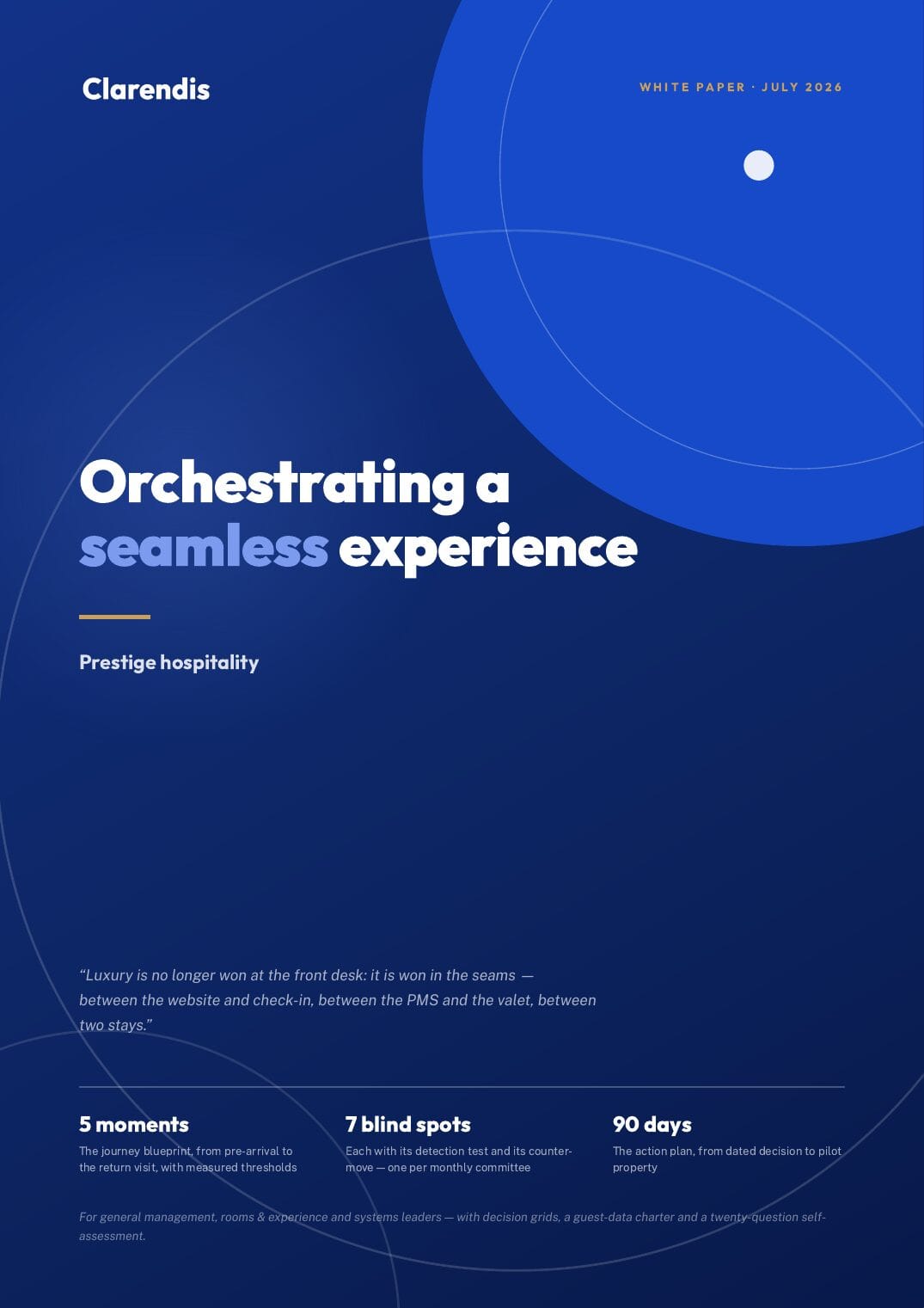
Cover of the white paper
White paper · July 2026
White paper — Prestige hospitality: orchestrating a seamless experience

Read the opening pages

The 52 pages of this white paper. The first 15 are readable in full; the rest is sent by email.

Page 1 of the white paper “Luxury Hospitality: Orchestrating a Seamless Experience”
Page 1

White paper · July 2026

Orchestrating a seamless experience

Prestige hospitality

“Luxury is no longer won at the front desk: it is won in the seams — between the website and check-in, between the PMS and the valet, between two stays.”

5 moments

7 blind spots

90 days

The journey blueprint, from pre-arrival to the return visit, with measured thresholds

Each with its detection test and its counter-move — one per monthly committee

The action plan, from dated decision to pilot property

For general management, rooms & experience and systems leaders — with decision grids, a guest-data charter and a twenty-question self-assessment.

Page 2 of the white paper “Luxury Hospitality: Orchestrating a Seamless Experience”
Page 2

Contents

Foreword 03 Executive summary — the document in ten claims 04 Your reading path 06 1 The great “digital” misunderstanding Digitising is not automating · The seam, not the screen · The cost of friction · Three houses: the palace, the resort, the collection 07 2 Guest data, the house's memory The single guest view · The legal frame (GDPR, nFADP) · The VIP file as a vault · The guest profile that actually serves 12 3 Seamless architecture: the PMS at the core The pivot PMS · The integration layer · Composable or suite · The vendor requirements grid · Total cost 17 4 The seamless journey, moment by moment Before arrival · Check-in · The stay, the room, the table · Departure · After the stay 22

5 The blind spots Check-in that dehumanises · Personalisation that surveils · Staff bypassed · Reviews endured · The OTA that owns the guest · VIP data leaking · The measurement never taken 28 6 Deciding without predicting What is written, what is scenario · Concierge AI, direct sales, sustainability · The four no-regret decisions 33 7 Orchestrating teams and partners The score for every craft · The RACI of the stay · Training without denaturing · The service charter 38 8 The 90-day plan Where are you starting from? · D1-D30, D31-D60, D61-D90 · The five-number dashboard · The five mistakes 42 Moving to execution 48 Appendices — Glossary, sources, about, self-assessment 49-51

The through-line

Luxury is not seen, it is felt — and it is lost in the seams. This document turns that into a measurable discipline.

Page 3 of the white paper “Luxury Hospitality: Orchestrating a Seamless Experience”
Page 3

Foreword

A loyal guest arrives at 11 p.m. after a twelve-hour flight. He booked a quiet room; he wrote it twice. At the desk he is asked his name, someone searches, and he is given a room over the street. Nothing was wrong: the booking existed, so did the preference — it simply lived in a different piece of software than the one the receptionist had open. Luxury did not lack means that night; it lacked a seam.

This document is written from inside the craft, for those who practise it — not one more panorama on “the hotel of the future”. Its position fits in one sentence: in prestige hospitality, digital must not be seen; it must make everything hold together, end to end across the stay, and give staff back the time to serve. That can be decided, specified and measured. So you will find things to act on, not things to ponder: a journey blueprint, grids with thresholds, templates to copy as they are (a guest profile, a service charter, a vendor requirements grid), a 90-day plan, a self-assessment. Never a finding without the decision that goes with it.

A point of intellectual honesty: we design, deploy and operate these systems for our clients — which is precisely how we know where they break. The grids and thresholds in this document are the ones we accept being held to on our own projects.

How to read this document. The chapters stand alone; page 6 offers a path per role. If you read only ten pages: the executive summary (p. 4-5), the journey blueprint (ch. 4) and the 90-day plan (ch. 8). The self-assessment in appendix D will tell you where to start.

Enjoy the read — and may your seams never show, neither at the desk nor on the screen.

Cédric Guittard

Anna Hoang

cedric.guittard@clarendis.com

anna.hoang@clarendis.com

for the Clarendis team — July 2026

Page 4 of the white paper “Luxury Hospitality: Orchestrating a Seamless Experience”
Page 4

Executive summary

The document in ten claims. Each is developed, tooled and located in the chapter indicated.

01 Prestige hotel digital is invisible.

02 Luxury is lost in the seams, not in the moments.

Any technology the guest notices has already failed. It must disappear into the walls and into the staff's pockets, to give time back to the human gesture. (ch. 1)

Every team does its part well; the fault is born in the transitions — from website to check-in, from room to table. Seamlessness is a discipline, not a sum of excellences. (ch. 1, 4)

03 The house's memory is an asset — and a responsibility.

04 Without a pivot PMS there is no seamlessness — only promises.

A single guest view, recognised everywhere without the guest repeating themselves. That file is worth more than the furniture; it is governed like a vault (GDPR, nFADP). (ch. 2)

The property management system is the beating heart: until it is the single source of truth for the stay, every added tool worsens the friction. (ch. 3)

05 Architecture is bought reversible, never captive.

06 The journey is specified moment by moment, with thresholds.

Your stay and guest data remain exportable at any time, every component replaceable. The vendor grid in chapter 3 makes it contractual. (ch. 3)

“Seamless” cannot be decreed: it is cut into five moments, each with a measurable promise. The chapter 4 blueprint turns it into a contract. (ch. 4)

Page 5 of the white paper “Luxury Hospitality: Orchestrating a Seamless Experience”
Page 5

07 Personalisation that surveils offends more than it serves.

08 Whoever owns the guest relationship owns the margin.

Reminding a guest of what they never said, anticipating too much, tracing the intimate: the limit is comfort, not technical capability. The rule: serve without ever seeming to spy. (ch. 5)

Every stay sold through an intermediary is a relationship you do not own. Direct accounts for 25% of volumes but 33% of revenue: it is not one more channel, it is taking back your own clientele. (ch. 5, 6)

09 Seamlessness is first a matter of teams.

10 90 days are enough to prove it — on a single property.

No software replaces the handover between the desk, housekeeping, the table and the concierge. The tool serves the score; it does not write it. (ch. 7)

See clearly (D1-D30), frame and equip (D31-D60), prove on a pilot property (D61-D90): the chapter 8 plan, with dated deliverables and its five numbers. (ch. 8)

The thesis of this document

Seamless excellence cannot be bought in licences: it is orchestrated — one memory, one pivot PMS, one score for the teams — and it is proven one stay at a time. Everything that follows gives the blueprint, the templates and the plan to do it.

Page 6 of the white paper “Luxury Hospitality: Orchestrating a Seamless Experience”
Page 6

Your reading path

Fifty-two pages are not read in one sitting. Three paths depending on your seat — each fits within an hour.

GENERAL MANAGEMENT

EXPERIENCE & ROOMS

SYSTEMS & IT

You carry the brand and arbitrate. 25 min:

You live the stay every day. 1 h:

Full document recommended. 1 h 30:

01 Ch. 4 — the journey blueprint, moment by moment

01 The summary in ten claims (p. 4-5)

01 Ch. 3 — the pivot PMS, the integration layer, composable or suite

02 Ch. 1 — the misunderstanding, the three houses, the cost of friction

02 Ch. 2 — the guest profile and its charter

02 Ch. 3 — the vendor requirements grid, to attach to every RFP

03 Ch. 5 — check-in that dehumanises, personalisation that surveils

03 Ch. 6 — the four no-regret decisions

03 Ch. 5 — the seven blind spots, one per architecture review

04 Ch. 8 — the 90-day plan and its five numbers

04 Ch. 7 — the teams' score and the RACI of the stay

04 Appendix A — the glossary, to talk to your vendors

You will know what to fund, in what order, and how to check it is moving.

You leave with what you need to equip your teams without betraying them.

You leave with the target architecture and the requirements to impose.

What you came looking for

Your question

Where this document answers

Page

“Where do we start without breaking everything?”

The self-assessment, then the 90-day plan on a pilot property

51 · 42

“How do we recognise a guest everywhere?”

The single guest view and the guest profile that actually serves

12 · 15

“Which PMS, which architecture?”

The composable/suite grid and the vendor requirements grid

19 · 20

“How do we measure seamlessness?”

The five-number dashboard, before any volume metric

45

Page 7 of the white paper “Luxury Hospitality: Orchestrating a Seamless Experience”
Page 7

Chapter 1

The great “digital” misunderstanding

1

Your finest suite knows exactly what luxury means; the path that leads to it has often forgotten. This chapter replaces the word “digital” with a measurable discipline — the seam — prices what friction costs you, and places your house among three archetypes.

1.1 Digitising is not automating

The debate — “does technology dehumanise hospitality?” — rests on a confusion. Digitising is not replacing the receptionist with a kiosk: it is taking the typing, the searching and the memory-jogging off her hands to leave her the look, the word and the gesture. Good hotel technology does not take the human's place; it gives the human back the time to be human.

The misunderstanding begins when the recipes of volume hospitality — generalised self-check-in, the chatbot that answers everything, the kiosk that replaces the welcome — are imported into houses whose value rests on the exact opposite: recognition, attention, time given. Our position is clear: no automation should replace a moment of relationship the guest came for. Check-in remains a welcome; automation prepares what surrounds it — the room ready, the preference known, the path smooth — so the welcome can happen, shorter and truer.

The rule that runs through this document. For every digital project, a single question filters everything: does this device add relationship time, or take it away? A kiosk that replaces the welcome takes it away; a tablet that gives the housekeeper the pillow preference adds it. The first is refused, the second studied.

Page 8 of the white paper “Luxury Hospitality: Orchestrating a Seamless Experience”
Page 8

1

Chapter 1 — The great “digital” misunderstanding

1.2 The seam, not the screen: seamlessness translated into thresholds

“A smooth experience” cannot be managed. What can: the transitions, and the threshold below which each one breaks. Here is the grid we recommend attaching to every specification — each row is a seam between two moments, and the right-hand column the prestige threshold:

The seam

The requirement, plainly said

The prestige threshold

Booking → arrival

The preference written at booking is known to the desk, without the guest repeating it

100% of preferences visible on arrival

Arrival → room

The room matches the promise (quiet, floor, view) or the gap is acknowledged and compensated before it is reported

Zero unanticipated surprises

Room → table

The restaurant, the spa, the concierge know the guest and their stay without a fresh introduction

1 single profile, every point of service

Request → response

Every request — in person, by message, via the app — receives a human, tracked response

< 15 min on site; zero lost requests

Stay → departure

The bill is right, explained, settled without waiting; departure is not a queue but a farewell

Disputed bills < 1%; zero wait at departure

Departure → return

The house writes rarely, personally; on return, everything that was known is found again

≤ 1 message/month; memory recovered 100%

How to use it. Measure each seam today (a week of readings is enough), post the gaps, and make this grid the contractual annex for your providers — booking engine, PMS vendor, outsourced concierge included. A missed threshold is not a technical incident: it is the house's promise broken, and it is handled at that level.

Page 9 of the white paper “Luxury Hospitality: Orchestrating a Seamless Experience”
Page 9

1

Chapter 1 — The great “digital” misunderstanding

1.3 What friction costs — a pricing to redo with your own data

Friction does not cost “image” — it costs room-nights, unsold services and returns that never happen. Three leaks can be priced in one day of analysis, with your own data; here is the method, line by line:

1

The return that never happened

Take your 100 best guests from last year; count how many did not come back, and for how many a reason is documented. An unacknowledged friction is worth, in prestige, several future stays. It is the most expensive and the most invisible leak.

2

The service never offered

Spa, table, transfer: count the stays where no additional service was offered at the right moment. Almost always, it is because the team did not know — not because the guest did not want it.

3

The time stolen from staff

Time, over one day, what the desk spends typing and retyping between systems; multiply by headcount and days. That time is confiscated relationship — it alone justifies the pivot PMS (ch. 3).

Friction's profit-and-loss — illustrative 80-key property, per year

Returns that never happened

€610k

Services never offered

€270k

Time stolen from staff

€190k

Orders of magnitude reconstructed with the method above — your data will give your amounts; that is precisely the exercise.

Our recommendation: do this pricing before any budget arbitration, and present it to the board as above — three leaks, three amounts, three projects opposite. It is the document that turns “we should modernise” into a dated decision.

Page 10 of the white paper “Luxury Hospitality: Orchestrating a Seamless Experience”
Page 10

1

Chapter 1 — The great “digital” misunderstanding

1.4 Three houses: the palace, the resort, the collection

This document's recommendations do not weigh the same everywhere. Three archetypes cover most of the sector — identify yours; it calibrates the chapter 8 plan:

The urban palace

The resort

The collection

One address, dense service, business and repeat guests, a short and intense stay.

An estate, long stays, a multitude of service points — table, spa, beach, activities — and families.

Several houses under one signature, each singular, a clientele that moves from one to the other.

Your urgency: recognition and speed — the memory (ch. 2) and frictionless check-in (ch. 4). Time is your rare luxury.

Your urgency: orchestration — the teams' score (ch. 7) and the moment-by-moment journey (ch. 4), because your seams are many.

Your urgency: shared architecture — the PMS and the single guest view (ch. 3) without imposing a homogenising head office; the memory follows the guest from address to address.

Your risk: stacking tools on a front desk already under strain.

Your risk: each service point becoming a silo that ignores the others.

Your risk: standardising in the system's name and losing each house's singularity.

And in Switzerland?

For Swiss prestige hospitality, two specifics run through this document: the nFADP frames guest data with its own requirements (records, breach notification, transfers out of Switzerland), and discretion — an international clientele, private stays — makes the file's confidentiality as sensitive a subject as data protection itself. The Swiss sidebars in chapters 2 and 6 return to it.

Page 11 of the white paper “Luxury Hospitality: Orchestrating a Seamless Experience”
Page 11

1

Chapter 1 — The great “digital” misunderstanding

The dated-decision template, to copy as it is

Every serious programme begins with a management decision — one page, dated, signed. Here is the template; replace the brackets and sign it this week:

Seamless-experience decision — template

“[Date]. The management of [house] decides to raise the experience, end to end across the stay, to the level of its finest moment. [First name Last name] is mandated to lead the programme and reports monthly to management. The six seams of the grid (p. 8) are adopted as the house standard; the current gap will be measured within 30 days and published in committee. The pivot PMS and the single guest view take precedence over any new visible project. No automation will replace a moment of relationship the guest comes for. Committed budget: [amount] over [duration].”

This text is sent to no one: it is an internal note. It dates your trajectory, names a single owner — not a committee — and makes the two priorities enforceable against every project that comes next.

What this changes for you

MANAGEMENT

EXPERIENCE

SYSTEMS

General management. Sign the dated decision and demand the pricing of the three leaks (p. 9) within 30 days. Until those two documents exist, refuse any “overhaul” budget.

Experience & rooms. Measure the six seams of p. 8 — one week of readings — and make them the language of your stay reviews. They restate your irritants as verifiable commitments.

Systems & IT. Time the desk's typing and retyping (p. 9). That number, alone, opens the chapter 3 pivot-PMS file.

Page 12 of the white paper “Luxury Hospitality: Orchestrating a Seamless Experience”
Page 12

Chapter 2

Guest data, the house's memory

2

Your house's best CRM already exists: it is your head receptionist's memory. This chapter raises it to the rank of a system — the single guest view, the profile that serves in ten seconds, the legal frame (GDPR, nFADP) translated into gestures, and the VIP file governed like a vault.

2.1 The single guest view, without a big bang

One guest, one identifier, every point of service. It is the prerequisite for everything else: recognition on arrival, the profile of the next section, the service that never makes anyone repeat themselves. And it is the graveyard of pharaonic projects: three-year “single customer repository” programmes fail by exhaustion. We recommend the progressive-matching approach, which delivers value from the first quarter.

1

Match by e-mail and phone across the existing bases (PMS, booking engine, spa, restaurant, CRM) without migrating anything: a mapping table is enough for the desk's profile to show the full history. Weeks, not years.

2

Treat duplicates by value: start with the 500 best guests — where every recognition error costs the most — then work down. The overall duplicate rate is a vanity; the rate at the top of the file is a steering metric.

3

Set the golden write rule: every piece of data has one master system (the stay is born in the PMS, the preference in the CRM) and the others read it. It is that rule — not the tool — that keeps the repository from re-fragmenting within the year.

Page 13 of the white paper “Luxury Hospitality: Orchestrating a Seamless Experience”
Page 13

2

2.2 The frame, plainly said: GDPR and nFADP applied to the stay

Nothing in the law forbids knowing your guest — everything in it frames the manner. Four obligations cover most hotel situations; here is each one, with the operational gesture opposite:

A legal basis for every note

Stay history falls under performance of the contract; preferences and dates under consent or documented legitimate interest. The gesture: one sentence at the desk — “would you like us to note your preferences for your next stays?” — and, on the profile, who consented, and when.

The right of access and erasure

The guest can request their profile and its erasure. The gesture: a two-day procedure, tested once a quarter with a real request — and the writing rule of p. 15: nothing on the profile the guest could not read.

Minimisation and retention

Collect only what serves the stay; keep nothing beyond its usefulness. The gesture: the profile's fields (p. 15) as the maximum perimeter, and an annual purge of profiles with no interaction for [3-5] years — decided, dated, executed.

Transfers and processors

Your PMS vendor, your agency, your host all see this data. The gesture: a maintained list of processors with their contracts (art. 28), the data's location, and the question asked in writing: who, at the vendor, can read our profiles?

And in Switzerland?

The nFADP converges with the GDPR on the essentials — records, information, breach notification to the FDPIC — with a sensibility of its own: for a Swiss house, discretion about guests' identity is a custom as strong as an obligation. A house receiving European guests applies the GDPR to those profiles anyway: align everything on the most demanding standard, one procedure, two legal notices.

Page 14 of the white paper “Luxury Hospitality: Orchestrating a Seamless Experience”
Page 14

2

2.3 The VIP file is governed like a vault

Public identities, private addresses, habits, presences no one must be able to reveal: a prestige house's file is a target — for fraud, the press, curiosity. It calls for a level of protection the standard PMS does not offer by default. Five non-negotiable measures, to check at your house this week:

1.

Access by role and by perimeter. A receptionist sees her house's guests — never an export of the entire file. The test question: how many people, today, can export the whole base? The right answer fits on one hand.

2.

The consultation log. Who opened which profile, when — logged, retained, and reviewed when a sensitive profile is consulted with no matching stay. It is the measure that discourages internal curiosity, the sector's first leak vector.

3.

A staff departure = a procedure. Access revoked the same day, a review of the last 90 days' exports, a contractual clause on the file — all three, systematically.

4.

The most exposed guests, set apart. Public figures, very large accounts: restricted-access profile, no name in the clear in mailings, undisclosed presences, an agreed arrival protocol. A short list, kept by a named person.

5.

The leak drill, once a year. Tabletop scenario: the base is in the press tomorrow morning. Who calls whom, who speaks to guests, who notifies the CNIL or the FDPIC within 72 hours? Two hours of drill beat a binder never opened.

The budget argument: price these five measures — they cost a fraction of a single incident (notification, crisis management, loss of the guests concerned). It is the best return in this entire document.

Page 15 of the white paper “Luxury Hospitality: Orchestrating a Seamless Experience”
Page 15

2

2.4 The guest profile that actually serves — the template

Most of the sector's CRMs store everything and serve nothing at the moment of welcome. The useful profile fits on one screen and answers one question: what must I know in the ten seconds this guest walks through the door? Here are the fields — and above all the ones we exclude:

What the profile contains — 8 fields, no more

What the profile excludes — deliberately

1. Identity, language and preferred form of address

✕ The guest's scored “potential”. A value score read by staff changes the gaze — and the guest feels it.

2. Stay history, all houses, with favourite rooms

3. Declared preferences (pillow, floor, quiet, table, diet)

✕ Inferred data (estimated income, assumed situation): wrong one time in three, indefensible under GDPR, toxic in a leak.

4. In progress: booking, request, incident to follow

5. Dates that matter, given by the guest

✕ Anything the guest could not bear to read. The profile must be showable to them as it is — that is, after all, their right of access. Write every note assuming it.

6. Allergies and service constraints

7. Preferred contact channel and frequency

8. Service notes — readable by the guest on request

Our recommendation: impose these 8 fields as the interface contract on your vendor — not the reverse. A tool that needs 40 fields to work will manufacture 40 empty fields; the short profile, 100% filled, beats the rich profile 15% filled.

The remaining 37 pages are in the complete document.

Download the white paper
Page 16, blurred — available in the full document
Page 16 · in the full document
Page 17, blurred — available in the full document
Page 17 · in the full document
Page 18, blurred — available in the full document
Page 18 · in the full document
Page 19, blurred — available in the full document
Page 19 · in the full document
Page 20, blurred — available in the full document
Page 20 · in the full document
Page 21, blurred — available in the full document
Page 21 · in the full document
Page 22, blurred — available in the full document
Page 22 · in the full document
Page 23, blurred — available in the full document
Page 23 · in the full document
Page 24, blurred — available in the full document
Page 24 · in the full document
Page 25, blurred — available in the full document
Page 25 · in the full document
Page 26, blurred — available in the full document
Page 26 · in the full document
Page 27, blurred — available in the full document
Page 27 · in the full document
Page 28, blurred — available in the full document
Page 28 · in the full document
Page 29, blurred — available in the full document
Page 29 · in the full document
Page 30, blurred — available in the full document
Page 30 · in the full document
Page 31, blurred — available in the full document
Page 31 · in the full document
Page 32, blurred — available in the full document
Page 32 · in the full document
Page 33, blurred — available in the full document
Page 33 · in the full document
Page 34, blurred — available in the full document
Page 34 · in the full document
Page 35, blurred — available in the full document
Page 35 · in the full document
Page 36, blurred — available in the full document
Page 36 · in the full document
Page 37, blurred — available in the full document
Page 37 · in the full document
Page 38, blurred — available in the full document
Page 38 · in the full document
Page 39, blurred — available in the full document
Page 39 · in the full document
Page 40, blurred — available in the full document
Page 40 · in the full document
Page 41, blurred — available in the full document
Page 41 · in the full document
Page 42, blurred — available in the full document
Page 42 · in the full document
Page 43, blurred — available in the full document
Page 43 · in the full document
Page 44, blurred — available in the full document
Page 44 · in the full document
Page 45, blurred — available in the full document
Page 45 · in the full document
Page 46, blurred — available in the full document
Page 46 · in the full document
Page 47, blurred — available in the full document
Page 47 · in the full document
Page 48, blurred — available in the full document
Page 48 · in the full document
Page 49, blurred — available in the full document
Page 49 · in the full document
Page 50, blurred — available in the full document
Page 50 · in the full document
Page 51, blurred — available in the full document
Page 51 · in the full document
Page 52, blurred — available in the full document
Page 52 · in the full document
Share this white paper