← Back to whitepapers

White paper · October 2025

White paper — Digital leadership: leading the transformation

Digital leadership: leading the transformation. 35 pages written from the field — we know where transformations break: rarely on the technology, almost always on the human side.

  • The leader's posture: visible sponsor, arbitrate rather than supervise, the dated decision
  • The transformation RACI, the single owner, and the rule of thirds for the budget
  • Supporting change, stage by stage: say why, listen to the field, train through practice, prove, embed
  • The blind spots: the project without a sponsor, the seminar-style training, the forgotten middle management, change fatigue
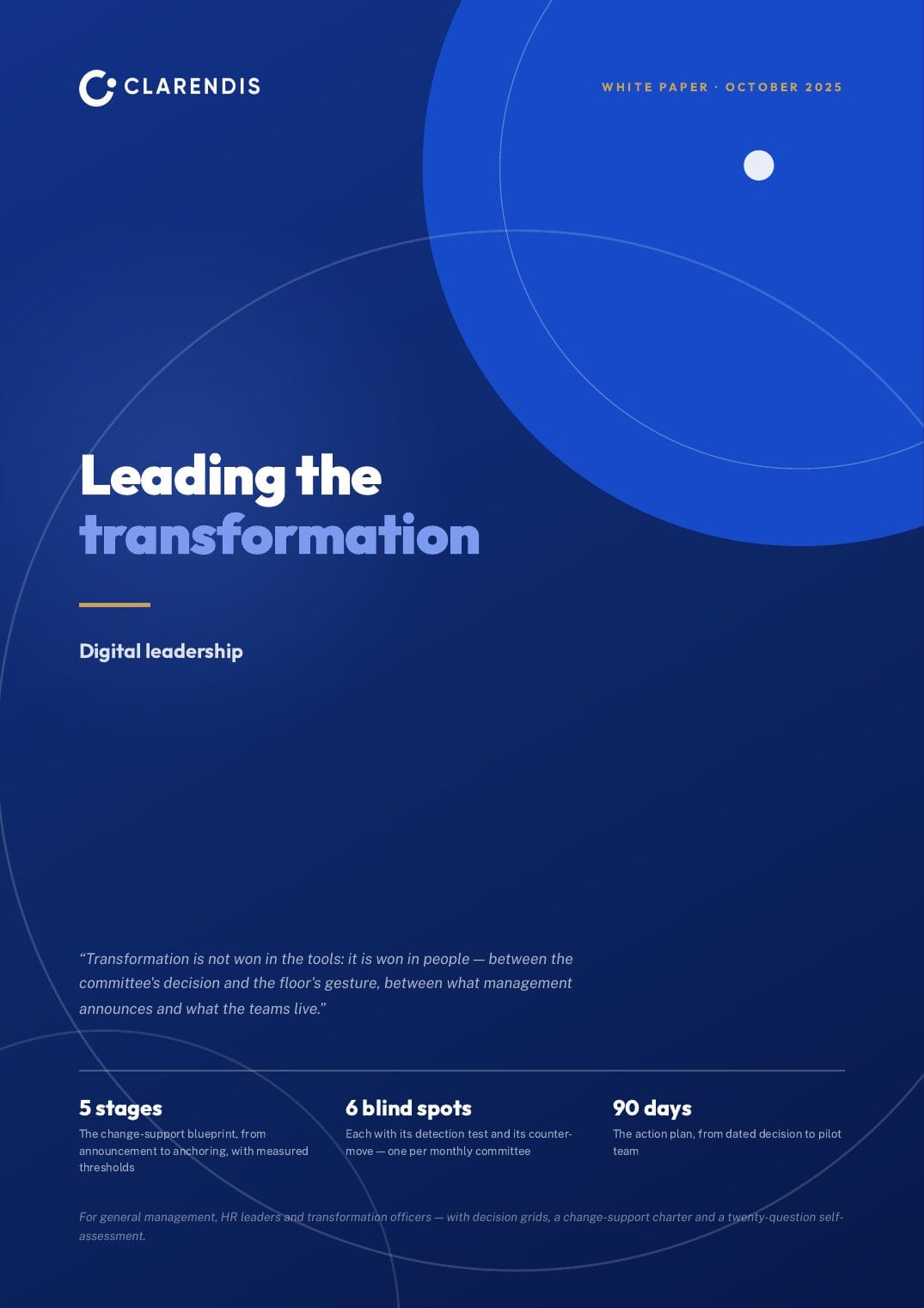
Cover of the white paper
White paper · October 2025
White paper — Digital leadership: leading the transformation

Read the opening pages

The 35 pages of this white paper. The first 10 are readable in full; the rest is sent by email.

Page 1 of the white paper “Digital leadership: Supporting transformation”
Page 1

White paper · October 2025

Leading the transformation

Digital leadership

“Transformation is not won in the tools: it is won in people — between the committee's decision and the floor's gesture, between what management announces and what the teams live.”

5 stages

6 blind spots

90 days

The change-support blueprint, from announcement to anchoring, with measured thresholds

Each with its detection test and its counter-move — one per monthly committee

The action plan, from dated decision to pilot team

For general management, HR leaders and transformation officers — with decision grids, a change-support charter and a twenty-question self-assessment.

Page 2 of the white paper “Digital leadership: Supporting transformation”
Page 2

Contents

Foreword 03 Executive summary — the document in ten claims 04 Your reading path 06 1 The “digital transformation” misunderstanding Transforming is not tooling · The seam, not the announcement · The cost of failed change · Three organisations: the SME, the mid-cap, the group 07 2 The leader's posture The visible sponsor · Arbitrate, don't supervise · Digital exemplarity · The dated decision 11 3 Organising the transformation The single owner · Governance that holds · The transformation RACI · The budget and the rule of thirds 15

4 Supporting change, stage by stage Say why · Listen to the floor · Train through practice · Prove and celebrate · Anchor 19 5 The blind spots The sponsorless project · Top-down communication · Seminar training · Middle management forgotten · Change fatigue · The measurement never taken 23 6 Deciding without predicting What is written, what is scenario · Generative AI, hybrid, talent · The four no-regret decisions 27 7 The 90-day plan Where are you starting from? · The D1-D90 timeline · The five-number dashboard · The 90 days on one page 30 Moving to execution 33 Appendix — Self-assessment and about 34

The through-line

Transformation is not decreed in committee, it is won on the floor — and it is lost between the two. This document turns that into a measurable discipline.

Page 3 of the white paper “Digital leadership: Supporting transformation”
Page 3

Foreword

A management committee, one Monday. The new tool has been deployed for three months; the licences are paid, the communication went out, the vendor delivered. And the usage figures come in: a third of the teams logged in once, the rest work as before. Nothing was wrong: the tool is good, the need is real — it is the path between the decision and the daily gesture that was never built. The transformation did not lack budget that quarter; it lacked support.

This document is written from inside the craft, for those who practise it — not one more panorama on “the leader of tomorrow”. Its position fits in one sentence: digital transformation is first a transformation of people, and it is led like a project — with a sponsor, stages, thresholds and proofs — never like an announcement. That can be decided, specified and measured. So you will find things to act on, not things to ponder: a change-support blueprint, grids with thresholds, templates to copy as they are (a dated decision, a change-support charter, a RACI), a 90-day plan, a self-assessment. Never a finding without the decision that goes with it.

A point of intellectual honesty: we design, deploy and operate digital systems for our clients — which is precisely how we know where transformations break: rarely on the technology, almost always on the human side. The grids and thresholds in this document are the ones we accept being held to on our own projects.

How to read this document. The chapters stand alone; page 6 offers a path per role. If you read only eight pages: the executive summary (p. 4-5), the change-support blueprint (ch. 4) and the 90-day plan (ch. 7). The self-assessment on page 34 will tell you where to start.

Enjoy the read — and may your transformations show on the floor, not only in the plans.

Cédric Guittard

Anna Hoang

cedric.guittard@clarendis.com

anna.hoang@clarendis.com

for the Clarendis team — October 2025

Page 4 of the white paper “Digital leadership: Supporting transformation”
Page 4

Executive summary

The document in ten claims. Each is developed, tooled and located in the chapter indicated.

01 Transformation cannot be bought in licences: it is led.

02 Transformation is lost in the seam, not in the plan.

A tool deployed without support is a cost without effect. Value is born when the daily gesture changes — and that is led like a project. (ch. 1)

The plan is good, the teams are good; the fault is born between the two — between the announcement and the lived experience, between the committee and the floor. (ch. 1, 4)

03 Without a visible sponsor there is no transformation — only projects.

04 One single owner, one short governance.

One name — not a committee — carries the transformation, and reports monthly on five numbers. Everything else is meetings. (ch. 3)

The leader who carries, arbitrates and embodies is the first documented success factor. Delegating the sponsorship is already giving up. (ch. 2)

05 The support budget equals the tool budget — or the tool fails.

06 Change support is specified stage by stage, with thresholds.

The rule of thirds: one third licences, one third integration, one third support. The business plan that shows only the licence should be reread multiplied by three. (ch. 3)

“Bringing the teams on board” cannot be decreed: five stages, each with a measurable promise. The chapter 4 blueprint turns it into a contract. (ch. 4)

Page 5 of the white paper “Digital leadership: Supporting transformation”
Page 5

07 Resistance is information, not a fault.

08 Middle management makes or breaks the transformation.

Behind every “it won't work” there is a real risk the plan did not see, or a loss no one acknowledged. Listen before convincing. (ch. 4, 5)

They are the ones who translate the decision into daily gestures — and the ones forgotten between the committee that decides and the floor that gets trained. (ch. 5)

09 AI does not change the rule: it hardens it.

10 90 days are enough to prove it — on a single team.

The faster the technology moves, the more support matters. The leader's AI doctrine is written now, on one page — not under the first vendor's pressure. (ch. 6)

See clearly (D1-D30), frame and bring on board (D31-D60), prove on a pilot team (D61-D90): the chapter 7 plan, with dated deliverables and its five numbers. (ch. 7)

The thesis of this document

Successful transformation cannot be bought in licences or seminars: it is orchestrated — a sponsor who embodies, an owner who leads, support that is measured — and it is proven one team at a time. Everything that follows gives the blueprint, the templates and the plan to do it.

Page 6 of the white paper “Digital leadership: Supporting transformation”
Page 6

Your reading path

Thirty-five pages are not read in one sitting. Three paths depending on your seat — each fits in under an hour.

GENERAL MANAGEMENT

HR & MANAGERS

TRANSFORMATION OFFICER

You carry and arbitrate. 20 min:

You live the change every day. 45 min:

Full document recommended. 1 h:

01 The summary in ten claims (p. 4-5)

01 Ch. 3 — the single owner, the governance, the budget

01 Ch. 4 — the change-support blueprint, stage by stage

02 Ch. 2 — the leader's posture and the dated decision

02 Ch. 4 — the blueprint, your daily working tool

02 Ch. 5 — middle management forgotten, change fatigue

03 Ch. 6 — the four no-regret decisions

03 Ch. 5 — the six blind spots, one per monthly committee

03 Ch. 3 — the transformation RACI

04 Ch. 7 — the 90-day plan and its five numbers

04 Ch. 7 — the 90-day plan, to post at your desk

04 The change-support charter (p. 22)

You will know what to carry yourself, what to entrust, and how to check it is moving.

You leave with the full method and the thresholds to impose.

You leave with what you need to bring your teams on board without exhausting them.

What you came looking for

Your question

Where this document answers

Page

“Where do we start without breaking everything?”

The self-assessment, then the 90-day plan on a pilot team

34 · 30

“Why don't our projects get taken up?”

The six blind spots and the change-support blueprint

23 · 19

“What is my role, exactly?”

The leader's posture and the transformation RACI

11 · 17

“How do we measure change support?”

The five-number dashboard, before any project metric

31

Page 7 of the white paper “Digital leadership: Supporting transformation”
Page 7

Chapter 1

The “digital transformation” misunderstanding

1

Your plans know where to go; it is the path between the decision and the daily gesture that gets lost. This chapter replaces the word “transformation” with a measurable discipline — change leadership — puts a number on what waiting costs you, and locates your organisation among three archetypes.

1.1 Transforming is not tooling

The debate — “should we transform?” — is behind us; the misunderstanding persists. Transforming is not stacking tools or announcing a plan: it is changing daily gestures — the way people sell, produce, decide — in people who had good reasons to do otherwise. The tool is the stage set of the transformation; the support work is the play.

The misunderstanding begins when the tool gets budgeted and the rest gets improvised: communication in one meeting, training in one e-learning, adoption by decree. The research has documented it for twenty years — most transformations miss their goals, and the dominant cause is almost never technical: it is the human factor, the absent sponsor, the floor never listened to (McKinsey and other change barometers, constant on this point). The good news: those causes can be led.

The rule that runs through this document. For any transformation project, a single question filters everything: who has to change which daily gesture, and what have we planned to help them? A project that can answer is a managed effort; a project that cannot is an announcement — and an announcement transforms nothing.

Page 8 of the white paper “Digital leadership: Supporting transformation”
Page 8

1

Chapter 1 — The “transformation” misunderstanding

1.2 The seam, not the announcement: change leadership as thresholds

“Bringing the teams on board” cannot be managed. What can: the handovers between the decision and the floor, and the threshold below which each one breaks. Here is the grid we recommend annexing to every transformation plan — each row is a seam, and the right-hand column the threshold to demand:

The seam

The requirement, plainly said

The threshold to demand

Decision → announcement

Every employee knows what changes for them, why, and when — from their manager's mouth, not from an e-mail

100% of teams briefed face to face within 15 days

Announcement → listening

Objections from the floor are collected, logged and handled — not “managed”

Every objection gets a named answer < 15 days

Listening → training

People are trained at their post, on real tasks, with a champion — never in an off-site seminar

100% trained in real conditions, one champion per 10

Training → usage

Real usage is measured, and a tool that slows people down gets fixed — the team is never blamed

Active usage ≥ 70% at 60 days, measured, published

Usage → proof

The first gains are quantified and told by the teams themselves — not by management

1 quantified proof told per quarter, per pilot team

Proof → anchoring

The new gesture enters the rituals — objectives, onboarding, reviews — or the old one returns

Old process switched off within 6 months, drift measured

How to use it. Measure each seam on your last deployed project (a week of interviews is enough), post the gaps, and make this grid the annex of every new plan — change-support vendors included. A missed threshold is not a communication problem: it is the transformation coming apart in silence, and it is treated at that level.

Page 9 of the white paper “Digital leadership: Supporting transformation”
Page 9

1

Chapter 1 — The “transformation” misunderstanding

1.3 What failed transformation costs — a costing to redo at home

A failed transformation does not cost “delay” — it costs licences paid for nothing, hours lost in the double system, and change credit spent for the next time. Three leaks can be costed in one day of analysis, with your own data; here is the method:

1

The tool paid for, not used

List your licences over the past three years; cross them with real usage. Every seat paid and unused is an exact number your CFO can produce in an hour — and the most painless of the three, because it is the only visible one.

2

The double system

When the new tool has not replaced the old one, teams do both: enter here, copy there, reconcile by hand. Time one week; multiply. It is the most expensive and the most normalised leak.

3

The change credit spent

Every failed project makes the next one more expensive: more scepticism, more support needed, more departures of your best people. Count the projects abandoned in three years — that is the multiplier on your next budget.

The P&L of failed transformation — illustrative 250-person mid-cap, over 3 years

Double system

$680k

Unused licences

$285k

Change credit spent

$200k

Orders of magnitude reconstructed with the method above — your data will give your amounts; that is precisely the exercise.

Our recommendation: run this costing before any new project, and present it to the committee as above — three leaks, three amounts, a support budget across from them. It is the document that turns “we should support change better” into a dated decision.

Page 10 of the white paper “Digital leadership: Supporting transformation”
Page 10

1

Chapter 1 — The “transformation” misunderstanding

1.4 Three organisations: the SME, the mid-cap, the group

The recommendations in this document do not weigh the same everywhere. Three archetypes cover most cases — identify yours; it calibrates the chapter 7 plan:

The SME (10-50 people)

The growing mid-cap

The group in flux

The owner sees everyone every week; few processes, many habits; every hour counts.

Several teams or sites, a middle layer of management, habits dating from a smaller size.

Several entities, different cultures, transformations in succession — and teams that have seen a few come and go.

Your strength: proximity — the leader's exemplarity (ch. 2) transforms faster than any plan.

Your urgency: organisation — the single owner and the RACI (ch. 3), and middle management brought on board first (ch. 5).

Your urgency: proof — the pilot team that tells its story (ch. 4, 7), because your floor no longer believes announcements, only peers.

Your risk: carrying everything alone, and everything stopping when you look away.

Your risk: the announcement reaching the floor distorted — or never.

Your risk: change fatigue — blind spot 5.5.

What the three share

Whatever the size, transformation follows the same law: it moves at the speed of trust, not at the speed of the plan. Trust is built by proofs (ch. 4) and destroyed by unkept announcements — which is why this document never has you announce what is not ready.

© Clarendis — October 2025 edition 10

The remaining 25 pages are in the complete document.

Download the white paper
Page 11, blurred — available in the full document
Page 11 · in the full document
Page 12, blurred — available in the full document
Page 12 · in the full document
Page 13, blurred — available in the full document
Page 13 · in the full document
Page 14, blurred — available in the full document
Page 14 · in the full document
Page 15, blurred — available in the full document
Page 15 · in the full document
Page 16, blurred — available in the full document
Page 16 · in the full document
Page 17, blurred — available in the full document
Page 17 · in the full document
Page 18, blurred — available in the full document
Page 18 · in the full document
Page 19, blurred — available in the full document
Page 19 · in the full document
Page 20, blurred — available in the full document
Page 20 · in the full document
Page 21, blurred — available in the full document
Page 21 · in the full document
Page 22, blurred — available in the full document
Page 22 · in the full document
Page 23, blurred — available in the full document
Page 23 · in the full document
Page 24, blurred — available in the full document
Page 24 · in the full document
Page 25, blurred — available in the full document
Page 25 · in the full document
Page 26, blurred — available in the full document
Page 26 · in the full document
Page 27, blurred — available in the full document
Page 27 · in the full document
Page 28, blurred — available in the full document
Page 28 · in the full document
Page 29, blurred — available in the full document
Page 29 · in the full document
Page 30, blurred — available in the full document
Page 30 · in the full document
Page 31, blurred — available in the full document
Page 31 · in the full document
Page 32, blurred — available in the full document
Page 32 · in the full document
Page 33, blurred — available in the full document
Page 33 · in the full document
Page 34, blurred — available in the full document
Page 34 · in the full document
Page 35, blurred — available in the full document
Page 35 · in the full document
Share this white paper