
Civic Engagement Platforms
Local authorities face a contradictory imperative: to strengthen citizen participation whilst managing reduced teams and constrained budgets. The law now requires prior consultation on numerous development projects, participatory budgets are proliferating under pressure from residents, and each consultation generates its share of contributions to process: sometimes several thousand for a medium-sized local authority.
Officers in local democracy services juggle between paper forms, saturated email inboxes and shared spreadsheets that cannot cope with the workload. Presenting the results becomes a conundrum: how does one prove that each contribution has been read, analysed, and taken into account? Elected officials want usable summaries, citizens demand transparency, and the CNIL, the French data protection authority, monitors the processing of personal data.
And when the time comes to vote on a participatory budget, the question of electoral integrity immediately arises. Teams spend more time justifying their methodology than organising dialogue.
This solution belongs to the Websites, Content & Communities family.

Challenges holding back your performance
Generic tools reveal their limitations from the first large-scale consultation. Google Forms manages neither voter authentication nor proof of non-manipulation of results. Excel collapses when required to categorise 3,000 free contributions and extract actionable trends. Event service providers offer disposable platforms, rebuilt for each consultation, with no possibility of capitalisation.Certain local authorities cobble together consumer polling tools that do not comply with the GDPR requirements of the public sector.Result: staff manually copying data between systems, reporting deadlines extending to the point where results become obsolete, and citizens who ultimately doubt the sincerity of the process. Mistrust sets in, participation drops.
Our Technical Approach
Our approach stems from an observation: a participation platform is not an enhanced polling tool, but rather a trust infrastructure. The voting system relies on a cryptographic proof mechanism that guarantees voter anonymity whilst enabling verification of ballot integrity: each citizen can verify that their vote has been counted without revealing their choice.
For processing open contributions, we integrate semantic analysis that automatically identifies recurring themes, detects duplicates and proposes a categorisation that agents can validate or adjust. This is not a black box: each grouping is traceable, each exclusion decision documented. The presentation of results relies on public dashboards where citizens can see how their contributions have informed final decisions.
The objective is not to automate democratic dialogue, but to provide teams with the means to manage it at scale without losing their credibility.
Secure voting system
Semantic analysis of contributions
Transparent restitution of results
Technical Architecture
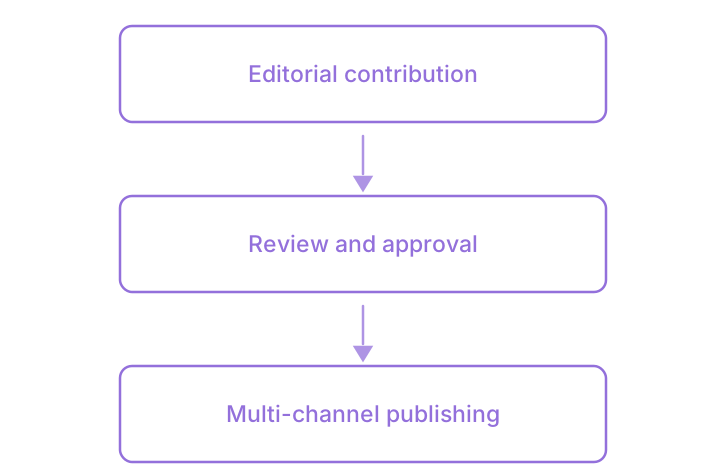
Contribute, have it approved, publish across channels: Decoupled CMS Architectures (Headless) and Streaming Platforms (VOD/Live) share this path.
- Secure voting system
- Semantic analysis of contributions
- Transparent restitution of results
Smooth and frictionless integration
The platform interconnects with the authority’s existing directories: Active Directory, FranceConnect, or electoral roll depending on the level of authentication required. Participation data can flow back to your GIS to map contributions by ward, or to your CRM to enhance knowledge of service users. We work with your IT teams to define the data flows, not against them.
Deployment is carried out through pilot consultation before roll-out, which enables staff to be trained on a real-world case.
Framework of the scheme
Definition of the consultation objectives, the required level of authentication and the participation criteria with your legal services and local democracy.
Configuration and testing
Platform configuration, integration with existing directories, and comprehensive simulation of the citizen journey with a test panel.
Launch and support
Deployment, back-office staff training, and responsive support throughout the consultation period.
Restitution and capitalisation
Generation of public summaries, compliant archiving, and feedback to improve future editions.
Measurable results for your organisation
- Processing time for contributions reduced by a factor of 4 through assisted categorisation
- Participation rates in participatory budgeting increased by 35% on average after 2 editions
- Results delivery timeframe reduced to 72 hours following the close of poll
- Zero legal challenges to the integrity of votes since 2019
- 60% reduction in officer time devoted to post-consultation explanation requests
- GDPR and CNIL compliance documented and auditable at all times
Clarifying your decision-making
How do you ensure that voting cannot be manipulated, including by your own teams?
The voting protocol produces a cryptographic proof any third party can verify. Clarendis has no technical access to individual votes, and ballot integrity can be audited independently. Several local authorities have commissioned that audit through their data protection officer or an external firm.
Does semantic analysis not risk distorting citizens’ contributions?
The algorithm suggests groupings, it does not decide. Each categorisation is subject to human validation and the original contributions remain accessible. Officers keep control: the tool saves time on initial sorting, not on interpretation.