
Process Digitalisation
In a local authority or public body, each request follows a circuit. Staff leave, planning permissions, purchase orders, hierarchical validations. On paper: literally. Printed forms that circulate from office to office, sometimes with post-it notes to indicate the next stage.
Signature folders that wait three days on the corner of a desk because the head of service is away. Files mislaid between two floors, found a month later. Staff spend considerable time tracking the progress of a request, chasing up by telephone, reconstructing validation histories. The public, meanwhile, wait.
Without visibility. The regulatory framework nonetheless imposes response timeframes: two months for planning permission, for example. When the paper circuit takes six weeks just to collect signatures, there is no margin left to process properly. And in case of litigation, reconstructing who validated what, and when, amounts to administrative archaeology.
This solution belongs to the Business Operations & ERP family.

Challenges holding back your performance
Attempts at digitisation do exist. PDF forms to be completed by hand then scanned. Shared Excel spreadsheets for progress tracking: quickly desynchronised, never up to date. Generic workflow tools designed for the private sector, which fail to understand the specificities of the public sector: conditional validation circuits based on amounts, mandatory multiple signatures, temporary delegations in cases of absence.These tools impose their own logic. The organisation adapts to the tool rather than the other way round.Result: staff circumvent the system, revert to paper for complex cases, and one ends up with two parallel circuits. The worst of both worlds: the maintenance burden of digital systems without reaping the benefits.
Our Technical Approach
Our approach begins with your actual procedures, not a theoretical model. We first map existing workflows with the officers who operate them on a daily basis: the real pathways, not those described in service notes. We identify routing rules: who validates what, according to which criteria (amount, nature of request, department concerned), with which delegations possible.
These rules feed an engine that automatically directs each file to the correct validator. Forms are designed to collect precisely the information required at each stage: no more: and to guide the user or officer in their input. Each action is timestamped and retained in an unalterable audit trail, admissible in the event of inspection.
The integrated electronic signature complies with eIDAS regulation, with the level appropriate to each type of act. The validator signs from their workstation or smartphone, the file advances immediately.
Business rules engines for routing
Immutable audit trails
Legal electronic signature
Technical Architecture
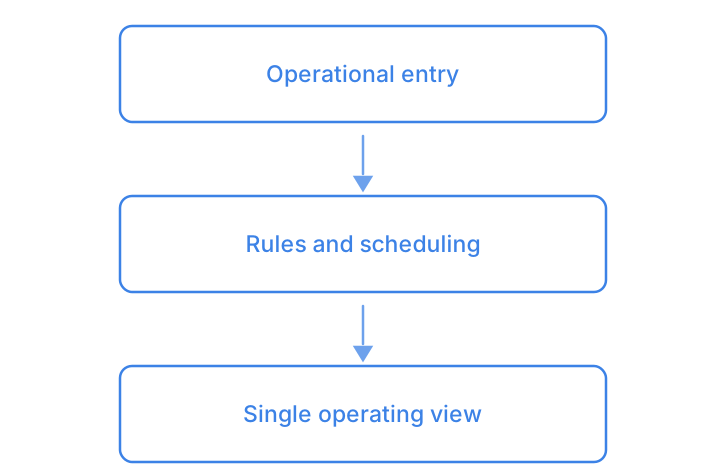
Enter once, let the rules schedule, read a single view: this foundation is shared across the family — you will find it in Workshop & After-Sales Management and in Management Systems (PMS).
- Business rules engines for routing
- Immutable audit trails
- Legal electronic signature
Smooth and frictionless integration
We do not replace your information system. We connect to it. Forms can pre-populate fields from your LDAP directory, your HR software or your business database. Validated files feed your existing applications via standard connectors.
We begin with a pilot procedure: often leave requests or purchase orders below threshold: to validate the approach with a controlled scope before extending.
Process mapping
Workshop with the relevant officers to document actual procedures, validation rules and frequent exceptions.
Configuration of the driver
Configuration of the rules engine and forms for a test procedure. Connection to the directory and existing data sources.
Progressive deployment
Go-live with a pilot user group, adjustments based on field feedback, staff training.
Extension and autonomy
Extension to other identified procedures. Transfer of competencies so that your teams can create their own forms.
Measurable results for your organisation
- Processing time for a request reduced by 70% on average (from 12 days to 3-4 days on the tested workflows)
- Zero files mislaid: every request is traceable at all times
- Regulatory deadlines met with instruction margin preserved
- Complete audit trail exportable with one click for compliance checks or audits
- Agents freed from manual follow-ups: 2 to 3 hours per week recovered per manager
- Business continuity ensured even when working remotely or during unforeseen absence
Clarifying your decision-making
How to manage cases where the approval workflow needs to change mid-process?
The rules engine handles exceptions: return for further information, escalation to another approver, redirection to another department. These alternative paths are defined at design stage rather than improvised, and each fork remains recorded in the audit trail.
Does electronic signature have the same legal value as a handwritten signature?
Electronic signature carries the same legal value for acts that permit it. Clarendis uses certificates compliant with the eIDAS regulation, at the appropriate level: simple for internal approvals, advanced or qualified for acts binding the authority. The level for each use is defined with you.