
B2B/B2C Consumer Portals
Energy suppliers and network operators are facing mounting pressure: customers no longer wish to receive an incomprehensible bill every two months. They want to understand why their consumption soared in January, compare their industrial sites, and be alerted before exceeding their contracted power capacity. On the operations side, support teams are overwhelmed with calls for basic requests: meter readings, bank details amendments, invoice downloads.
Each interaction costs between €8 and €15. Regulatory obligations are accumulating: provision of consumption data (tertiary decree), display of energy mix information, incentives for savings. IT Directors are juggling ageing billing systems, data from smart meters or smart gas meters to integrate, and strict GDPR security requirements.
Business units are demanding rapid developments whilst IT manages technical debt. In this context, offering a customer portal that merely displays PDFs is no longer sustainable: neither for your customers, nor for your teams.
This solution belongs to the Customer & User Portals family.

Challenges holding back your performance
Current customer portals are often appendages to the billing IT system: they display what the back-office can produce, not what the customer seeks to understand. Consumption data arrives with a delay, in unusable formats. To visualise a load curve, the B2B customer must export a CSV and cobble something together in Excel. Excess alerts either do not exist or arrive after the bill.On the selfcare side, modifying a billing address generates a ticket processed manually. Generic portals on the market ignore business specificities: they cannot handle regulated tariffs, multi-site operations with different consumption profiles, or time-of-use constraints.Result: a portal that nobody uses, support costs that do not decrease, and professional customers who threaten to switch to competitors.
Our Technical Approach
Our approach begins with a simple question: what is your customer actually trying to accomplish when they log in? Viewing their monthly consumption, understanding a spike, downloading a certificate for their landlord, adjusting their subscribed capacity.
We build the portal around these real user journeys, not around your internal data structure. The data visualisation isn’t decorative: it enables B2B customers to compare their 15 sites over the same period, identify the one that’s drifting, receive an alert when their consumption exceeds a threshold they’ve defined themselves. Self-reading integrates into the workflow: the customer photographs their meter, OCR extracts the reading, the billing system is updated without human intervention.
Administrative self-care covers the tasks that saturate your call centre: changing contact details, downloading documents, subscribing to options. Online payment reduces bad debt and processing costs. Each feature is designed to reduce the burden on your teams whilst increasing customer satisfaction.
Dataviz Interactive
Aesthetic charts comparing current consumption to the previous year.
Eco-friendly Actions and Alerts
Notification system (email/SMS) if consumption exceeds a defined budget.
Administrative Self-Service
Downloading of domicile certificates, change of bank details or declaration of change of address.
Online Payment
Integration of payment components (Stripe, SEPA) to settle an overdue invoice.
Multi-Site (For B2B)
For business customers, consolidated view of consumption across all their buildings.
Automated Meter Reading
Interface enabling the client to input their old meter readings easily.
Technical Architecture
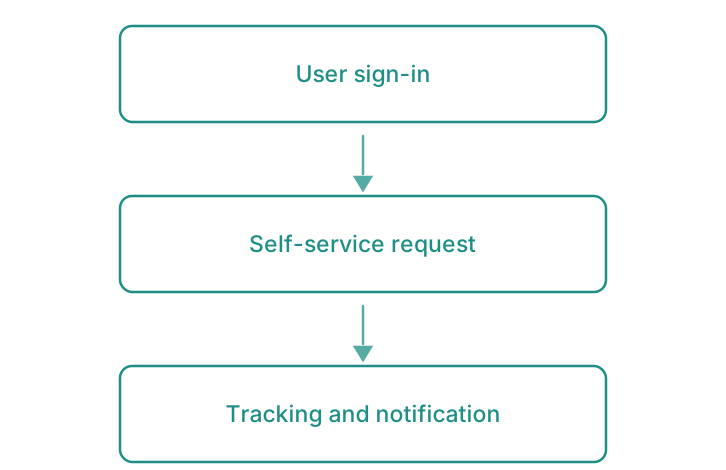
Identify the user, let them act on their own, keep them informed: VIP Member Portal and Concierge Applications work the same way.
- Dataviz InteractiveAesthetic charts comparing current consumption to the previous year.
- Eco-friendly Actions and AlertsNotification system (email/SMS) if consumption exceeds a defined budget.
- Administrative Self-ServiceDownloading of domicile certificates, change of bank details or declaration of change of address.
- Online PaymentIntegration of payment components (Stripe, SEPA) to settle an overdue invoice.
- Multi-Site (For B2B)For business customers, consolidated view of consumption across all their buildings.
- Automated Meter ReadingInterface enabling the client to input their old meter readings easily.
Smooth and frictionless integration
We do not replace your billing IT system: we connect to it. The portal interfaces with your existing systems via API or file exchanges if necessary. Data from smart meters/smart gas meters is retrieved from network operator/GRDF flows without development on the distributor side. Authentication can rely on your existing directory or on a dedicated solution according to your security constraints.
Deployment is progressive: we begin with the consultation/bills foundation, we add alerts, then self-care, then payment. Each component brings value independently.
Journey and flow mapping
Analysis of recurring support requests, identification of data available in your IT systems, definition of priority journeys to be covered.
Development of the platform foundation and connectors
Construction of the consultation interface, integration with the billing IS and consumption data flows (the network operator, GRDF, internal metering).
Activation of value-added services
Progressive deployment of alerts, automatic meter reading, administrative self-service and online payment according to your business priorities.
Driving adoption and iterations
Monitoring of usage rates by functionality, analysis of abandoned journeys, continuous adjustments based on field feedback and metrics.
Measurable results for your organisation
- 35 to 50% reduction in customer service calls for level 1 enquiries (invoices, statements, certificates)
- Portal adoption rate exceeding 60% of active clients at 12 months
- Average processing time for administrative amendments reduced from 4 days to instantaneous
- 20% reduction in complaints related to invoice misunderstanding
- Tertiary decree compliance ensured with consumption data export in regulatory format
- Reduced bad debt rate by 15% through online payment and proactive alerts
Clarifying your decision-making
Our consumption data is in a 15-year-old proprietary format. Can this really be interfaced?
A legacy proprietary format remains interfaceable: Clarendis has already handled COLD exports, fixed-width flat files and AS/400 databases. We develop a specific connector that transforms your data into a usable format, and its cost is built into the project.
How can we ensure that clients will actually use this portal rather than continue to ring?
Adoption of a consumer portal is encouraged rather than forced. Customers who call about an invoice are redirected to the portal by your advisers, with assistance on their first visits. Clarendis measures adoption by segment and adjusts the user journeys as friction appears. B2B customers adopt fastest once they see the value of multi-site data visualisation.