← Back to whitepapers

White paper · Launch edition — August 2026

White paper — From obligation to architecture

From obligation to architecture — e-invoicing 2026-2035. 39 pages to turn a regulatory constraint into an architecture decision — with no conflict of interest: Clarendis sells no invoicing platform and no software.

  • A comparison grid of approved platforms — criteria, contractual traps, pre-sales questions
  • A map of the impacts on your information system: ERP, CRM, document management, accounting
  • The blind spots official guides leave out: advance payments, self-billing, expense claims, cross-border flows
  • The 2027-2035 trajectory: the SME deadline and the EU obligations, without building twice
Cover of the white paper
White paper · Launch edition — August 2026
White paper — From obligation to architecture

Read the opening pages

The 39 pages of this white paper. The first 11 are readable in full; the rest is sent by email.

Page 1 of the white paper “From obligation to architecture — E-invoicing 2026-2035”
Page 1

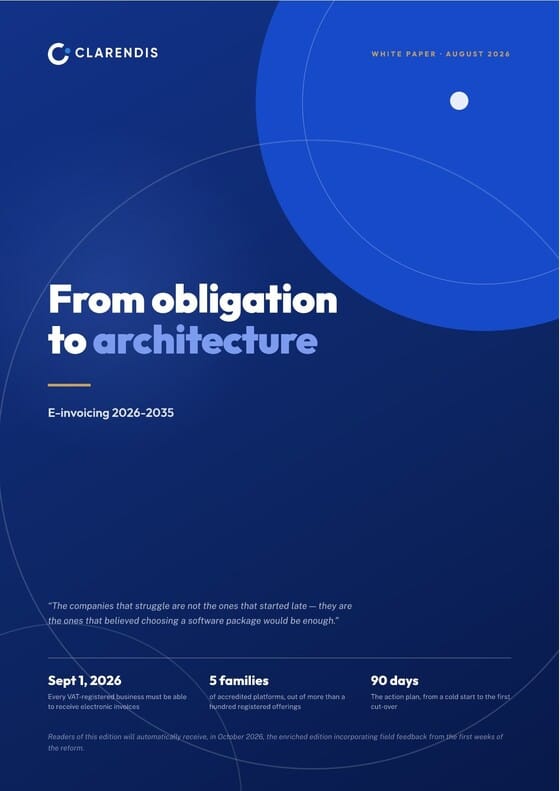
White paper · August 2026

From obligation to architecture

E-invoicing 2026-2035

“The companies that struggle are not the ones that started late — they are the ones that believed choosing a software package would be enough.”

Sept 1, 2026

5 families

90 days

Every business established in France must be able to receive electronic invoices

of accredited platforms, out of more than a hundred registered offerings

The action plan, from a cold start to the first cut-over

Readers of this edition will automatically receive, in October 2026, the enriched edition incorporating field feedback from the first weeks of the reform.

Page 2 of the white paper “From obligation to architecture — E-invoicing 2026-2035”
Page 2

Contents

Foreword 03 Executive summary — the document in ten statements 04 Your reading path 06 1 What July changed The summer misunderstanding · What is literally required · The penalties · The good-faith file 07 2 What the reform does to your information system The invoice stops being a document · An invoice’s real journey · The five points of contact · What breaks in practice · The order of works 11 3 Choosing without getting it wrong Five families of players · Start from your flows, never from demos · 6 blocks, 21 criteria · Five contractual traps · Special cases 16 4 The blind spots Advance payments · Credit notes · Self-billing · Expense claims · International · B2C · Intra-group · Three sectors · The minimum test plan 24 5 2027, 2030, 2035: the trajectory September 2027 · July 2030, ViDA · January 2035 · From compliance to value · The no-regret decisions 29 6 The 90-day action plan Where are you starting from? · D1-D30 · D31-D60 · D61-D90 · The five-number dashboard 33 Moving to execution 36 Appendices — Glossary, primary sources, about Clarendis 37

Page 3 of the white paper “From obligation to architecture — E-invoicing 2026-2035”
Page 3

Foreword

For eighteen months, e-invoicing has produced an abundant literature: vendor guides, platform webinars, hurried articles. Almost all of it shares two flaws. It is written by players who have something to sell you at the end of the argument, and it treats the reform as a tax formality that a good tool would settle. Our engagements show the opposite: the companies that struggle are not the ones that started late — they are the ones that believed choosing a software package would be enough.

Clarendis is a digital-steering consulting network. Our business is advice and analysis — framing, architecture, programme steering — and implementation when our clients want it, down to development if needed: we have, for instance, built an e-invoicing solution on Odoo, proof that our recommendations can go all the way to code. What we do not do: sell an accredited platform, or take referral commissions on anyone else’s. This line is not a posture — it is what allows us to write chapter 3 the way it is written: we make our living from the success of your project, not from the choice of a vendor.

This document gathers what our engagements teach us in the field: what works, what breaks, what costs. Every regulatory statement rests on a dated official source, all listed in the appendix. And we have kept only the figures that genuinely help you decide; mood statistics have been set aside.

How to read this document. The chapters stand alone. If September worries you, start with chapter 1 and the plan in chapter 6. If your platform is chosen but the project is stalling, chapter 2 will probably tell you why. If you are mid-consultation, chapter 3 is your interview grid. Each chapter closes with the same panel, what this changes for you, written for three readers: the CEO, the CFO, the CIO. It is deliberately the same subject seen from three angles, because these projects most often fail where leadership, finance and IT do not work together.

An edition is dated by nature. This one is current as of August 4, 2026, four weeks before entry into force. The October edition will add what only reality can teach.

Enjoy the read — and a good start.

Cédric Guittard

Anna Hoang

cedric.guittard@clarendis.com

anna.hoang@clarendis.com

for the Clarendis team

Page 4 of the white paper “From obligation to architecture — E-invoicing 2026-2035”
Page 4

Executive summary

The document in ten statements. Each is developed and sourced in the chapter indicated.

1

2

The timetable has not moved, and it will not move again. On September 1, 2026, every business established in France must be able to receive electronic invoices; large companies and mid-caps must additionally issue and transmit their e-reporting. SMEs will issue from September 1, 2027. (Chapter 1)

The “tolerance” announced in July concerns penalties, not obligations. It is earned and it is proven: a real difficulty, documented, followed by corrective action. Inaction confers no entitlement to it. (Chapter 1)

3

4

One act conditions everything: appointing an accredited platform. It is the platform that registers you in the national directory — there is no direct registration. Without a platform, your suppliers literally cannot reach you. (Chapter 1)

The invoice stops being a document and becomes a controlled data flow. What used to be page layout becomes data; what used to be invisible becomes traceable; what used to be periodic becomes continuous. It is an architectural shift, not a format change. (Chapter 2)

5

6

The first worksite is not the tool — it is your third-party master data. Routing rests on the directory, the directory on SIREN/SIRET identifiers, and the actual state of customer and supplier databases is routinely the largest workload item in these projects. (Chapter 2)

A rejection is not a refusal. Rejection is technical — the invoice is deemed never issued, hence never paid; refusal is commercial — the invoice exists, the dispute gets handled. Who handles what, within what deadline: two procedures to write before go-live. (Chapter 2)

7

Choose your platform from your flows, never from demos. More than a hundred offerings, five families of players (named in chapter 3), none “right” in the absolute. Five questions asked in order narrow the official list to three to five candidates in half an hour; your one-page flow sheet does the rest. (Chapter 3)

Page 5 of the white paper “From obligation to architecture — E-invoicing 2026-2035”
Page 5

8

9

Reversibility is negotiated at signature — afterwards, it is bought. Data ownership, archive restitution, capped exit cost: the two pages of the contract that will be worth money in three years, in a market that is going to consolidate. (Chapter 3)

Your “special” cases are the real project. Advance payments, credit notes, self-billing, expense claims, international flows, intra-group: every untreated case is a non-compliance on borrowed time or a payment blockage in the making. (Chapter 4)

10

2026 is only the first step, and the constraint hides an asset. 2027 extends issuance to SMEs with a commercial cascade effect that will not wait for the law; 2030 brings the European ViDA obligations; 2035 harmonises. And the same plumbing opens, as soon as it runs, three value worksites: working capital steered in real time, automated P2P, treasury on fresh data. This year’s decisions must serve both. (Chapter 5)

Where to start, depending on your situation:

Nothing is underway. Chapter 1 (what is required, the good-faith file), then straight to the 90-day plan in chapter 6, “cold start” sequence. Your absolute priority: the dated decision and the appointment of a platform.

The project is launched, the platform chosen. Chapters 2 and 4: the five IT points of contact and the blind spots are the two places where your schedule is probably lying.

You are “ready”. Chapter 4 for the trial by fire of the special cases, chapter 5 to check that your architecture will survive 2027 and 2030 — and the chapter 6 dashboard to put that “ready” to the test.

Page 6 of the white paper “From obligation to architecture — E-invoicing 2026-2035”
Page 6

Your reading path

Three waymarked itineraries. The “What this changes for you” panels, at the end of each chapter, are written for your seat at the table.

CEO CEO 25 minutes

CFO CFO 1 hour

CIO CIO 1 h 30

01 Executive summary

01 Chapter 1 in full (penalties, good-faith file)

Full document recommended. Your critical path:

02 chapter 1 (§1.1 and §1.4: the misunderstanding, and the dated decision that falls to you)

02 chapter 2, §2.3-2.4 (rejection/refusal, the procedures to write)

01 chapter 2 (the five points of contact)

02 chapter 4 (your acceptance test set)

03 the six “CEO” panels

03 chapter 3, blocks 4 and 5 of the grid (reversibility, full cost)

04 chapter 6, §6.4 (the five numbers to put on your agenda).

03 chapter 3, blocks 2-3-4 (lifecycle, API, reversibility)

04 chapter 4, §4.2 and §4.4 (credit notes, expense claims)

04 chapter 5, §5.4 (EN 16931 as pivot, isolated exchange layer)

You will know what to demand, from whom, and how to measure it.

05 chapter 6 in full — the plan is yours.

05 chapter 6, D61-D90.

What you came here for

The four promises of the download page, and where each is kept:

Promise

Where

In what form

The accredited-platform comparison grid

Chapter 3

The 5 families with named players, the five questions that narrow the official list to three to five candidates, then 6 blocks and 21 criteria — for each, the exact question to ask and what a good answer contains

The map of impacts on your IT system

Chapter 2

The 5 points of contact, what breaks in practice, and the order of works

The blind spots of the official guides

Chapter 4

8 situations, each with its trap and the decision to settle

The 2027-2035 trajectory

Chapter 5

The 3 deadlines, what real time makes possible (working capital, P2P, steering), and the 4 “no-regret” decisions of 2026

Page 7 of the white paper “From obligation to architecture — E-invoicing 2026-2035”
Page 7

Chapter 1

What July changed

1

This chapter condenses our August 2026 analysis note, published on clarendis.com, which covers the September urgency in detail. Here: the essentials, to ground what follows.

1.1 The summer misunderstanding

O n July 10, 2026, the Direction générale des Finances publiques published on impots.gouv.fr a practical start-up guide in question-and-answer form. The next day, the ministry for Public Action and Accounts announced by press release (no. 898, July 11, 2026) a “tolerant and benevolent” implementation towards good-faith businesses encountering technical difficulties at start-up.

Many heard “tolerance” and understood “postponement”. The administration wrote the opposite in so many words: this approach constitutes neither a postponement nor a suspension of the obligation. Three principles structure the guide:

The legal timetable stands. No date moves (article 289 bis of the French tax code, CGI).

Economic continuity is preserved. An invoice received outside the electronic circuit after September 1 — email, PDF, paper — remains usable for payment and VAT deduction, provided it corresponds to a real transaction. The right to deduct is not lost merely because of the channel.

This continuity is not an exemption. The out-of-circuit invoice is tolerated on condition that regularisation through the electronic circuit is underway . The guide explicitly rules out: durably ignoring the obligation, undertaking no steps at all, deliberately maintaining parallel circuits, invoking start-up difficulties to block payments.

The question you will be asked in an audit is therefore not “were you perfectly compliant on September 1?” but: “can you demonstrate a serious compliance trajectory?” It is a question of evidence — §1.4 answers it.

Page 8 of the white paper “From obligation to architecture — E-invoicing 2026-2035”
Page 8

1

Chapter 1 — What July changed

1.2 What is literally required

September 1, 2026

September 1, 2027

Large companies and mid-caps

Receive + issue + e-reporting

SMEs, micro-businesses

Receive

Issue + e-reporting

The most misunderstood point: the reception obligation has no size exception whatsoever. Micro-business, independent professional, association — all must be able to receive from September 2026, because their large-company and mid-cap suppliers will start issuing. More than ten million economic actors are concerned.

Three acts condition compliance:

1.

Appoint an accredited platform, directly, or through your software vendor or your accounting firm. The official list (101 platforms at its publication on January 16, 2026, more than 130 registered by mid-2026) is published on impots.gouv.fr. Beware of “registration in progress” claims: until accreditation is granted, compliance is not guaranteed.

2.

Check your entry in the national directory (facturation.chorus-pro.gouv.fr/annuaire, free lookup by SIREN). You do not register yourself — no direct form exists: your platform declares you there when you are onboarded. Your role: check that your legal information is accurate and that your entry carries an active invoicing address.

3.

Comply with the admitted structured formats for issuance: UBL, CII or Factur-X. A PDF sent by email is not an electronic invoice within the meaning of the reform.

In case of anomaly, the DGFiP national helpline answers on 0 806 807 807 (free service + call cost, Monday-Friday 8:30-18:00).

The four links to bookmark

— The DGFiP start-up guide and the official platform list: impots.gouv.fr → professionals → “Je passe à la facturation électronique”

— Your directory entry (free check by SIREN): facturation.chorus-pro.gouv.fr/annuaire

— The general entry point: economie.gouv.fr → “Tout savoir sur la facturation électronique”

— The up-to-date detail of penalties: entreprendre.service-public.gouv.fr → “Facturation électronique : les sanctions évoluent”

Page 9 of the white paper “From obligation to architecture — E-invoicing 2026-2035”
Page 9

1

Chapter 1 — What July changed

1.3 The penalties: what the law actually says

Out-of-date figures abound online. The regime in force is that of the 2026 finance act (law no. 2026-103 of February 19, 2026, article 123):

Breach

Penalty

Legal basis

Failure to issue in electronic format

€50 per invoice, capped at €15,000/year (the former €15 amount is no longer in force)

CGI, art. 1737 III

No accredited platform for reception

Formal notice; €500 if without effect after 3 months, then €1,000 per breach recorded every 3 months

CGI, art. 1737 IV bis

Failure to transmit e-reporting

€500 per missing transmission, capped at €15,000/year

CGI, art. 1788 D

The right to err exists (CGI, art. 1737 V): these fines do not apply to the first offence of the current year and the three preceding years, remedied spontaneously or within 30 days of a first request from the administration.

These amounts are not the real risk. The real risk is operational: a supplier who cannot invoice you, an invoice that never arrives, a payment dispute — and, from chapter 2 onwards, everything a badly wired flow does to your cash position.

1.4 The good-faith file, on one page

The administration has announced that it will distinguish businesses engaged in a serious trajectory from those in inertia. It will take into account difficulties that are real, documented, and followed by corrective action . Three adjectives, three requirements, and four exhibits you must be able to produce:

A dated decision. Internal note, minutes, management email recording that the subject has been taken in hand, with an owner and a timetable. One page. The date must precede the difficulty invoked.

The trail of your steps. Quotes, exchanges with vendors and platforms, contract, support tickets, minutes. This material already exists; it is simply scattered across mailboxes.

The precise difficulty. “We did not have time” is not one. “Our vendor will not ship the update before November — here is their letter” is one. Document the blockage, not the delay.

The corrective measures. A flow-by-flow cut-over plan, dated.

Page 10 of the white paper “From obligation to architecture — E-invoicing 2026-2035”
Page 10

1

Chapter 1 — What July changed

Three practical principles complete the file: you may switch over progressively (the guide explicitly allows it — start with the simplest flow); keep paying and invoicing (economic continuity comes first; run the regularisation in parallel); keep a logbook — date, incident, cause, action, status; ten minutes a week, and this document is worth more than any attestation.

The distinction is sharp, and it is the only one that counts: having started, even badly, or not having started at all.

The dated-decision template, to copy as is

“[Date]. The management of [company] resolves to bring the company into compliance with the electronic invoicing obligation (art. 289 bis CGI). [First name Last name] is appointed project owner. Milestones: flow census and third-party master data assessment within 30 days; choice of the accredited platform within 60 days; first cut-over within 90 days. A logbook of incidents and decisions is opened as of this day. Signature.”

This text is not sent to anyone: it is an internal note. Have management sign it, date it and archive it in the project file (a simple internal email also sets a date). It is the first exhibit of your good-faith file, the one you will produce if the administration questions your trajectory. Five lines dated today are worth more than ten pages dated November.

What this changes for you

CEO

CFO

CIO

CEO. Sign the dated decision of §1.4 this week — one page, one owner, one timetable. It is the cheapest and most profitable document of the whole project: it opens the benefit of tolerance on its own.

CFO. Check the company’s directory entry yourself — five minutes on facturation.chorus-pro.gouv.fr/annuaire. If it is missing or wrong, you know your no. 1 urgency; if it is clean, you have just earned the right to sleep on September and work on 2027.

CIO. §1.2 gives you the three target formats; chapter 2 awaits you. Until then, a single action: ask every vendor involved for its written position on formats and platform connectivity. The answers — and the silences — will draw your risk map.

© Clarendis — August 2026 · contents 10

Page 11 of the white paper “From obligation to architecture — E-invoicing 2026-2035”
Page 11

Chapter 2

What the reform does to your information system

2

Here is the map of impacts on your information system, announced on the download page. It is the most important chapter of this document, and the one vendor publications skim over: detailing what has to change on your side sells no licences.

2.1 The invoice stops being a document

For as long as anyone can remember, an invoice has been a page: a header, lines, a total, legal notices. Whether printed or PDF changes nothing about its nature — it is a document meant for human eyes, which your accountant reads, interprets and re-keys.

The reform ends that definition. An electronic invoice within the meaning of article 289 bis of the CGI is a structured data file — UBL, CII, or Factur-X, which combines a readable PDF with an embedded XML file. The difference is not cosmetic: in a structured invoice, every piece of information — the parties’ identity, every line, every VAT rate, the transaction category — occupies a defined field, machine-readable without interpretation.

Three cascading consequences — and that is the whole chapter:

What used to be page layout becomes data. A misplaced notice on a PDF got through; a badly filled field in an XML no longer does. The invoice is checked at the circuit’s entrance — by your platform, by your customer’s — and rejected if malformed. Your data quality stops being a back-office topic and becomes a condition of getting paid.

What used to be invisible becomes traceable. The electronic invoice carries a lifecycle: deposited, issued, received, refused, paid. Every status is time-stamped, and some of them are reported to the administration. “We never received it” disappears — and with it part of the late-payment litigation, in both directions.

What used to be periodic becomes continuous. With e-reporting, the administration no longer discovers your activity at the VAT return: it receives the data as it flows. The gap between your accounts and your declared flows becomes mechanically visible. The internal consistency of your IT — invoicing, accounting, reporting — is no longer a quality objective; it is a tax exposure.

The journey of an invoice from September 1, 2026

statuses returned: rejected / refused / paid

1

2

3

4

5

Your invoicing tool

Your accredited platform

Your customer’s platform

Your customer

National directory

Tax administration invoicing data and e-reporting transmitted continuously, in parallel with the circuit

© Clarendis — August 2026 · contents 11

The remaining 28 pages are in the complete document.

Download the white paper
Page 12, blurred — available in the full document
Page 12 · in the full document
Page 13, blurred — available in the full document
Page 13 · in the full document
Page 14, blurred — available in the full document
Page 14 · in the full document
Page 15, blurred — available in the full document
Page 15 · in the full document
Page 16, blurred — available in the full document
Page 16 · in the full document
Page 17, blurred — available in the full document
Page 17 · in the full document
Page 18, blurred — available in the full document
Page 18 · in the full document
Page 19, blurred — available in the full document
Page 19 · in the full document
Page 20, blurred — available in the full document
Page 20 · in the full document
Page 21, blurred — available in the full document
Page 21 · in the full document
Page 22, blurred — available in the full document
Page 22 · in the full document
Page 23, blurred — available in the full document
Page 23 · in the full document
Page 24, blurred — available in the full document
Page 24 · in the full document
Page 25, blurred — available in the full document
Page 25 · in the full document
Page 26, blurred — available in the full document
Page 26 · in the full document
Page 27, blurred — available in the full document
Page 27 · in the full document
Page 28, blurred — available in the full document
Page 28 · in the full document
Page 29, blurred — available in the full document
Page 29 · in the full document
Page 30, blurred — available in the full document
Page 30 · in the full document
Page 31, blurred — available in the full document
Page 31 · in the full document
Page 32, blurred — available in the full document
Page 32 · in the full document
Page 33, blurred — available in the full document
Page 33 · in the full document
Page 34, blurred — available in the full document
Page 34 · in the full document
Page 35, blurred — available in the full document
Page 35 · in the full document
Page 36, blurred — available in the full document
Page 36 · in the full document
Page 37, blurred — available in the full document
Page 37 · in the full document
Page 38, blurred — available in the full document
Page 38 · in the full document
Page 39, blurred — available in the full document
Page 39 · in the full document
Share this white paper