← Back to whitepapers

White paper · June 2026

White paper — Industry 4.0: MES, WMS and the digitalisation of production

Industry 4.0: MES, WMS and the digitalisation of production. 55 pages written from the field: we design, deploy and operate these systems for our clients, which is precisely how we know where they break.

  • The ERP-MES-WMS triangle: who does what, the MES as shop-floor pivot, the WMS as physical-flow pivot
  • Single master data, traceability, NIS2 and the batch record
  • The digitalised flow, stage by stage: plan, release, control and trace, store and ship, the operator station
  • The blind spots: the screen that slows the operator down, the showcase dashboard, the ghost spreadsheet, the connected machine no one uses
Cover of the white paper
White paper · June 2026
White paper — Industry 4.0: MES, WMS and the digitalisation of production

Read the opening pages

The 55 pages of this white paper. The first 16 are readable in full; the rest is sent by email.

Page 1 of the white paper “Industry 4.0: MES, WMS and Production Digitalisation”
Page 1

White paper · June 2026

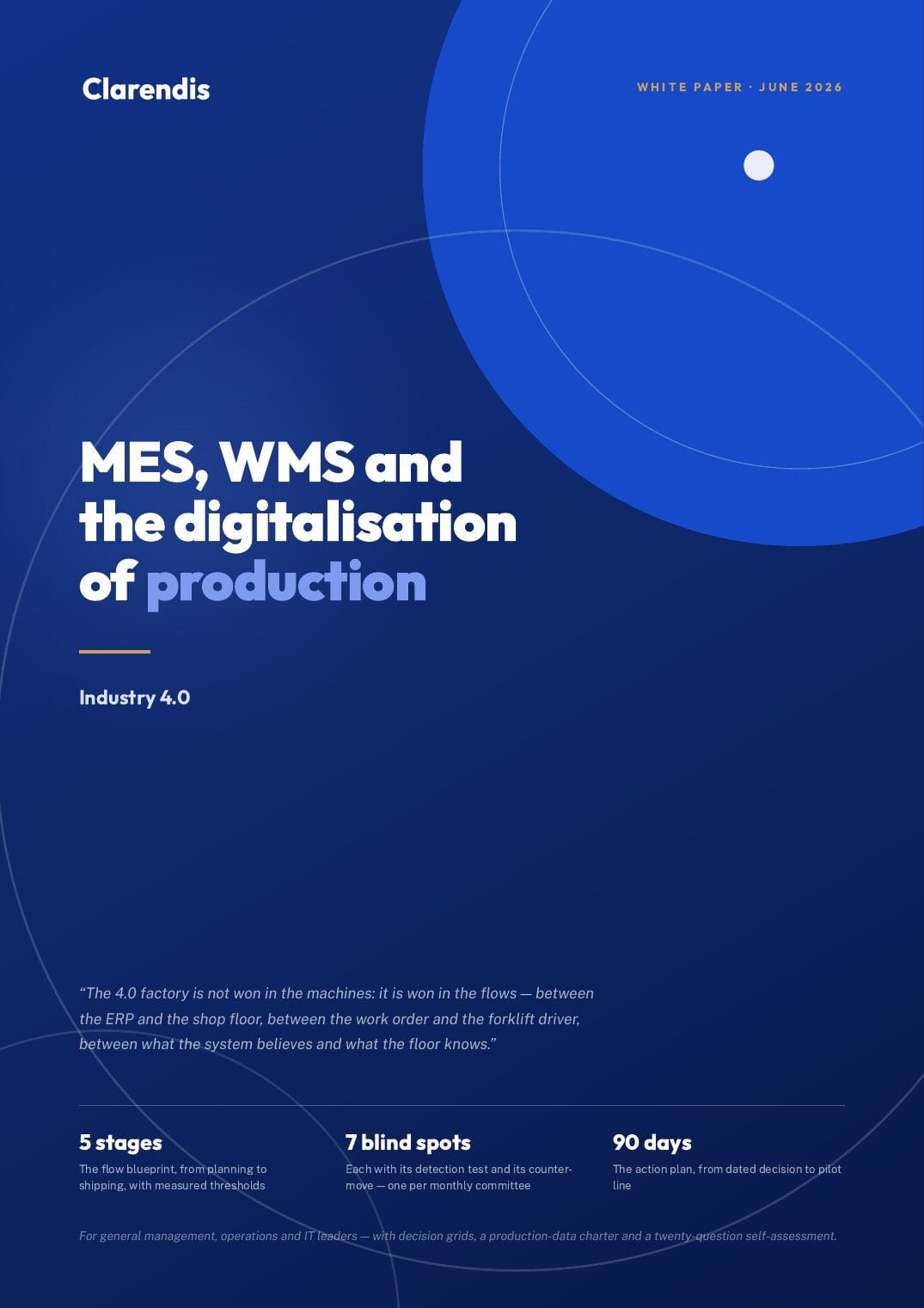
MES, WMS and the digitalisation of production

Industry 4.0

“The 4.0 factory is not won in the machines: it is won in the flows — between the ERP and the shop floor, between the work order and the forklift driver, between what the system believes and what the floor knows.”

5 stages

7 blind spots

90 days

The flow blueprint, from planning to shipping, with measured thresholds

Each with its detection test and its counter-move — one per monthly committee

The action plan, from dated decision to pilot line

For general management, operations and IT leaders — with decision grids, a production-data charter and a twenty-question self-assessment.

Page 2 of the white paper “Industry 4.0: MES, WMS and Production Digitalisation”
Page 2

Contents

Foreword 03 Executive summary — the document in ten claims 04 Your reading path 06 1 The “factory 4.0” misunderstanding Digitising is not robotising · The flow, not the screen · The cost of paper · The market in figures · Three factories: the workshop, the mid-cap, the subcontractor 07 2 Production data, the factory's memory The single master data · Traceability and NIS2 · Machine data · The batch record that actually serves 13 3 The architecture: ERP, MES, WMS — who does what The systems triangle · The MES, pivot of the shop floor · The WMS, pivot of the physical flow · Integration · Composable or suite · The vendor grid 18 4 The digitalised flow, stage by stage Plan · Launch and produce · Inspect and trace · Store and ship · The operator's workstation 24

5 The blind spots The screen that slows the operator · The showcase dashboard · The ghost spreadsheet · The connected machine left unused · The WMS bypassed · The data that sleeps · The measurement never taken 30 6 Deciding without predicting What is written, what is scenario · Industrial AI, digital twin, sustainability · The four no-regret decisions 35 7 Orchestrating teams and partners The seam between crafts · The RACI of the work order · Training without weighing down · The shop-floor charter 40 8 The 90-day plan Where are you starting from? · D1-D30, D31-D60, D61-D90 · The five-number dashboard · The five mistakes · After D90, multi-line 44 Moving to execution 51 Appendices — Glossary, sources, about, self-assessment 52-54

The through-line

Performance is not seen on a screen, it is felt in the flow — and it is lost between systems. This document turns that into a measurable discipline.

Page 3 of the white paper “Industry 4.0: MES, WMS and Production Digitalisation”
Page 3

Foreword

A Monday morning, an urgent order. The ERP says the material is in stock; the forklift driver says it is gone; the shop-floor manager launches the work order anyway — “we'll see”. At 11 a.m., the line stops. Nothing was wrong: the stock had moved, the information existed — it was simply on a slip of paper on the storekeeper's desk, waiting to be typed in. The factory did not lack machines that morning; it lacked a flow.

This document is written from inside the craft, for those who practise it — not one more panorama on “the factory of the future”. Its position fits in one sentence: industrial digitalisation is not about adding screens, but about making data flow end to end — from order to shipment — and giving teams back the time to produce. That can be decided, specified and measured. So you will find things to act on, not things to ponder: a flow blueprint, grids with thresholds, templates to copy as they are (a batch record, a shop-floor charter, a vendor requirements grid), a 90-day plan, a self-assessment. Never a finding without the decision that goes with it.

A point of intellectual honesty: we design, deploy and operate these systems for our clients — which is precisely how we know where they break. The grids and thresholds in this document are the ones we accept being held to on our own projects.

How to read this document. The chapters stand alone; page 6 offers a path per role. If you read only ten pages: the executive summary (p. 4-5), the flow blueprint (ch. 4) and the 90-day plan (ch. 8). The self-assessment in appendix D will tell you where to start.

Enjoy the read — and may your flows never stop, neither on the shop floor nor between two systems.

Cédric Guittard

Anna Hoang

cedric.guittard@clarendis.com

anna.hoang@clarendis.com

for the Clarendis team — June 2026

Page 4 of the white paper “Industry 4.0: MES, WMS and Production Digitalisation”
Page 4

Executive summary

The document in ten claims. Each is developed, tooled and located in the chapter indicated.

01 4.0 cannot be bought in sensors: it is won in the flows.

02 Paper and the ghost spreadsheet are your real competitors.

A connected machine whose data does not circulate is an expensive gadget. Value is born when information follows the material, without re-typing. (ch. 1)

Not the over-equipped German factory: the printed work order, the stock recounted by hand, the local file no one consolidates. (ch. 1, 5)

03 Production data is an asset — and a responsibility.

04 ERP, MES, WMS: three roles, never interchangeable.

One master data set — items, BOMs, routings, stocks — that every system reads. It is worth more than the machines; it is governed (traceability, NIS2). (ch. 2)

The ERP decides what to produce, the MES knows how it is going, the WMS knows where the material is. Every time a system steps out of its role, friction sets in. (ch. 3)

05 Architecture is bought reversible, never captive.

06 The flow is specified stage by stage, with thresholds.

Your production data remains exportable at any time, every component replaceable. The chapter 3 vendor grid makes it contractual. (ch. 3)

“Digitalising production” cannot be decreed: five stages, each with a measurable promise. The chapter 4 blueprint turns it into a contract. (ch. 4)

Page 5 of the white paper “Industry 4.0: MES, WMS and Production Digitalisation”
Page 5

07 The tool that slows the operator will be bypassed — rightly.

08 Whoever owns their master data owns their margin.

An MES that adds clicks without giving back time manufactures false data: the operator types at end of shift, from memory. Workstation ergonomics is a board-level subject. (ch. 4, 5)

False stock = safety overstock, shortages, emergency transport. Stock accuracy is not a storekeeper's subject: it is tied-up cash and margin. (ch. 2, 4)

09 4.0 is first a matter of teams.

10 90 days are enough to prove it — on a single line.

No software replaces the handover between planning, the shop floor, quality and the warehouse. The tool serves the score; it does not write it. (ch. 7)

See clearly (D1-D30), frame and equip (D31-D60), prove on a pilot line (D61-D90): the chapter 8 plan, with dated deliverables and its five numbers. (ch. 8)

The thesis of this document

The high-performing factory cannot be bought in licences or sensors: it is orchestrated — one master data set, an MES and a WMS in their right place, one score for the teams — and it is proven one work order at a time. Everything that follows gives the blueprint, the templates and the plan to do it.

Page 6 of the white paper “Industry 4.0: MES, WMS and Production Digitalisation”
Page 6

Your reading path

Fifty-five pages are not read in one sitting. Three paths depending on your seat — each fits within an hour.

GENERAL MANAGEMENT

OPERATIONS

SYSTEMS & IT

You arbitrate and fund. 25 min:

You live the shop floor every day. 1 h:

Full document recommended. 1 h 30:

01 The summary in ten claims (p. 4-5)

01 Ch. 4 — the flow blueprint, stage by stage

01 Ch. 3 — the ERP-MES-WMS triangle, integration, composable or suite

02 Ch. 1 — the misunderstanding, the cost of paper, the three factories

02 Ch. 2 — the master data and the batch record

02 Ch. 3 — the vendor requirements grid, to attach to every RFP

03 Ch. 6 — the four no-regret decisions

03 Ch. 5 — the screen that slows, the ghost spreadsheet, the WMS bypassed

03 Ch. 5 — the seven blind spots, one per architecture review

04 Ch. 8 — the 90-day plan and its five numbers

04 Ch. 7 — the teams' score and the RACI of the work order

You will know what to fund, in what order, and how to check it is moving.

04 Appendix A — the glossary, to talk to your vendors

You leave with what you need to equip your teams without slowing them.

You leave with the target architecture and the requirements to impose.

What you came looking for

Your question

Where this document answers

Page

“Where do we start without breaking everything?”

The self-assessment, then the 90-day plan on a pilot line

54 · 44

“MES, WMS, ERP: who does what?”

The systems triangle and the single-role rule

19-21

“Which vendor, which architecture?”

The composable/suite grid and the vendor requirements grid

22 · 23

“How do we measure digitalisation?”

The five-number dashboard, before any volume metric

47

Page 7 of the white paper “Industry 4.0: MES, WMS and Production Digitalisation”
Page 7

Chapter 1

The “factory 4.0” misunderstanding

1

Your machines know how to produce; it is the information around them that wastes time. This chapter replaces the word “4.0” with a measurable discipline — the flow — prices what paper costs you, and places your factory among three archetypes.

1.1 Digitising is not robotising

The debate — “is Industry 4.0 for us?” — rests on a confusion. Digitising is not replacing the operator with a robot nor stuffing the shop floor with sensors: it is taking the typing, the searching and the recounting off the teams' hands to leave them the setting, the inspection and the improvement. Good industrial technology does not take the place of the craft gesture; it gives it back the time to be done well.

The misunderstanding begins when the showcases of large groups — the full digital twin, the autonomous line, the data lake — are imported into factories whose daily life is made of printed slips, hand-recounted stocks and local spreadsheets. Our position is clear: before any advanced component, the basic data must flow — the work order, the stock, the traceability — without paper or re-typing. The sensor comes after; the flow comes first.

The rule that runs through this document. For every digital project, a single question filters everything: does this device make data move faster than the material, or does it add typing? A screen that demands ten clicks to report an operation adds it; a scanner that records the movement at the moment of the gesture removes it. The first is refused, the second studied.

Page 8 of the white paper “Industry 4.0: MES, WMS and Production Digitalisation”
Page 8

1

Chapter 1 — The “factory 4.0” misunderstanding

1.2 The flow, not the screen: digitalisation translated into thresholds

“A digitalised factory” cannot be managed. What can: the handovers between two stages of the flow, and the threshold below which each one breaks. Here is the grid we recommend attaching to every specification — each row is a seam between two stages, and the right-hand column the threshold to demand:

The seam

The requirement, plainly said

The threshold to demand

Order → planning

The order is entered once; load, material and lead time are computed without re-typing

Zero re-typing between ERP and planning

Planning → shop floor

The work order reaches the workstation with drawing, routing and material — never ahead of it

100% of WOs launched with material available

Shop floor → tracking

Progress is reported at the moment of the gesture, in seconds — not at end of shift, from memory

Reporting < 30 s, as it happens

Quality → traceability

Inspection is recorded at the source; the batch record builds itself, piece by piece

Batch record reconstructed < 1 h

Production → warehouse

Every material movement is scanned at the moment of the gesture; system stock is real stock

Stock accuracy ≥ 98%

Warehouse → customer

Shipping is prepared without searching; the customer knows where their order stands without calling

Service rate ≥ 95%, zero “where is my order” calls

How to use it. Measure each seam today (a week of readings is enough), post the gaps, and make this grid the contractual annex for your providers — integrator, MES vendor, WMS vendor included. A missed threshold is not an IT incident: it is a promised customer lead time breaking, and it is handled at that level.

Page 9 of the white paper “Industry 4.0: MES, WMS and Production Digitalisation”
Page 9

1

Chapter 1 — The “factory 4.0” misunderstanding

1.3 What paper costs — a pricing to redo with your own data

Paper and re-typing do not cost “modernity” — they cost hours, tied-up stock and late-delivery penalties. Three leaks can be priced in one day of analysis, with your own data; here is the method, line by line:

1

Non-production time

Time, over one week, what the shop floor and the warehouse spend typing, searching, recounting, printing; multiply by headcount and weeks. That time is confiscated capacity — it alone justifies the MES-WMS project (ch. 3).

2

The stock that lies

Compare system stock and real stock on a hundred references; price the safety overstock, the shortages and the emergency transports the gap causes. It is the most expensive and the most normalised leak.

3

The delay paid twice

Count the year's late penalties and emergency transports — then the share caused not by production, but by information: the WO launched without material, the untraceable batch, the priority discovered too late.

Paper's profit-and-loss — illustrative 120-person factory, per year

The stock that lies

€540k

Non-production time

€310k

Delays paid twice

€180k

Orders of magnitude reconstructed with the method above — your data will give your amounts; that is precisely the exercise.

Our recommendation: do this pricing before any budget arbitration, and present it to the board as above — three leaks, three amounts, three projects opposite. It is the document that turns “we should digitalise” into a dated decision.

Page 10 of the white paper “Industry 4.0: MES, WMS and Production Digitalisation”
Page 10

1

Chapter 1 — The “factory 4.0” misunderstanding

1.4 The market in figures — what the movement says

Three figures are enough to frame the decision. They do not say “you must go” — they say your competitors are going, the offering is maturing fast, and the gap widens in silence:

~$15bn

+17%/yr

Cloud

The global MES market in 2025

The WMS market's growth

The fastest-growing segment

Growing 10 to 13% a year depending on the analyst — driven by the need for real-time production visibility.

~$4.6bn in 2025 — the strongest momentum of the trio, driven by the demand for accurate real-time stock.

On MES as on WMS, cloud deployment grows faster than on-premise — the offering within reach of mid-caps widens every year.

Orders of magnitude cross-checked from several research firms (MarketsandMarkets, Mordor Intelligence, Grand View Research, 2025-2026) — to be read as trends, never as predictions.

What these figures change for a mid-cap: five years ago, the MES was a large-group project; the cloud offering now puts it within reach of an 80-person factory. The real question is no longer “can we afford it?” but “in what order, and on what scope?” — the subject of chapter 3 and the 90-day plan.

Page 11 of the white paper “Industry 4.0: MES, WMS and Production Digitalisation”
Page 11

1

Chapter 1 — The “factory 4.0” misunderstanding

1.5 Three factories: the workshop, the mid-cap, the subcontractor

This document's recommendations do not weigh the same everywhere. Three archetypes cover most of the industrial fabric — identify yours; it calibrates the chapter 8 plan:

The workshop (10-50 people)

The multi-line mid-cap

The audited subcontractor

Several lines or sites, an installed ERP, dense logistics flows, a real systems team.

Small series, deep craft expertise, a light ERP or management software, plenty of paper and human memory.

Aerospace, medical, automotive, food: order-givers who demand traceability, certificates and portals.

Your urgency: orchestration — the ERP-MES-WMS triangle in its right place (ch. 3) and the single master data (ch. 2), because your seams are many.

Your urgency: getting off paper — the digital WO at the workstation and scanned stock (ch. 4). A light MES or a shop-floor module is often enough.

Your urgency: native traceability — the batch record that builds itself (ch. 2) and inspection recorded at the source (ch. 4).

Your risk: each site or line becoming a silo with its own spreadsheets.

Your risk: buying the large group's tool and abandoning it in six months.

Your risk: reconstructing every record by hand, the day before the audit.

And the regulation?

Two texts run through this document: NIS2 raises the cybersecurity requirement for a large share of manufacturers and their subcontracting chain, and the CSRD makes the production footprint documentable and published. Neither can be improvised on paper: the sidebars in chapters 2 and 6 return to them.

Page 12 of the white paper “Industry 4.0: MES, WMS and Production Digitalisation”
Page 12

1

Chapter 1 — The “factory 4.0” misunderstanding

The dated-decision template, to copy as it is

Every serious programme begins with a management decision — one page, dated, signed. Here is the template; replace the brackets and sign it this week:

Production digitalisation decision — template

“[Date]. The management of [company] decides to make production data flow end to end, from order to shipment, without paper or re-typing. [First name Last name] is mandated to lead the programme and reports monthly to management. The six seams of the grid (p. 8) are adopted as the standard; the current gap will be measured within 30 days and published in committee. The single master data and stock accuracy take precedence over any new visible project. No tool will be deployed that slows the operator at the workstation. Committed budget: [amount] over [duration].”

This text is sent to no one: it is an internal note. It dates your trajectory, names a single owner — not a committee — and makes the two priorities enforceable against every project that comes next.

What this changes for you

MANAGEMENT

OPERATIONS

SYSTEMS

General management. Sign the dated decision and demand the pricing of the three leaks (p. 9) within 30 days. Until those two documents exist, refuse any “4.0” budget.

Operations. Measure the six seams of p. 8 — one week of readings — and make them the language of your production reviews. They restate your irritants as verifiable commitments.

Systems & IT. Time the typing and re-typing between ERP, shop floor and warehouse (p. 9). That number, alone, opens the chapter 3 MES-WMS file.

Page 13 of the white paper “Industry 4.0: MES, WMS and Production Digitalisation”
Page 13

Chapter 2

Production data, the factory's memory

2

Your factory's best system already exists: it is your shop-floor manager's memory. This chapter raises it to the rank of master data — single items, BOMs, routings and stocks, traceability that builds itself, and machine data put to work.

2.1 The single master data, without a big bang

One item, one code, every system. It is the prerequisite for everything else: the plan that computes right, the stock that tells the truth, the batch record that builds itself. And it is the graveyard of pharaonic projects: three-year “master data” programmes fail by exhaustion. We recommend the progressive clean-up approach, which delivers value from the first quarter.

1

Clean up by value: start with the 200 items that make 80% of the volume — codes, BOMs, routings verified on the floor — then work down. The master data's overall error rate is a vanity; the rate at the top of the volume is a steering metric.

2

Match without migrating: a mapping table between the ERP's, the shop floor's and the warehouse's codes is enough for everyone to read the same reality — weeks, not years. Migration comes when the triangle (ch. 3) is decided.

3

Set the golden write rule: every piece of data has one master system (the item is born in the ERP, progress in the MES, the movement in the WMS) and the others read it. It is that rule — not the tool — that keeps the master data from re-fragmenting within the year.

Page 14 of the white paper “Industry 4.0: MES, WMS and Production Digitalisation”
Page 14

2

Chapter 2 — Production data

2.2 The frame, plainly said: traceability and NIS2 applied to the shop floor

Nothing in the texts requires a particular piece of software — everything in them requires proof. Four obligations cover most industrial situations; here is each one, with the operational gesture opposite:

Upstream-downstream traceability

Which material batch this part comes from, in which orders that batch went out. The gesture: the batch scan at every movement — receipt, launch, shipment — and the quarterly test: reconstruct a record in under an hour, simulated recall included.

NIS2 — enforceable cybersecurity

A large share of manufacturers and their subcontractors falls in scope: risk management, incident notification, management liability. The gesture: the access inventory (who can touch what, from where), office/shop-floor network separation, and one incident drill a year.

Shop-floor data retained

Production parameters, inspections, non-conformities: retained, dated, attributable — the duration depends on your sector. The gesture: the written retention policy (what, how long, where) and the annual purge — decided, dated, executed.

Subcontractors and providers

Your MES vendor, your integrator, your maintainer all see your production data. The gesture: a maintained list of third-party accesses, the data's location, and the question asked in writing: who, at the vendor, can read our routings and our cost prices?

The useful reversal

Compliance is lived as a constraint; it is in reality the programme's best budget argument. The same project that satisfies the auditor — batch scanning, automatic records, controlled access — is the one that removes re-typing and makes the stock reliable. One expense, two returns.

Page 15 of the white paper “Industry 4.0: MES, WMS and Production Digitalisation”
Page 15

2

Chapter 2 — Production data

2.3 Machine data: connect little, exploit everything

The temptation is to connect everything — every spindle, every sensor, every cabinet. The usual result: a data lake no one looks at, and connected machines left unused (blind spot 5.4). Our recommendation reverses the reasoning: start from the decision to be made, work back to the data that feeds it, connect that — and nothing else. Three uses pay off almost everywhere:

1

Run/stop status and its causes. The simplest and most profitable data: when the line stops, why, for how long. It feeds OEE and targets improvement where it pays — without a single additional sensor on most recent machines.

2

Automatic part counting. Every part counted by the machine is a report the operator no longer makes. It is the connection that gives time back to the workstation — the one that makes all the others accepted.

3

The parameters that make quality. Temperature, torque, pressure — only those your quality team knows how to interpret. Recorded per batch, they turn the traceability record into proof, and drift into an alert before scrap.

The three-question rule before connecting: what decision does this data change? who looks at it, how often? what happens when it crosses the threshold? Three clear answers: connect. One hesitation: it is a gadget — the money goes to the flow.

Page 16 of the white paper “Industry 4.0: MES, WMS and Production Digitalisation”
Page 16

2

Chapter 2 — Production data

2.4 The batch record that actually serves — the template

Most systems store everything and prove nothing on audit day. The useful record builds itself, piece by piece, as production goes — and answers one question: what must I be able to show within an hour if this batch causes a problem? Here are the fields — and above all the ones we exclude:

What the record contains — 8 sections, no more

What the record excludes — deliberately

1. The batch's identity: item, quantity, WO, dates

✕ After-the-fact entry. A record filled at week's end, from memory, proves nothing — it manufactures plausible falsehood.

2. The material batches consumed, with their certificates

✕ Data no one exploits. Every field required “just in case” will be badly filled and pollute the useful ones.

3. The routing executed: operations, workstations, who, when

4. Quality inspections, recorded at the source

✕ Judgement of people. The record traces production facts, never an evaluation of the operator — or the reporting will start arranging itself.

5. The machine parameters that make quality (p. 15)

6. Non-conformities and their decisions (accepted, reworked, scrapped)

7. The orders and customers served by this batch

8. Attached documents: drawing revision, certificates, photos

Our recommendation: impose these 8 sections as the interface contract on your vendor — not the reverse. A tool that demands 40 fields per operation will manufacture 40 false fields; the short record, 100% built as it happens, beats the rich record reconstructed the day before the audit.

The remaining 39 pages are in the complete document.

Download the white paper
Page 17, blurred — available in the full document
Page 17 · in the full document
Page 18, blurred — available in the full document
Page 18 · in the full document
Page 19, blurred — available in the full document
Page 19 · in the full document
Page 20, blurred — available in the full document
Page 20 · in the full document
Page 21, blurred — available in the full document
Page 21 · in the full document
Page 22, blurred — available in the full document
Page 22 · in the full document
Page 23, blurred — available in the full document
Page 23 · in the full document
Page 24, blurred — available in the full document
Page 24 · in the full document
Page 25, blurred — available in the full document
Page 25 · in the full document
Page 26, blurred — available in the full document
Page 26 · in the full document
Page 27, blurred — available in the full document
Page 27 · in the full document
Page 28, blurred — available in the full document
Page 28 · in the full document
Page 29, blurred — available in the full document
Page 29 · in the full document
Page 30, blurred — available in the full document
Page 30 · in the full document
Page 31, blurred — available in the full document
Page 31 · in the full document
Page 32, blurred — available in the full document
Page 32 · in the full document
Page 33, blurred — available in the full document
Page 33 · in the full document
Page 34, blurred — available in the full document
Page 34 · in the full document
Page 35, blurred — available in the full document
Page 35 · in the full document
Page 36, blurred — available in the full document
Page 36 · in the full document
Page 37, blurred — available in the full document
Page 37 · in the full document
Page 38, blurred — available in the full document
Page 38 · in the full document
Page 39, blurred — available in the full document
Page 39 · in the full document
Page 40, blurred — available in the full document
Page 40 · in the full document
Page 41, blurred — available in the full document
Page 41 · in the full document
Page 42, blurred — available in the full document
Page 42 · in the full document
Page 43, blurred — available in the full document
Page 43 · in the full document
Page 44, blurred — available in the full document
Page 44 · in the full document
Page 45, blurred — available in the full document
Page 45 · in the full document
Page 46, blurred — available in the full document
Page 46 · in the full document
Page 47, blurred — available in the full document
Page 47 · in the full document
Page 48, blurred — available in the full document
Page 48 · in the full document
Page 49, blurred — available in the full document
Page 49 · in the full document
Page 50, blurred — available in the full document
Page 50 · in the full document
Page 51, blurred — available in the full document
Page 51 · in the full document
Page 52, blurred — available in the full document
Page 52 · in the full document
Page 53, blurred — available in the full document
Page 53 · in the full document
Page 54, blurred — available in the full document
Page 54 · in the full document
Page 55, blurred — available in the full document
Page 55 · in the full document
Share this white paper