← Back to whitepapers

White paper · August 2026

White paper — Finding clients: what outsourced prospecting will not do for you

Finding clients: what outsourced prospecting will not do for you. 34 pages on building your acquisition as an SMB, without buying promises — with no conflict of interest: Clarendis sells no acquisition service, no platform, no subscription.

  • The question grid to use before signing, and how to spot the shopfront with no workshop behind it
  • The arithmetic of SMB acquisition: the funnel, the narrow long-cycle market, playing relevance rather than volume
  • What can be outsourced and what cannot: an honest division of roles
  • The blind spots: the "qualified" lead that is not, the purchased list, automation that destroys reputation
Cover of the white paper
White paper · August 2026
White paper — Finding clients: what outsourced prospecting will not do for you

Read the opening pages

The 34 pages of this white paper. The first 10 are readable in full; the rest is sent by email.

Page 1 of the white paper “Finding clients: what outsourced prospecting will not do for you”
Page 1

White paper · August 2026

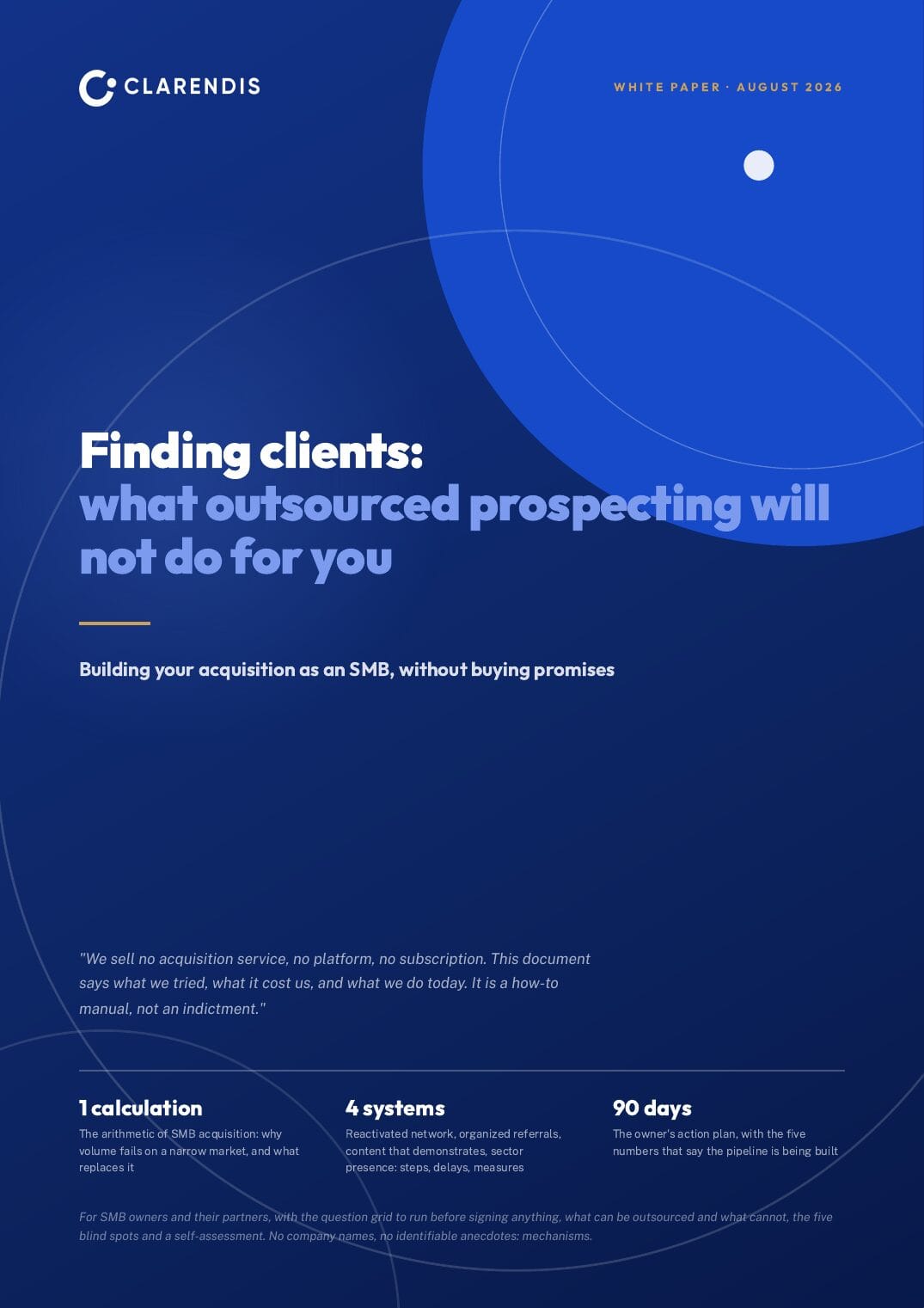
Finding clients: what outsourced prospecting will not do for you

Building your acquisition as an SMB, without buying promises

"We sell no acquisition service, no platform, no subscription. This document says what we tried, what it cost us, and what we do today. It is a how-to manual, not an indictment."

1 calculation

4 systems

90 days

The arithmetic of SMB acquisition: why volume fails on a narrow market, and what replaces it

Reactivated network, organized referrals, content that demonstrates, sector presence: steps, delays, measures

The owner's action plan, with the five numbers that say the pipeline is being built

For SMB owners and their partners, with the question grid to run before signing anything, what can be outsourced and what cannot, the five blind spots and a self-assessment. No company names, no identifiable anecdotes: mechanisms.

Page 2 of the white paper “Finding clients: what outsourced prospecting will not do for you”
Page 2

Contents

Foreword 03 Eight statements before signing anything 04 Where to start, depending on your situation 06 1 The promise and what it hides Why it hits home · Spotting the storefront with no workshop · The question grid before signing 07 2 The arithmetic of SMB acquisition The funnel and its volumes · The narrow, long-cycle market · Playing relevance, not volume 11 3 The personal network, reactivated The system, its steps, its rhythm · First effects and causes of failure 15 4 Referrals, organized From endured word-of-mouth to a steered system · The moment, the wording, the follow-up 18

5 Content that demonstrates Show the work rather than promise · The sustainable rhythm · Distribution before production 21 6 Sector presence Being where your market talks to itself · Choose few, hold long 23 7 What can be outsourced, what cannot The honest split of roles · Buying well what you buy 25 8 The blind spots The "qualified" lead that is not · The bought list · Automation that destroys · Content without distribution · Quitting at three months 27 9 The 90-day plan Prime, install, measure · The D1-D90 timeline · The five-number dashboard 30 Appendix · The twenty-question self-assessment 33

The stance

An SMB's acquisition cannot be bought: it gets built, on what an SMB has and nobody can rent, its network, its happy clients, its demonstrable know-how. This document turns that into four concrete systems, with their real delays, and a plan to hold them.

Page 3 of the white paper “Finding clients: what outsourced prospecting will not do for you”
Page 3

Foreword

Every week, the same message lands in an SMB owner's inbox, under different signatures: "we find your future clients". Guaranteed qualified meetings, a machine that prospects while you sleep, results from the first month. The promise hits home because it targets the weak point of almost every SMB: the company knows how to produce, how to serve, not how to sell itself. So you sign. You take the required subscriptions, the tools, the credits. You wait. And three months later, nothing has happened, except a budget gone and a file of "prospects" who have never heard of you.

We are well placed to write it: we were that owner. We signed, paid, waited, cancelled, and started again elsewhere believing the problem was the vendor, not the method. This document says what we tried, what it cost us, and what we do today, which works. Our position: we sell no acquisition service, no platform, no subscription, and take no referral commission. Nobody pays us to steer your budget, in either direction.

One important clarification: this is a how-to manual, not an indictment. The assessment of the promises takes one chapter, the first, because the problem must be stated once, properly, question grid included. Everything else is devoted to what actually produces clients in an SMB, four systems to build, each with its steps, its rhythm, its measure and its causes of failure, to what can legitimately be outsourced, and to the plan for the first ninety days. Good vendors do exist; chapter 7 says how to recognize them and what to entrust to them.

How to use it. Page 6 orients you by situation. In a hurry, read the eight statements (p. 4-5), chapter 2, the arithmetic, it is what changes the way you look at this, and the 90-day plan (ch. 9). The goal is simple: that you know what to do on Monday morning, not only what to avoid.

Enjoy the read, and may your next client come down a path you built.

Cédric Guittard

Anna Hoang

cedric.guittard@clarendis.com

anna.hoang@clarendis.com

for the Clarendis team · August 2026

Page 4 of the white paper “Finding clients: what outsourced prospecting will not do for you”
Page 4

Eight statements before signing anything

The document in eight statements. Each is developed and equipped in the chapter indicated.

01 The promise works because it targets your real weak point.

02 Volume arithmetic does not work on your market.

Acquisition is the Achilles heel of almost every SMB. That is what makes the cold outreach effective, and also what makes building in-house so profitable: the problem is real, only the sold solution is not. (ch. 1)

A prospecting funnel lives on large numbers. On a market of a few hundred qualified accounts, with a long sales cycle, large numbers do not exist: you play relevance, not volume. (ch. 2)

03 Your first deposit of clients sleeps in your phone.

04 Referrals are not endured: they are organized.

Former clients, former colleagues, suppliers, classmates: the reactivated personal network produces more meetings in three months than any cold campaign, and it costs only consistency. (ch. 3)

"Natural" word-of-mouth is a system that ignores itself: asked at the right moment, worded to be transmissible, tracked like a pipeline, it becomes your most profitable channel. (ch. 4)

05 The content that sells is the content that demonstrates, not the content that promises.

06 On a narrow market, being known by a hundred right people is enough.

Sector presence, the annual trade show, the professional association, the circle where your market talks, gets chosen once and held for years. Few places, a long time: the opposite of a campaign. (ch. 6)

Showing a solved problem, a method, a commented job: that is the proof of competence the prospect is looking for. One useful article a month, distributed in the right place, beats four posts a week written for the algorithm. (ch. 5)

Page 5 of the white paper “Finding clients: what outsourced prospecting will not do for you”
Page 5

07 You outsource execution, never the relationship.

08 Acquisition that works is slow to start and hard to stop.

Address research, tooling, graphic production buy well. The voice that speaks to your future clients, the choice of targets and the first conversation cannot be delegated: that is where trust is decided. (ch. 7)

This book's four systems produce little in the first month and a lot in the second year: an asset being built, not a campaign being launched. Quitting at three months is the leading cause of failure, ahead of any error of method. (ch. 8, 9)

What this document is not

An indictment of vendors: good ones exist, and chapter 7 says how to recognize them and what to entrust to them. A sales manual: it stops at the meeting obtained, not at the signature. A collection of anecdotes: no company names, no identifiable cases, no client result figures, mechanisms, which will still be true when the logos have changed.

The question that sums up the book: where did your last three real clients come from? Ask it before any budget. In most SMBs, the answer is: a relationship, a referral, a reputation. Rarely a campaign. This book organizes what the answer reveals, instead of funding what it refutes.

Page 6 of the white paper “Finding clients: what outsourced prospecting will not do for you”
Page 6

Where to start, depending on your situation

Four situations cover most readers. Find yours: it gives the reading order and the move that can follow this very week.

"I'm being courted, and I'm tempted"

Ch. 1 → ch. 2 → ch. 7. The question grid before signing, the arithmetic that says whether volume can work for you, and what a good vendor can be entrusted with, in that order.

Before signing

This week: put the four questions of p. 9 to the salesperson. The quality of the answers is worth all the free trials.

"I already paid, and nothing happened"

Ch. 2 → ch. 3 → ch. 9. Understand why it could not work (it was not you), restart with the fastest system, the network, and run the 90 days. The budget already spent paid for a lesson; this book makes it pay off.

The most frequent case

This week: list your last three real clients and where they came from. That is your acquisition strategy, revealed.

"I want to build, where do I start?"

Ch. 2, then the four systems (ch. 3-6), then ch. 9. The systems' order is the order of their delays: the network produces in weeks, referrals in months, content and sector presence in quarters. You stack them in that order; you do not launch four at once.

The full path

This week: block the two weekly hours of ch. 9. Without that protected slot, nothing that follows will exist.

"My partner wants to sign, I don't"

Ch. 2 (the arithmetic) → ch. 1 (the grid) → ch. 7 (the split). The debate is not settled on opinions: it is settled on the p. 12 calculation applied to your market, and on the vendor's answers to the grid. Often, the conclusion is neither "sign" nor "refuse": it is buy less, better, and build the rest.

The arbitration path

Page 7 of the white paper “Finding clients: what outsourced prospecting will not do for you”
Page 7

Chapter 1

The promise and what it hides

1

One chapter of assessment, and not one more: why the promise hits home, how to spot the storefront with no workshop, and the question grid that separates real vendors from subscription machines. Then, we build.

1.1 Why the promise hits home

The promise "we find your clients" works for an honourable reason: it targets a real problem. Most SMBs were born of a craft, not of a conquered market, the founder knew how to make, the first clients came through relationships, and twenty years later the company still depends on three main accounts and on the phone ringing. Acquisition was never built; it was inherited. When it runs out of steam, the owner faces a trade they never learned, with no time to learn it. That is exactly where the promise strikes: it offers to buy what you do not know how to do.

Let it be said plainly: wanting to delegate is not a fault. Accounting, payroll, IT delegate perfectly well. The problem is not delegation, it is that acquisition, unlike payroll, depends on what only you possess: your credibility, your knowledge of the trade, your relationships. A third party can tool all of that (ch. 7); it cannot replace it. The offers claiming otherwise sell an impossibility, and chapter 2 will show why, numbers in hand.

The chapter's reversal: the right reflex facing outreach is neither signing nor contempt, it is a question: "what does this offer assume I already possess?" A relevant target list, a credible message, a clear offer: if you have them, you barely need the offer; if you do not, it will not work.

Page 8 of the white paper “Finding clients: what outsourced prospecting will not do for you”
Page 8

1

Chapter 1 · The promise and what it hides

1.2 Spotting the storefront with no workshop

Setting up an acquisition company has never been cheaper: a landing page generated in an evening, AI visuals, unverifiable testimonials, an automated outreach sequence, and the same promise as everyone else. None of this is illegal, and some of these players work seriously. But the barrier to entry has vanished, and with it any guarantee that behind the storefront there is a workshop. Some signs that should switch vigilance on; none is proof, their accumulation is:

Results without a mechanism

Every sector, every size

"30 guaranteed meetings a month", but never how, for whom, on which market. A professional describes their method; a storefront describes its promises.

Prospecting that works is specific to a market. The offer that suits "craftsmen as well as software vendors" knows neither.

Subscriptions required upfront

Manufactured urgency

Tools, credits, licences "required by the system", billed to you and often commissioned to them: the model wins before producing anything.

"We only take two clients per sector", "the offer expires Friday": artificial scarcity is a sales technique, not a feature of a full order book.

Long commitment, blurry exit

Their own outreach annoyed you

Twelve firm months "while the machine ramps up", and cancellation terms in fine print: the duration protects the vendor from the day you will measure.

The generic, insistent, visibly automated message that irritated you: that is exactly what they will send in your name. Their outreach is their demo.

The simplest test: ask to speak to two active clients, from your sector or a nearby one, unprepared and unaccompanied. A vendor who produces results has happy clients who take the call. The answer to that one request, or its evasion, says almost everything.

Page 9 of the white paper “Finding clients: what outsourced prospecting will not do for you”
Page 9

1

Chapter 1 · The promise and what it hides

1.3 The grid before signing: four questions, and the disqualifying answers

Four questions suffice, asked in writing, answers kept. They require no expertise, and they sort better than a month of trial:

The question

The disqualifying answer

1 · Who actually produces the work? Who writes the messages, who picks the targets, who picks up the phone: names, a team, a tenure, not "our expert pool"

Vagueness about the people, a team "being staffed", or discovering everything goes to subcontractors

2 · What share is automated? How many messages leave without a human reading them, with what real personalization, and who answers when a prospect answers

"Our AI personalizes every message" without being able to show three real sent examples

3 · What happens if nothing comes? At what deadline the assessment is made, on which figures, and what the contract provides: refund, free extension, exit

"That never happens", or a guarantee that restarts the clock instead of returning the money

4 · What is the real commitment? Contract, side subscriptions, notice period, and the all-in total cost of year one, written on one line

A total that cannot be written on one line, or third-party subscriptions "at your expense" found in an annex

Note what this grid does not demand: guaranteed results. Nobody honest can guarantee clients, yours is a trade, a market, a cycle. The grid tests something else: transparency about the real work. A professional answers the four questions precisely and without taking offence; a storefront negotiates, embellishes or bristles. And if the four answers are good, chapter 7 will tell you what to entrust to them, because there are good purchases to make, once the split of roles is set.

And now, let's turn the page: the assessment is made, it will occupy no more of this document. The real question is not "why didn't it work", it is "what can work, for you, with your means". It begins with a calculation, chapter 2's.

Page 10 of the white paper “Finding clients: what outsourced prospecting will not do for you”
Page 10

1

Chapter 1 · The promise and what it hides

1.4 The inventory of what you already own

Before building anything, one hour of inventory. Every established SMB owns, without counting them, the four assets on which chapters 3 to 6 will build, and which no vendor can rent out:

The relationships · chapter 3

The happy clients · chapter 4

Former clients, former colleagues, suppliers, peers, classmates: people who already know you are serious. Count them: there are always more than you think, and each knows a hundred people you do not.

Those who re-sign every year, who call you first, who have already cited you favourably without your knowing. They are your volunteer sales force; nobody steers it.

The demonstrable know-how · chapter 5

The sector legitimacy · chapter 6

The problems you solve every day that your prospects cannot: each one is a piece of content that demonstrates. You have years of stock; it is only waiting to be told.

Your years in the trade give you the right to speak where your market gathers: shows, federations, circles. A newcomer would pay dearly for that entry ticket; you have it.

This inventory explains the failure of the volume machines: they mobilize none of these four assets. They write to strangers, in a voice that is not yours, about a know-how they do not understand. They play the hardest game, convincing strangers, while leaving on the table the easiest one: activating those who already know you. The four system chapters do the opposite.

This week's move: the hour of inventory, ideally with a partner. Four lists, even incomplete: your fifty useful relationships, your ten happiest clients, your five tellable solved problems, the three places where your market talks. These four lists are the raw material of the whole rest of the book.

© Clarendis · August 2026 edition 10

The remaining 24 pages are in the complete document.

Download the white paper
Page 11, blurred — available in the full document
Page 11 · in the full document
Page 12, blurred — available in the full document
Page 12 · in the full document
Page 13, blurred — available in the full document
Page 13 · in the full document
Page 14, blurred — available in the full document
Page 14 · in the full document
Page 15, blurred — available in the full document
Page 15 · in the full document
Page 16, blurred — available in the full document
Page 16 · in the full document
Page 17, blurred — available in the full document
Page 17 · in the full document
Page 18, blurred — available in the full document
Page 18 · in the full document
Page 19, blurred — available in the full document
Page 19 · in the full document
Page 20, blurred — available in the full document
Page 20 · in the full document
Page 21, blurred — available in the full document
Page 21 · in the full document
Page 22, blurred — available in the full document
Page 22 · in the full document
Page 23, blurred — available in the full document
Page 23 · in the full document
Page 24, blurred — available in the full document
Page 24 · in the full document
Page 25, blurred — available in the full document
Page 25 · in the full document
Page 26, blurred — available in the full document
Page 26 · in the full document
Page 27, blurred — available in the full document
Page 27 · in the full document
Page 28, blurred — available in the full document
Page 28 · in the full document
Page 29, blurred — available in the full document
Page 29 · in the full document
Page 30, blurred — available in the full document
Page 30 · in the full document
Page 31, blurred — available in the full document
Page 31 · in the full document
Page 32, blurred — available in the full document
Page 32 · in the full document
Page 33, blurred — available in the full document
Page 33 · in the full document
Page 34, blurred — available in the full document
Page 34 · in the full document
Share this white paper