
Customer Portals & Loyalty
A returning customer costs five to seven times less to convert than a new one.
Yet, most e-commerce retailers invest 80% of their acquisition budget whilst neglecting the post-purchase experience. The result: repeat purchase rates that stagnate below 25%, return requests that saturate customer service via email, loyalty points that no one understands or uses. On the operations side, it’s silent chaos. The customer calls to enquire about their parcel’s status: the information exists, but is scattered between the WMS, the carrier and the ERP.
They want to modify their subscription: they must go through a form, then manual processing. They have a €15 credit somewhere: no one knows where. Support teams spend their days copying and pasting between systems. E-commerce managers see their NPS stagnate without understanding why.
Meanwhile, Amazon has accustomed your customers to managing everything in three clicks.
This solution belongs to the Customer & User Portals family.
Challenges holding back your performance
The conventional response: a basic customer portal provided by the e-commerce platform, supplemented by disparate plugins. A loyalty module that doesn’t communicate with the CRM. Parcel tracking that redirects to the courier’s website. An email-based returns system with a shared Excel spreadsheet for tracking.Result: customers juggle between three different interfaces, receive contradictory emails, and end up ringing. Your support team spends 40% of their time on WISMO (Where Is My Order) enquiries that could be self-service. Loyalty programmes, hastily designed, generate either abuse or indifference: rarely engagement.And when you want to modify the rules, it’s three weeks of development.
Our Technical Approach
Our approach stems from a fundamental observation: the customer portal is not a feature—it is the centre of gravity of your post-purchase relationship.
We build a unified layer that aggregates real-time data from your ecosystem: ERP, WMS, carriers, e-commerce platform, CRM—to present customers with a coherent view of everything that concerns them. SSO authentication simplifies access, whether the customer arrives from the website, the app, or a transactional email. The loyalty engine we deploy is not a static rewards catalogue: it is a rules-based system that your marketing teams can adjust without technical tickets—birthday bonuses, category multipliers, progressive tiers.
The returns portal (RMA) guides the customer through to the shipping label, updates stock in real-time, and triggers refunds or credit notes automatically according to your rules. Every support interaction avoided is a measurable victory.
Customer & Loyalty PortalnnReturns Portal (RMA)
Interface allowing the customer to declare a return and print their label.
Loyalty Engines
Dynamic calculation of rewards, points or status according to configurable rules.
Single Sign-On Authentication
Simple login (Google, Apple, OTP via email) avoiding forgotten passwords.
Centralised History
Visualisation of all past purchases, whether web or physical.
Carrier Tracking
Aggregation of delivery statuses in real-time from logistics systems.
Customer Account & Loyalty ManagementnnSubscription Management
Tools enabling the deferral, suspension or modification of a recurring order.
Technical Architecture
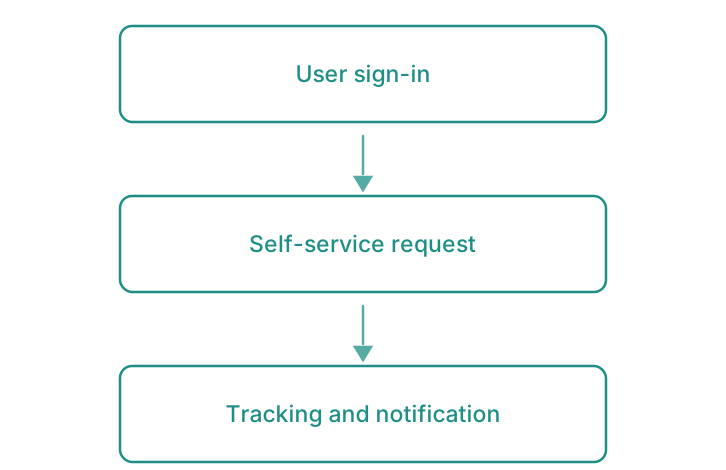
Identify the user, let them act on their own, keep them informed: VIP Member Portal and Concierge Applications work the same way.
- Customer & Loyalty PortalnnReturns Portal (RMA)Interface allowing the customer to declare a return and print their label.
- Loyalty EnginesDynamic calculation of rewards, points or status according to configurable rules.
- Single Sign-On AuthenticationSimple login (Google, Apple, OTP via email) avoiding forgotten passwords.
- Centralised HistoryVisualisation of all past purchases, whether web or physical.
- Carrier TrackingAggregation of delivery statuses in real-time from logistics systems.
- Customer Account & Loyalty ManagementnnSubscription ManagementTools enabling the deferral, suspension or modification of a recurring order.
Smooth and frictionless integration
We connect to your existing stack via API: your e-commerce platform, your e-commerce platform, your online shop, your Commerce Cloud CRM on the front end; your ERP, your accounting software, your management tool on the ERP side; your customer support tool or Freshdesk on the support side. Deployment is carried out by modules: often order tracking and returns first (immediate impact on support), then loyalty programmes at a later stage.
No big bang migration. Your IT team retains control over hosting and data. We work in short sprints with a business contact and a technical contact on the client side.
Customer Journey Mapping Post-Purchase
Analysis of current flows: orders, returns, support tickets, loyalty data. Identification of friction points and quick wins.
Architecture and connections
Design of the unified client portal, API mapping with your existing stack, definition of loyalty rules with marketing.
Modular deployment
Progressive roll-out to production: authentication, then tracking and feedback, then loyalty. User testing at each stage.
Transfer and optimisation
Training of teams in rule administration, implementation of dashboards, adjustments based on the first months of usage.
Measurable results for your organisation
- 35 to 50% reduction in support tickets related to order tracking and returns
- Repurchase rates increased by 15 to 20% within 12 months following the deployment of the loyalty programme
- Average return processing time halved through RMA automation
- Loyalty programme engagement rate exceeding 60% of active customers
- Marketing team autonomy over loyalty rules: modifications in hours, no longer in weeks
- Post-purchase NPS improvement of 8 to 12 points
Clarifying your decision-making
We already have a loyalty programme via our e-commerce platform. Why change?
A loyalty programme that works, and that your teams can evolve without depending on development, does not need replacing. Clarendis steps in when the rules are fixed, when the programme does not communicate with the CRM, or when you want to unify online and in-store channels. Connecting to the existing system is often preferable to replacing it.
How long before seeing concrete results?
The tracking and returns module is operational within 6 to 8 weeks in our deployments, with immediate effects on ticket volume. Loyalty requires 3 to 4 months of deployment, then two to three purchase cycles to measure the impact on repeat purchases: allow 6 to 9 months for robust figures.