
Management Systems (PMS)
A 50-room hotel generates 150 to 200 movements per day during peak season: arrivals, departures, extensions, room changes, special requests. Your receptionist juggles between the ringing telephone, the guest waiting for their bill, and the housekeeper asking which rooms have been vacated. Meanwhile, the channel manager sends through a reservation from an OTA, another arrives by email, and you must manually verify that you haven’t oversold.
In the evening, it’s reconciliation time: cross-referencing actual arrivals with reservations, noting no-shows, preparing invoicing. Every error—a room allocated twice, an extra night charged—costs you in refunds, negative reviews, and time lost apologising. And when the night team changes, or a seasonal worker arrives in July, everything needs explaining again.
The problem isn’t your team’s competence. It’s that they’re spending their energy coordinating information instead of welcoming guests.
This solution belongs to the Business Operations & ERP family.
Challenges holding back your performance
Many independent establishments still operate with paper planning, a shared Excel visualisation tool, or an old software programme installed on a single PC at reception. It works, until the day it doesn’t: the Excel file is opened by two people simultaneously, a reservation disappears. The software crashes on a Saturday evening, no support until Monday.The new receptionist takes three weeks to understand the in-house system. The OTAs don’t synchronise, so one blocks rooms ’just in case’. Invoicing requires re-entering information already input elsewhere. These tools weren’t designed for the pace of a hotel: they create additional work instead of absorbing it.
Our Technical Approach
A PMS is primarily a single source of truth: all reservations, all room statuses, all invoices in the same place, accessible to reception as well as to housekeeping on their mobile. The visual planning system shows in real-time what is occupied, what is departing, what is ready. When a guest arrives, their file is there: dates, negotiated rate, special requests.
Upon departure, the bill is generated in three clicks, with the entire stay consolidated: accommodation, breakfast, minibar. Housekeeping can instantly see the day’s departures and mark rooms as ready from their application. No more walkie-talkies, no more paper lists lying about. What we install is a system that follows the natural flow of hotel operations rather than constraining it.
Not another tool to learn, but a tool that replaces five makeshift solutions with one clear process.
Visual reservations planning
Accommodation billing with a single click
Room housekeeping monitoring
Technical Architecture
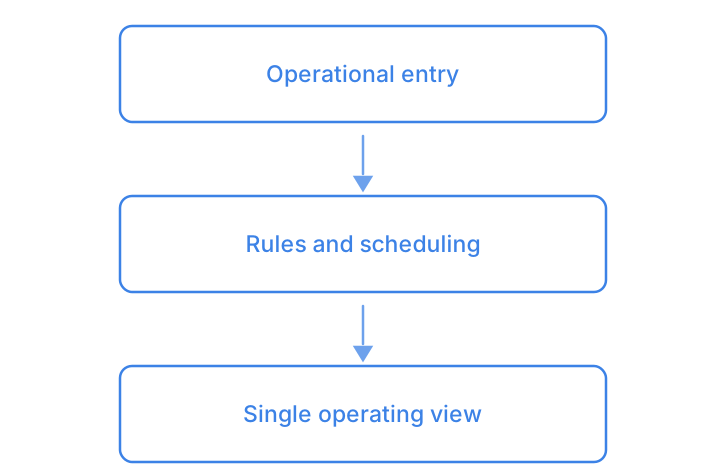
Enter once, let the rules schedule, read a single view: this foundation is shared across the family — you will find it in Order Management System (OMS) and in Workshop & After-Sales Management.
- Visual reservations planning
- Accommodation billing with a single click
- Room housekeeping monitoring
Smooth and frictionless integration
We are not asking you to change everything overnight. The PMS connects to your existing OTAs (one OTA, another OTA, your direct booking engine) to synchronise availability automatically. Your accounting software receives entries without re-keying. If you have connected locks or a till system, we check compatibility before we begin.
The migration of current bookings is carried out properly, without gaps in the schedule.
Audit of your current workflows
We spend half a day with your team to understand how you actually work — not how you should work.
Configuration and Data Import
Configuration of rooms, rates, OTA connections. Migration of your booking history and client records.
On-site training
A day with reception and the housekeeper. Practical case studies on your real situations: early arrival, billing dispute, room change.
Post-implementation support
Two weeks of enhanced support to adjust details, address enquiries, and ensure the system delivers on its promises.
Measurable results for your organisation
- Check-in time reduced from 4-5 minutes to less than 90 seconds
- Elimination of overbookings related to manual synchronisation errors
- End-of-stay billing in 3 clicks instead of 15 minutes of verification
- Autonomous housekeeper regarding room status — no more radio back-and-forth
- Training a new receptionist in half a day instead of a week
- Client history retained: preferences, previous stays, useful remarks
Clarifying your decision-making
How long before my team is operational?
Allow two to three days of actual transition. The first day covers joint configuration and training of key staff; on the following days the team works under live conditions with our support on hand. Most receptionists are working independently by the end of the first week.
What happens if the system crashes on a Saturday evening?
The PMS runs in the cloud with availability above 99.5%. If the local internet connection drops, an offline mode keeps critical operations running. Our support team answers at weekends too, precisely because that is when the need is greatest.