
Restaurant & Hotel POS
In a hotel-restaurant, the service operates on a just-in-time basis. The guest arrives at the bar, has a drink, moves to the table, orders a bottle, requests to charge everything to their room, then settles part by card and the remainder on an expense account. Meanwhile, the server juggles between three terminals that don’t communicate with each other, the receptionist awaits a call from the restaurant to know what to add to the bill, and in the kitchen they print illegible dockets.
This is the daily reality for F&B teams: constant back-and-forth between systems, manual re-entry with each room transfer, unexplained till discrepancies at the end of service. The PMS manages the rooms, the till manages the bills, but no one manages the connection.
The result: billing errors that irritate loyal customers, till closures that take 45 minutes, and servers who spend more time on the system than with the diners. When the establishment has several points of sale: restaurant, bar, room service, spa: the complexity explodes.
This solution belongs to the E-commerce & Booking family.
Challenges holding back your performance
Most hotels operate with a restaurant till that is disconnected from the PMS, linked by a daily export or, worse still, by a logbook. Room transfers are processed via a manually entered code, with the errors that this entails: incorrect room number, guest already departed, amount re-entered with the decimal point in the wrong place. Generic till solutions are unfamiliar with hotel-specific requirements: they do not recognise that a guest may have a half-board package, a negotiated corporate rate, or a debtor account to be invoiced at the month’s end.Generic integrators offer standard connectors that break down as soon as the PMS is updated. And when the WiFi fails during the Saturday evening rush, it’s back to pen and paper.
Our Technical Approach
The Clarendis approach stems from a simple principle: the restaurant till must be a native extension of the hotel system, not a satellite.
We deploy POS solutions that maintain permanent bidirectional connectivity with the PMS: real-time guest status enquiry, instantaneous room transfer with validation, synchronisation of rates and packages. Mobile ordering enables waiters to send orders directly to the kitchen and bar from the table, without re-keying.
Bill splitting handles complex scenarios: three diners, two different rooms, a cash payment for the third. Resilient mode stores transactions locally when the network fails, then automatically resynchronises. Till closure calculates variances, allocates by payment method and point of sale, generates accounting entries.
This is not a till with a connector: it is a system designed to keep service running smoothly even when everything becomes complicated.
Mobile Order Taking
Waiting staff input dishes directly at the table, sending orders to the kitchen instantaneously.
Room Charge (Room Transfer)
Real-time search of guest name and verification of room status.
Complex Bill Splitting
Pro-rata division, by seat or selection of specific lines without any fuss.
Resilient Mode (Offline)
Service continues even if the hotel Wi-Fi network experiences a failure.
Table Plan Management
Visual interface enabling table association, meal progress tracking and rotation optimisation.
Automated Till Closure
End-of-service reconciliation of direct payments (card/cash) and room charges.
Technical Architecture
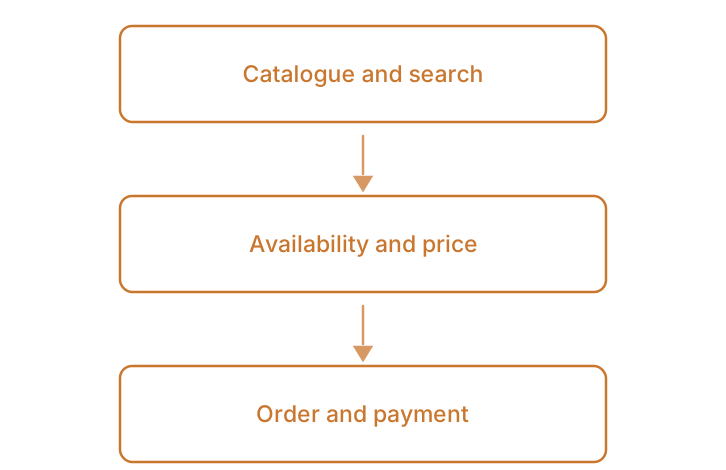
Search, check availability and price, order: these three steps also structure Direct Booking Engines and Marketplaces.
- Mobile Order TakingWaiting staff input dishes directly at the table, sending orders to the kitchen instantaneously.
- Room Charge (Room Transfer)Real-time search of guest name and verification of room status.
- Complex Bill SplittingPro-rata division, by seat or selection of specific lines without any fuss.
- Resilient Mode (Offline)Service continues even if the hotel Wi-Fi network experiences a failure.
- Table Plan ManagementVisual interface enabling table association, meal progress tracking and rotation optimisation.
- Automated Till ClosureEnd-of-service reconciliation of direct payments (card/cash) and room charges.
Smooth and frictionless integration
We work with your existing PMS: Opera, Mews, Misterbooking, or others. The integration is carried out point of sale by point of sale, generally starting with the main restaurant. Your teams continue to work during the deployment. Sales history and product database are migrated, floor plans recreated identically.
No equipment changes if your current terminals are compatible. On-site training under real service conditions.
Review of existing workflows
Analysis of your points of sale, your PMS, current billing processes and issues raised by the teams.
Configuration and PMS Integration
Configuration of the till, creation of connectors, import of items and tariffs, reproduction of floor plans.
Progressive rollout
Installation point of sale by point of sale, training of teams in real conditions, validation of room transfers.
Stabilisation and optimisation
Monitoring of initial closures, parameter adjustments, additional training if required, transition to standard support.
Measurable results for your organisation
- Room transfer time reduced from 2 minutes to 3 seconds per transaction
- Till variances reduced by 75% on average after 3 months
- Till closure reduced from 45 minutes to 10 minutes per point of sale
- Zero transaction loss observed during network outages thanks to resilient mode
- 60% reduction in customer complaints related to billing errors
- ROI observed between 8 and 14 months depending on establishment size
Clarifying your decision-making
Our PMS is dated and our provider no longer maintains the connectors. Is it still feasible?
A dated PMS can still be connected: Clarendis builds bespoke connectors where standard interfaces are absent, sometimes reading the database directly. Technical feasibility is audited before any commitment.
What happens if the system crashes during Saturday night service?
A resilient mode takes over automatically: terminals keep working locally, orders reach the kitchen, bills print. Everything resynchronises when the connection returns, without your customers or your staff noticing.