
Order Management System (OMS)
A customer places an order online. Your central warehouse is 400 kilometres away, but the product sits on a shelf in your shop just 3 kilometres from their home.
Yet it’s the warehouse that ships it.
Result: 48 hours’ delay, €8 shipping cost, an absurd carbon footprint. Your teams know this. Your store managers grumble: they have the stock, they could prepare the order in 20 minutes.
But your IT system cannot arbitrate. The ERP sees warehouse stock. The POS sees shop stock. No one speaks to anyone else.
So we apply a foolish rule: everything ships from the centre. Meanwhile, your shops underperform, your logistics margin erodes, and your customers receive ’your parcel is in transit’ texts for three days. Worse still: you sometimes have stock-outs at the warehouse whilst 15 shops have the product on their shelves. The order is cancelled.
The customer goes to a competitor. Your stock lies dormant, your turnover evaporates.
This solution belongs to the Business Operations & ERP family.

Challenges holding back your performance
Most retailers manage this with fixed rules in the ERP or Excel configuration files. Store X can dispatch, store Y cannot. Full stop. No contextual intelligence: neither customer distance, nor current store workload, nor actual stock levels, nor comparative costs are considered.Artisanal Ship-from-Store attempts create other problems: stores overwhelmed with web orders on a Saturday afternoon, sales staff preparing parcels instead of advising customers, stock becoming desynchronised between the e-commerce site and the till. As for traditional WMS, they orchestrate the warehouse: not the network. They were not designed to arbitrate between 80 stock points in real-time.
Our Technical Approach
The orchestration we implement functions as an intelligent dispatcher between your order capture and fulfilment points. For each order, the engine evaluates in real-time: which stock point can serve this customer, within what timeframe, at what cost, with what reliability? The criteria are configurable according to your priorities: speed, margin, carbon footprint, team capacity.
A store understaffed on a Tuesday morning? It is temporarily de-prioritised. A warehouse saturated before Christmas? The flow switches to eligible stores.
The system learns from your data: successful preparation rates by point of sale, average observed lead times, cancellations. It refines itself. On the returns side, same logic: the customer returns to store a product ordered online, the stock is immediately reinjected into available-to-sell inventory: web and physical. No more product blocked for 10 days awaiting warehouse repatriation.
Fulfilment from stores (Ship-from-Store)
Real-time stock updates
Unified returns management
Technical Architecture
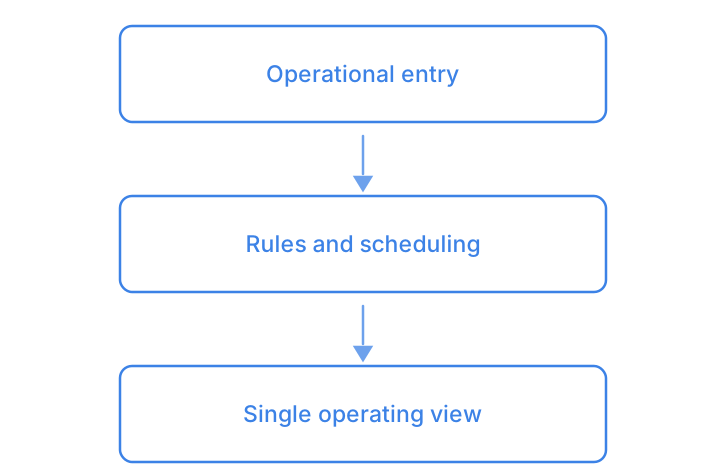
Enter once, let the rules schedule, read a single view: this foundation is shared across the family — you will find it in Management Systems (PMS) and in Workshop & After-Sales Management.
- Fulfilment from stores (Ship-from-Store)
- Real-time stock updates
- Unified returns management
Smooth and frictionless integration
The orchestration engine integrates with your existing workflows: it consumes stock from your ERP and POS systems, receives orders from your e-commerce platform, and returns dispatch instructions to your fulfilment tools. No system replacement required. We add a decision layer between what already exists. Deployment is carried out store by store: we begin with 5 pilot retail locations, adjust the rules, then expand.
Your IT teams retain control over business configurations.
Mapping of Flows and Inventory
Audit of your stock sources (ERP, WMS, POS), their update frequency, and current business rules. Identification of 10-15 pilot stores according to their profile and logistical maturity.
Order Management System ConfigurationnnConfiguration of the orchestration engine
Configuration of routing rules according to your priorities: distance, cost, lead time, load. Definition of thresholds per store and exceptions (excluded products, special periods).
Driver on restricted scope
Launch on pilot stores with daily monitoring: coverage rates, actual lead times, incidents. Continuous parameter adjustment over 6 to 8 weeks.
Deployment and Extension
Progressive rollout to the remainder of the network. Training of store teams. Implementation of management dashboards for day-to-day operations.
Measurable results for your organisation
- Reduction in average delivery time from 2.1 days to 0.8 days in areas covered by stores
- 25% to 35% reduction in transport costs on orders redirected to Ship-from-Store
- Increase in online displayed availability rate of 6 to 12 percentage points through stock aggregation
- Reduced cancellations due to stock-outs by 40% by leveraging store inventory
- Return resale time reduced from 8 days to 24 hours
- Web preparation workload distributed across the network — peaks absorbed without warehouse reinforcement
Clarifying your decision-making
Our stores weren’t designed to handle web order fulfilment — how do we manage this in practice?
Thresholds are defined with you: maximum orders per day per store, preparation time slots, eligible product categories. A city-centre store with two staff is not called upon like a flagship with a 200 m² stockroom. The orchestrator adapts to your operational reality.
How does one avoid selling online a product which has just been purchased in store?
The orchestrator works on promised stock, with configurable safety margins. If your till takes five minutes to report a sale, a reserve is held back. Where a conflict arises, the order is reallocated to another stock point without the customer or your teams having to intervene.