
A centralised product repository for omnichannel consistency
An average retailer manages between 5,000 and 50,000 active product lines. Each product sheet contains 40 to 150 attributes depending on the categories. Multiply this by the number of languages, channels (e-commerce site, marketplaces, print catalogues, in-store terminals, mobile applications) and countries. You have several million pieces of data to maintain.
In day-to-day reality, it’s the product manager waiting three days for photographs from the studio. It’s the e-commerce team discovering incomplete product sheets in production. It’s the category manager spending his Mondays correcting pricing errors on Amazon because the export crashed on Friday evening. Retail teams spend up to 40% of their time on data re-entry and manual verification tasks.
Product data errors generate customer returns, marketplace disputes, and catalogue delisting. Meanwhile, your competitors are enriching their product sheets and improving their visibility.
This solution belongs to the Data, Master Records & Reporting family.

Challenges holding back your performance
Most retailers operate with an assembly of shared Excel files, an ERP that was never designed to manage editorial content, and manual exports to each channel. Teams have developed their own macros, their own naming conventions. Nobody has exactly the same version of the catalogue. When a supplier sends an update, it takes a fortnight to reach all channels.PIM tools exist on the market, but many implementations fail: data models that are too rigid and don’t fit your categories, imposed workflows that don’t correspond to your organisation, connectors that are promised but never truly functional with your technical stack. In the end, teams circumvent the tool and return to Excel.
Our Technical Approach
Our approach stems from an observation: each retailer has its own business logic, its own product categories with their specific requirements. An effective PIM must adapt to this reality, not the other way round.
We first build your bespoke data model, with the flexibility required to manage both your simple products and your complex configurations (variants, bundles, customisable products). Media management is natively integrated: your assets are linked to products, versioned, automatically resized according to each channel’s constraints.
The syndication engine generates feeds for your marketplaces, your e-commerce, your print tools, in the exact formats expected. Validation workflows reflect your actual organisation: who enriches, who validates, who publishes, with which timescales and which alerts. For international operations, translation management integrates directly into the product sheet production workflow.
Flexible Modelling
Data structures adaptable to sizes, colours, and technical specifications.
Media Management (DAM)
Automatic linking of high-definition photographs and videos to product references.
Syndication Engine
Formatted export automatically for your different channels (Amazon, Zalando, Shopify).
Validation Workflows
Draft, review and validation process prior to any online publication.
Translation Management
Dedicated interface for bulk localising product sheets into multiple languages.
Real-Time Connection
Provision of product data sheets in an ultra-rapid manner for your websites.
Technical Architecture
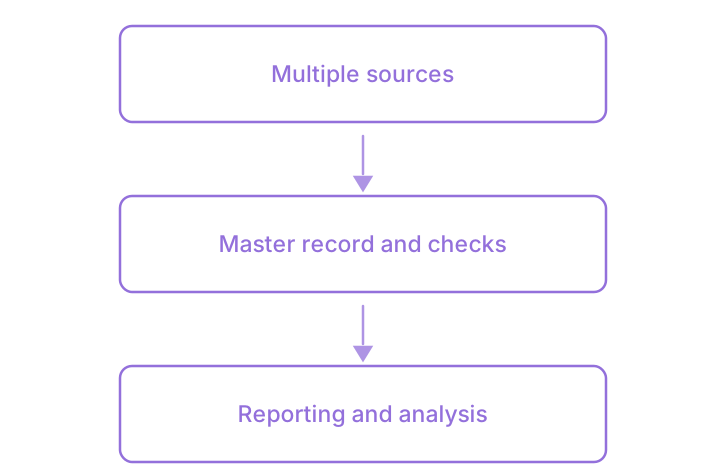
Several sources, one master record to arbitrate between them, then analysis: Core HR & Unified Repository and Observatories & Open Data stem from this same chain.
- Flexible ModellingData structures adaptable to sizes, colours, and technical specifications.
- Media Management (DAM)Automatic linking of high-definition photographs and videos to product references.
- Syndication EngineFormatted export automatically for your different channels (Amazon, Zalando, Shopify).
- Validation WorkflowsDraft, review and validation process prior to any online publication.
- Translation ManagementDedicated interface for bulk localising product sheets into multiple languages.
- Real-Time ConnectionProvision of product data sheets in an ultra-rapid manner for your websites.
Smooth and frictionless integration
Your ERP remains your reference system for pricing and stock levels. Your existing DAM can be retained or migrated progressively. We connect the PIM to your ecosystem via real-time APIs or scheduled imports according to your constraints. Teams continue working with their familiar tools during the transition.
We migrate category by category, starting with those that pose the most problems. No catalogue freeze period, no risky big bang approach.
Catalogue and Data Flow Audit
Mapping of your data sources, analysis of current quality, identification of friction points in your enrichment and publication processes.
Modelling and configuration
Construction of the data model tailored to your categories, configuration of workflows according to your organisation, setup of connectors with your ecosystem.
Pilot migration
Resumption of one or two representative categories, training of key users, validation of syndication flows under real conditions.
Deployment and transfer
Progressive rollout to other categories, team upskilling, procedure documentation, transition to RUN mode with support.
Measurable results for your organisation
- 60 to 75% reduction in time to market for new product references
- Product sheet error rate reduced fivefold within 6 months
- Teams freed from 8 to 12 hours per week of manual re-entry
- Product data sheet completion rate increasing from 65% to 95%
- 30% reduction in customer returns related to incorrect product information
- Syndication lead time to marketplaces reduced from 48 hours to under 2 hours
Clarifying your decision-making
We have 15 years of product history in our ERP system, how does the data migration process work?
Data migration into a PIM does not happen in one pass. We prioritise together: active products first, then the historical data relevant to customer service or spare parts. Data is cleansed and standardised during migration, and your ERP remains accessible for pure historical records.
How long before teams become autonomous on the tool?
Key PIM users become autonomous within 4 to 6 weeks in our deployments. Clarendis first trains a core group of two to three internal champions. The interface is designed so that routine operations are intuitive; in-depth training concerns administration and complex scenarios.