
Core HR & Unified Repository
In a multi-company group, each entity has historically built its own HR system. Head office uses an ageing HRIS, the Swiss subsidiary operates on a different vendor, the warehouse manages its temporary staff in a shared file.
Result: no one can say in real time how many employees are active, under what contract, with which access rights. When a manager arrives on Monday, their badge does not work: their account has not been created in the AD. When an employee leaves the company, their application access remains open for three weeks. HR spends their days re-entering the same information into five different systems, correcting discrepancies between payroll and the HRIS, responding to requests for organisation charts that no one knows how to generate automatically.
ISO or SOC 2 audits become panic exercises: reconstructing who had access to what, and when, takes weeks. The Finance Director requests a consolidated headcount, they receive three different figures depending on the source. This fragmentation is not a technical problem: it is an operational, regulatory and human risk.
This solution belongs to the Data, Master Records & Reporting family.

Challenges holding back your performance
Excel remains the default reconciliation tool: a master file that someone maintains by hand, never truly up to date, never truly reliable. Native connectors between HRIS and Active Directory exist, but they do not handle special cases: multi-contracts, internal mobility, secondments, external populations. Traditional MDM projects take 18 months and cost six times the initial budget, to deliver a repository that no one properly maintains.Generalist service providers offer point-to-point integrations that create new technical debt. Meanwhile, each system continues to diverge. HR departments compensate with manual procedures, email requests, parallel tracking spreadsheets. The problem is not the absence of tools: it is the absence of a single source of truth recognised by all systems.
Our Technical Approach
The Core HR system we are building is not yet another HRIS. It is an authoritative identity repository: a canonical database where each employee exists only once, with their complete history: contracts, reporting lines, authorisations, key dates. This repository positions itself at the centre of the ecosystem, not above it. It collects HR events from your existing sources: joiners, leavers, transfers, scope changes: and normalises them.
It then propagates these changes to consuming systems: Active Directory, SSO, physical access control, payroll, business tools. Synchronisation is bidirectional when necessary, with explicit priority rules to manage conflicts. Every modification is tracked: who changed what, when, from which system. The organisational chart is no longer a static PowerPoint; it generates on demand from actual data.
GDPR anonymisation applies automatically according to defined retention periods. The multi-company model is native: not a late addition that creates exceptions everywhere.
Multi-Company Modelling
Management of complex subsidiaries, collective agreements and cross-functional hierarchies.
Bidirectional Synchronisation
Permanent data exchange with payroll software (Silae, ADP, Payfit).
Automatic Access Creation
Automatic creation and suspension of e-mail accounts or shared workspaces.
Strict Audit Trail
Logging of each modification (who changed the salary, when?).
Dynamic Organisational Charts
Automatic generation of the company’s hierarchical tree, always up to date.
GDPR Anonymisation
Scripts purging personal data beyond statutory retention periods.
Technical Architecture
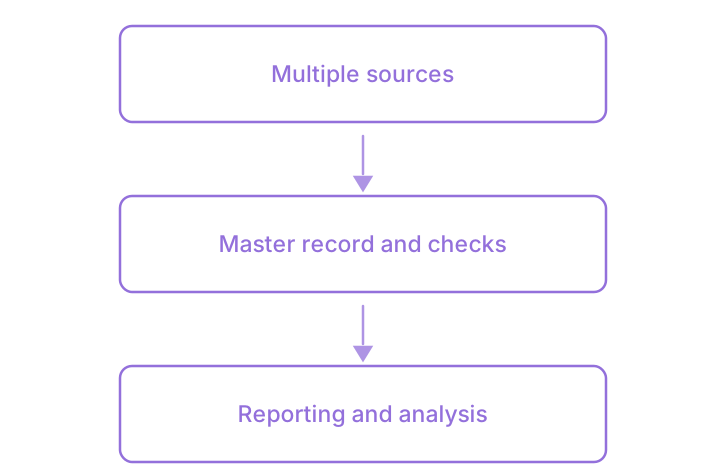
Several sources, one master record to arbitrate between them, then analysis: Observatories & Open Data and Batch Traceability & Genealogy stem from this same chain.
- Multi-Company ModellingManagement of complex subsidiaries, collective agreements and cross-functional hierarchies.
- Bidirectional SynchronisationPermanent data exchange with payroll software (Silae, ADP, Payfit).
- Automatic Access CreationAutomatic creation and suspension of e-mail accounts or shared workspaces.
- Strict Audit TrailLogging of each modification (who changed the salary, when?).
- Dynamic Organisational ChartsAutomatic generation of the company’s hierarchical tree, always up to date.
- GDPR AnonymisationScripts purging personal data beyond statutory retention periods.
Smooth and frictionless integration
You are not being asked to replace your existing systems. The repository connects to your existing HRIS, your AD, your payroll tool. We begin by mapping the actual flows: not those documented, but those that truly exist. The initial connectors are deployed in read-only mode to validate data quality before activating synchronisation.
Each system retains its role: the Core HR orchestrates, it does not replace. The application estate remains in place, it simply becomes coherent.
Identity Flow Mapping
Inventory of source and target systems, identification of data gaps, documentation of current implicit business rules.
Modelling of the repository
Definition of the canonical data model, priority rules between sources, validation workflows by population.
Progressive deployment of connectors
Connection in read mode, followed by system-by-system synchronisation activation, with dual-run period for validation.
Transfer and autonomy
Training of HR and IT teams, operational documentation, transition to run with stabilisation support.
Measurable results for your organisation
- 85% reduction in manual account creation — automatic provisioning within 4 hours following HR validation
- Zero orphaned access detected during audits — synchronised deactivation on effective departure date
- Consolidated group headcount available in real time, variance of less than 0.5% with payroll
- SOC 2 audit preparation time reduced by 75% — complete traceability without manual reconstruction
- 6-hour weekly time saving for the HR team on re-entry and inter-system corrections
- Organisational charts generated on demand, always synchronised with contractual reality
Clarifying your decision-making
How do you manage populations outside the HRIS — temporary staff, contractors, trainees?
The repository distinguishes population types with matching provisioning workflows. Temporary workers can be loaded from an agency file or a dedicated interface, with an automatic end date. Each population has its own provisioning and deactivation rules.
Our HR data are sensitive. Where are they hosted and who has access to them?
Your HR data are hosted in France or Switzerland according to your constraints, on infrastructure you control or on a sovereign cloud. Access is segmented by legal perimeter: a subsidiary administrator cannot see head office data. Every consultation is logged.