
Batch Traceability & Genealogy
A contaminated batch of minced beef. Forty-eight hours to identify the concerned points of sale, the restaurants supplied, the incriminated raw materials. Your quality director is on the telephone with the DGCCRF, your sales representative is receiving calls from major retailers, and your production team is searching through filing cabinets to reconstruct the journey of a batch manufactured three weeks ago.
In the agri-food sector, each actor in the chain: abattoir, processor, packager, logistics provider: adds a layer of information. Supplier batch numbers, receipt dates, storage times, production lines utilised, shipments by customer. European regulations (notably Regulation 178/2002) require the ability to trace up and down this chain within a matter of hours.
Not within a matter of days. IFS and BRC audits verify this capability. Distribution chains require it contractually. And when an incident occurs, the issue is no longer compliance: it is the economic survival of the company and consumer health.
This solution belongs to the Data, Master Records & Reporting family.
Challenges holding back your performance
Traceability exists on most sites.However, it is fragmented. One Excel file for goods inward, another for production orders, a third maintained by dispatch. The ERP contains some of the data, but not the links between incoming and outgoing batches. When the complete history of a batch needs to be reconstructed, someone spends hours manually cross-referencing these sources.Withdrawal-recall exercises systematically reveal gaps: an intermediate batch not traced, a shared production line not documented, residual raw material reincorporated without recording. These approximations go unnoticed during normal operations. They become critical in crisis situations, when each hour of delay expands the scope of the recall and the associated cost.
Our Technical Approach
Our approach is founded upon a straightforward principle: every material movement must automatically create a lineage link between batches. Upon receipt, the system records supplier batches. During production, it captures which incoming batches comprise each outgoing batch: including reincorporations of off-cuts or downgraded products. Upon dispatch, it associates batches with recipients.
This complete genealogy enables two types of instantaneous queries: ascending (from where does this finished product originate?) and descending (where has this raw material batch gone?). The material balance engine continuously verifies the consistency of quantities: what enters must correspond to what exits, within documented losses. Discrepancies signal either a data entry error or a process issue.
In the event of an alert, the system identifies the exact affected scope within minutes and can automatically quarantine suspect batches prior to dispatch.
Upward Traceability
From a defective finished product, trace back instantaneously to the batches of raw ingredients (origins).
Traceability & Lot GenealogynnDownstream Traceability
From an alerted raw ingredient, identify all impacted finished products and their end customers.
Simplified Workshop Entry
Ruggedised terminals enabling the scanning of ingredient identifiers during recipe preparation.
IT Block
Physical and software prohibition of using a batch whose bacteriological analysis is pending.
Material Balance
Comparison between quantities entered and quantities dispatched to detect any data entry errors.
Crisis Exercise Engine
Tool enabling recall simulations to be conducted in under 2 hours, as required by auditors.
Technical Architecture
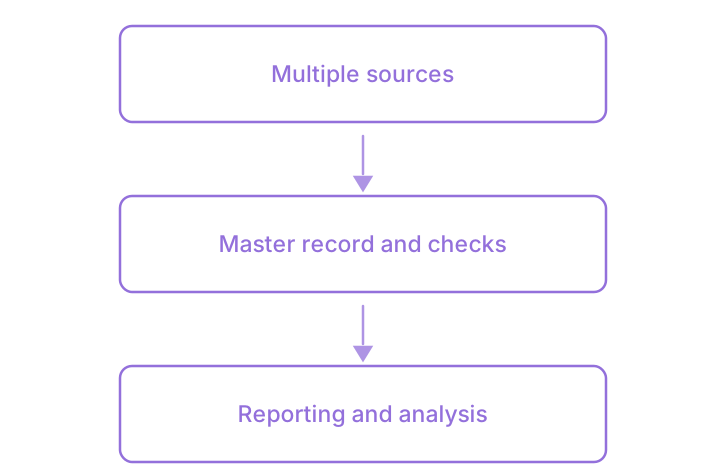
Several sources, one master record to arbitrate between them, then analysis: Core HR & Unified Repository and Observatories & Open Data stem from this same chain.
- Upward TraceabilityFrom a defective finished product, trace back instantaneously to the batches of raw ingredients (origins).
- Traceability & Lot GenealogynnDownstream TraceabilityFrom an alerted raw ingredient, identify all impacted finished products and their end customers.
- Simplified Workshop EntryRuggedised terminals enabling the scanning of ingredient identifiers during recipe preparation.
- IT BlockPhysical and software prohibition of using a batch whose bacteriological analysis is pending.
- Material BalanceComparison between quantities entered and quantities dispatched to detect any data entry errors.
- Crisis Exercise EngineTool enabling recall simulations to be conducted in under 2 hours, as required by auditors.
Smooth and frictionless integration
We work with your existing ERP, whether it be your ERP, your X3 accounting software, or a business system specific to the food and agriculture industry.
The objective is not to replace your production management tools, but to create a traceability layer which consolidates data already entered and completes the missing links. The workshop input interfaces are designed for operators, not for IT specialists. Deployment is carried out line by line if necessary, without production stoppage.
Mapping of material flows
Analysis of your actual processes for receipt, transformation and dispatch. Identification of current traceability break points and data already available in your systems.
Modelling of genealogy
Design of data model adapted to your products: management of blends, co-products, and reincorporations. Definition of material balance rules acceptable per line.
Pilot line deployment
Installation on a representative production line. Training of operators under actual conditions. Adjustments to input interfaces based on field feedback.
Generalisation and crisis exercise
Extension to other lines and sites. Simulation of a complete withdrawal-recall to validate the system’s responsiveness and train quality teams in its use under real conditions.
Measurable results for your organisation
- Response times to withdrawal-recall exercises reduced from several days to less than 2 hours
- Product recall scope reduced by 30 to 50% through precise identification of affected batches
- IFS/BRC compliance on traceability criteria validated from the first audit
- Detection of material balance deviations exceeding 0.5% in real time
- Elimination of duplicate entries between production and quality
- Automatic blocking of non-conforming batches before despatch — zero accidental shipment
Clarifying your decision-making
We already have traceability in our ERP. Why add an additional layer?
Your ERP most likely tracks stock movements. Does it automatically link the batch of meat received on 12 March with the 47 batches of ready meals made from it across three days of production? That complete genealogy is what is usually missing, and it is what Clarendis structures, drawing on the data already held in your system.
Our workshop operators are not comfortable with IT systems. How can we ensure field adoption?
Input interfaces are designed with your teams, not in an office: barcode scanning, ruggedised touchscreens, entry in three clicks at most. Training happens on the line, during production. A tool that slows the work down does not get used, hence testing under real conditions before deployment.