
Production Scheduling
In the food and beverage industry, scheduling is not a conventional planning problem. It is a perpetual game of Tetris where each piece has an expiry date. Your production managers juggle raw materials that deteriorate whilst waiting, production lines that must be cleaned between each allergen, and major retail customers who reject products if the remaining shelf life falls short of their requirements: often 2/3 of the total shelf life.
Add to this staffing constraints (teams working double or triple shifts), unpredictable equipment breakdowns, orders modified at D-1, and IFS/BRC audits that demand flawless traceability. Your teams spend their Monday mornings redoing the weekly schedule, their afternoons correcting it, and their nights hoping that a batch will not be rejected upon receipt at the customer’s premises because it was produced a day too late.
The cost of these errors is measured in tonnes of downgraded products, logistics penalties, and enforced overtime hours.
This solution belongs to the Business Operations & ERP family.
Challenges holding back your performance
Excel remains the predominant tool in 80% of food production facilities. The planning file weighs 15MB, contains macros that only Jean-Pierre understands, and crashes when one exceeds 200 order lines. Market ERPs offer scheduling modules, but they ignore the reality of cleaning between allergens: transitioning from a milk-based product to a lactose-free product is not merely a line in your visualisation tool, it is 45 minutes of washing and a validation protocol.As for specialised APS systems, their licence costs and implementation timeframes (12-18 months) restrict them to groups producing 100,000 tonnes per annum. Intermediate sites with turnover of €5-50M remain trapped between overly simplistic tools and inaccessible solutions.
Our Technical Approach
Our approach stems from an observation: your production manager knows their trade better than any algorithm. What they lack is a tool that calculates the consequences of their choices in real time.
We build a sequencing engine that integrates your actual constraints: cleaning matrices between products (time, resources, validations), grouping rules by allergen family, automatic calculation of latest manufacturing dates based on target use-by dates per customer. The Gantt interface enables immediate visualisation of conflicts: a drag-and-drop operation shows the impact on the remainder of the week.
The system alerts when a raw material approaches its best-before date and proposes to integrate it as a priority. Replanning takes minutes, not hours. And the link with your existing MRP enables anticipation of supply shortages before they block a production line. This is not spectacular artificial intelligence, it is robust algorithmic processing in service of human decisions.
Cleaning Matrices
Rules prohibiting certain sequences to avoid cross-contamination of allergens.
Dynamic Sequencing
Calculation of the exact launch order of Production Orders to minimise idle time (Setup time).
Management of Use-by/Best-before Dates
Prioritisation of the utilisation of the oldest raw material batches (FEFO).
Production SchedulingnnGantt Visualisation
Interactive graphical interface enabling the planner to drag and drop operations.
Real-Time Rescheduling
Instant adjustment if a machine breaks down or if a commercial emergency arises.
Production Purchasing Assistance (MRP)
Automatic deduction of raw ingredient requirements for the forthcoming week.
Technical Architecture
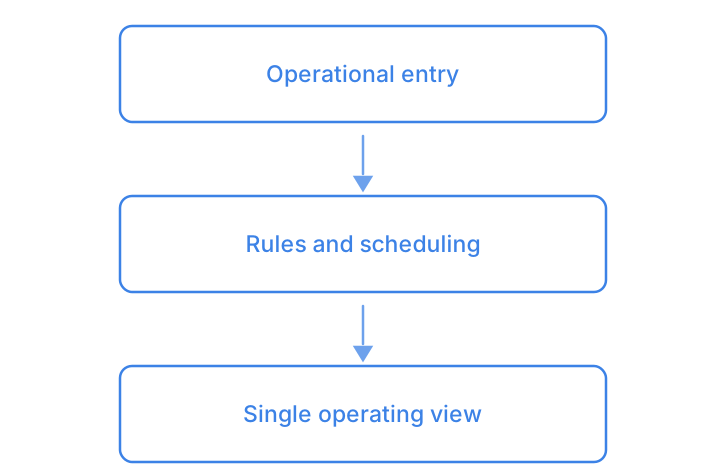
Enter once, let the rules schedule, read a single view: this foundation is shared across the family — you will find it in Management Systems (PMS) and in Order Management System (OMS).
- Cleaning MatricesRules prohibiting certain sequences to avoid cross-contamination of allergens.
- Dynamic SequencingCalculation of the exact launch order of Production Orders to minimise idle time (Setup time).
- Management of Use-by/Best-before DatesPrioritisation of the utilisation of the oldest raw material batches (FEFO).
- Production SchedulingnnGantt VisualisationInteractive graphical interface enabling the planner to drag and drop operations.
- Real-Time ReschedulingInstant adjustment if a machine breaks down or if a commercial emergency arises.
- Production Purchasing Assistance (MRP)Automatic deduction of raw ingredient requirements for the forthcoming week.
Smooth and frictionless integration
The tool connects to your existing ERP (your accounting software, your ERP, your business software, or other) to retrieve orders and stock levels. No re-entry, no duplicate maintenance. Deployment begins on one line or product family: we prove value before expanding. Your current Excel schedules serve as the foundation for configuring the initial constraint matrices.
Teams continue to work with their familiar reference points during the transition. Within 6 to 10 weeks, the new tool becomes the planning repository, without having paralysed production.
Constraint mapping
Analysis of your allergen matrices, actual cleaning times, best-before date rules by customer, and identification of current bottlenecks. Two days on-site with your production and quality teams.
Mockup on live data
Construction of a functional prototype using your orders from the past 3 months. Validation that the engine reproduces — and subsequently improves upon — your historical sequences.
Pilot deployment
Implementation in production on a limited scope (one line, one family). Planners use the tool in parallel with the existing system for 3-4 weeks.
Generalisation and autonomy
Extension to other lines, team training for parameter maintenance, documentation of procedures. You are autonomous, we remain available.
Measurable results for your organisation
- Reduction of 25 to 40% of time spent on planning and replanning each week
- 15% to 30% reduction in losses related to best before date overruns on raw materials
- Division by 2 of customer disputes regarding insufficient residual best before date
- Optimisation of cleaning sequences: 10 to 20% of machine time recovered
- Visibility of 2-3 weeks on critical procurement requirements
- Complete traceability of planning decisions for quality audits
Clarifying your decision-making
Our cleaning constraints are very specific to our process — how can we be sure that the tool will take them into account?
Cleaning matrices are fully configurable by your teams. Clarendis starts from your existing protocols, models them with you, and you retain control to evolve them. No constraint is hard-coded.
Our ERP system is 12 years old and our CIO refuses any project that affects it — is this a problem?
A legacy, protected ERP is not a problem: the scheduler operates in read-only mode, through automated exports or database views. No modification to your existing system, so the IT risk is virtually nil, which is often what unlocks the decision.