
Promotional Rule Engines
In retail, promotions account for between 20 and 40% of turnover.
However, their management has become a daily headache. E-commerce has its own rules, coded into the platform. Shops run on till software that applies different conditions. Marketing launches a ’20% off the second item’ offer without knowing whether the till will be able to calculate it.
Result: the web customer pays €47, the in-store customer pays €52 for the same basket. Teams spend hours checking discrepancies, complaints pile up, and nobody really knows what margin remains on a commercial operation. The marketing teams want to move quickly, IT puts the brakes on because each promotion requires specific development, and management control discovers the damage after the fact.
Not to mention the cumulation rules: can one apply a loyalty coupon to a flash offer? The answer changes depending on the channel, sometimes depending on the salesperson.
This solution belongs to the Billing, Quoting & Configurators family.

Challenges holding back your performance
Excel remains the promotional planning tool in many retailers. The rules are then manually re-entered into each system: e-commerce platform, till software, sometimes a third tool for kiosks or click & collect. Each re-entry introduces errors. E-commerce tools such as your e-commerce platform or your e-commerce platform have their promotional modules, but they do not communicate with the tills.ERPs offer pricing functions, but these are too rigid for complex marketing mechanisms. Generalist integrators develop bespoke connectors, which break with each update. Ultimately, IT becomes the bottleneck for each campaign, and marketing loses responsiveness against the competition.
Our Technical Approach
Our approach: a single rules engine that becomes the source of truth for all promotions, regardless of sales channel. This engine centralises the definition of offers: percentage, fixed amount, bundle, trigger threshold, eligibility conditions: in business language comprehensible to commercial teams. Stacking and exclusion rules are explicit, not buried in code.
The engine then exposes these rules via API to different systems: the web platform queries the engine at basket stage, the till does likewise at each scan. The calculation is performed in the same place, with the same logic. Marketing teams gain autonomy: they configure their offers in a dedicated interface, without IT tickets for each campaign.
Management control has a consolidated view of active promotions and their actual impact on margins.
Centralised coupon management
Reliable application of combination rules
Web and store synchronisation
Technical Architecture
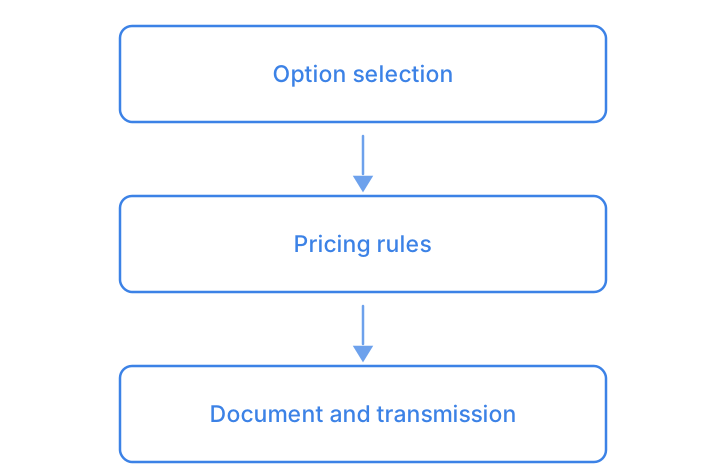
Select options, apply pricing rules, produce the document: Complex Commission Management and Monetisation & Subscriptions rest on this sequence.
- Centralised coupon management
- Reliable application of combination rules
- Web and store synchronisation
Smooth and frictionless integration
The engine interfaces with your existing systems without replacing them. Your e-commerce platform retains its purchasing funnel, it simply calls upon the engine for promotional calculations. Your till software maintains its user interface, it queries the same engine. We typically begin with a pilot channel: often the web: then extend to stores progressively.
Product and customer repositories remain in your current systems, the engine connects to them in read-only mode.
Mapping of existing mechanics
We identify all active promotions, their cumulation rules, and the systems that currently apply them. We identify discrepancies and contentious cases.
Business Rules Modelling
We translate your promotional mechanics into rules that can be processed by the engine, working alongside your marketing and management control teams. Each exclusion or accumulation scenario is explicitly defined.
Deployment on a pilot channel
The engine is connected to your website or to a group of test shops. One validates the calculation on real baskets before rolling out.
Extension and transfer of skills
Gradual rollout to other channels. Your teams are trained on offer configuration and performance monitoring.
Measurable results for your organisation
- Web/store price differential brought to zero on promotions managed by the engine
- Time to deploy a new promotion reduced from 5 days to 4 hours on average
- Customer claims relating to price variance discrepancies decreased by 60 to 80%
- Autonomous marketing team on 90% of promotional mechanics without IT intervention
- Real-time visibility of promotional costs by channel and by operation
- Cumulation rules applied uniformly, end of till-based discretionary decisions
Clarifying your decision-making
Our till software is 15 years old, can it genuinely call an external API?
Legacy till software can still be connected: for the oldest tills, local middleware acts as a bridge. The engine can also push rules in a format the till can read. The approach adapts to your estate.
What happens if the engine is unavailable during the Saturday rush?
The engine synchronises active rules to a local cache on each point of sale. If the network fails or the engine is unavailable, the till applies the rules in degraded mode. Infrastructure is sized to absorb peaks, Black Friday included.