
Complex Commission Management
In insurance, the remuneration of intermediaries is a perpetual headache. Between brokers, general agents, mandatories, introducers of business and their own sub-networks, each contract taken out triggers a cascade of commissions with different rates depending on the product, the length of the relationship, objectives achieved, and endorsements during the year.
The accounting teams juggle with commission agreements that have been accumulating for years: some signed fifteen years ago, never properly formalised in the IT system. Each month, it is the same ritual: reconciling premium collections with contracts, identifying settled due dates, applying the correct rates, managing reminders and regularisations, producing compliant schedules.
All this under pressure from intermediaries who dispute their statements, and from the finance directorate which wants accurate provisions. Not to mention ACPR controls which require complete traceability of remuneration flows paid to the network.
This solution belongs to the Billing, Quoting & Configurators family.

Challenges holding back your performance
Excel remains the predominant tool across many commercial and accounting departments. Files containing several thousand lines, maintained by one or two individuals who know the formulae by heart. When they leave, panic ensues. General-purpose ERPs can handle simple commissions: a fixed percentage on a sale; however, they cannot manage insurance-specific requirements: cascading commission structures across multiple levels, adjustments on prior years, variable rates according to collection thresholds, management of portfolio transfers between intermediaries.The result: hours of manual reprocessing, costly errors leading to disputes with the network, and an inability to respond promptly when a broker requests detailed breakdown of their remuneration over the past three years.
Our Technical Approach
Our approach stems from a straightforward observation: the problem is not technical, it is structural. Commission rules are dispersed: in paper agreements, emails, managers’ minds, hidden Excel cells. Before coding anything, we reconstruct with your teams the complete repository of remuneration rules.
Who receives what, on which perimeter, according to which conditions. Once this work is completed, we configure a calculation engine capable of applying these rules to your actual cash flow receipts. The cascade allocation: from wholesale broker through to sub-agent: is native. Reconciliation with receipts is automatic: only premiums actually settled trigger commissions.
Statements are generated in the format expected by each intermediary, with the contractual level of detail. All with complete traceability to justify every euro paid.
Automated cascade breakdown
Reconciliation with collections
Editing commission schedules
Technical Architecture
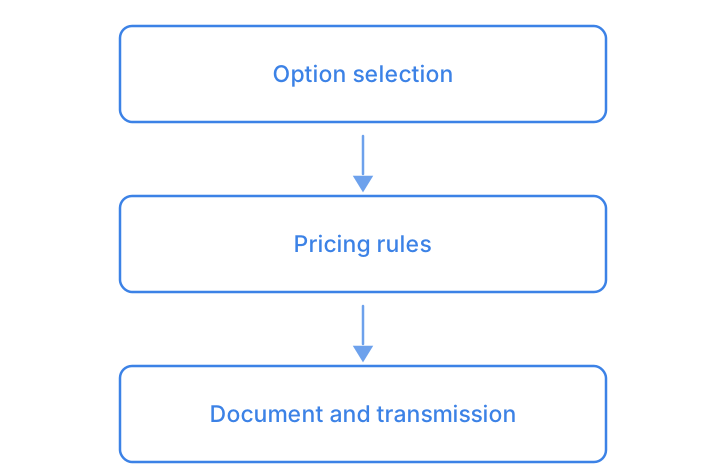
Select options, apply pricing rules, produce the document: Product Configurator & Quoting and Monetisation & Subscriptions rest on this sequence.
- Automated cascade breakdown
- Reconciliation with collections
- Editing commission schedules
Smooth and frictionless integration
We work with your existing systems: whether it’s a market insurance software package, an in-house legacy system, or a combination of both. The commission calculation tool is fed by automated flows from your contract database and your collections accounting. No re-entry, no forced migration. Existing commission agreements are modelled progressively, starting with the highest-volume ones.
Your teams retain their reference points, and the existing IT system continues to operate.
Mapping of Rules
Comprehensive inventory of agreements, identification of special cases and undocumented rules with your account managers.
Modelling and configuration
Translation of business rules into calculation engine parameters. Validation on real cases from your historical records.
Connection to data
Connection to contract and collection flows. Consistency testing with your current calculations over several periods.
Implementation and handover
Deployment to production on an initial scope. Training of teams, documentation of procedures, support for the first closing.
Measurable results for your organisation
- Monthly statement production time reduced from 4-5 days to a few hours
- Commission calculation error rate reduced to below 0.5% compared to 3-5% with manual processing
- Disputes with intermediaries reduced by two-thirds in the first year
- Ability to respond to a detailed justification request within 24 hours
- Provisions for reliable commissions with a variance of less than 2% at closing
- Complete traceability of payments for regulatory controls
Clarifying your decision-making
Our commission agreements are highly specific and have evolved over 20 years. Can your tool truly handle all of them?
Clarendis has modelled agreements with rates varying by seniority, crossed product and volume thresholds, four-level cascades, and clawback rules over three years. A rule that can be formulated can be configured. An audit of your most complex agreements validates feasibility before any commitment.
How long before we have an initial actionable result?
A first commission scope is operational within 6 to 8 weeks in our deployments, typically one network or product family representing 30 to 40% of volume. That includes modelling the rules, connecting to the data and validating with your teams. Extension to the remainder follows in successive waves.