
Dynamic Pricing Engines
A policyholder requests a motor insurance quote on your website at 10pm. They expect a response in under 3 seconds. During this time, your system must cross-reference their driving profile, claims history, geographical area, vehicle type, selected coverage, and apply the correct pricing rules: those validated by actuarial, not those from six months ago.
In reality, your technical teams juggle between multiple tariff repositories, business rules scattered across different systems, and actuaries working on Excel models that must then be translated into code. Each pricing update becomes a project in itself: testing, deployment, coordination between IT and business. Online comparison sites don’t wait.
Neither do your general agents, who lose sales when the system is slow or returns errors. And the regulator demands complete traceability of your pricing decisions. Between the commercial pressure of real-time and compliance requirements, your teams spend more time maintaining the existing system than developing your offerings.
This solution belongs to the Billing, Quoting & Configurators family.

Challenges holding back your performance
Most insurers operate with stacked layers: actuaries model in Excel or SAS, IT teams transcribe these rules into the management system, and middleware attempts to link with digital channels. At each stage, transcription errors, delays, and versions that diverge. When a tariff needs to change: new regulation, competitive adjustment, correction of an anomaly: the complete cycle takes weeks.Market pricing tools exist, but they are often designed for simpler contexts, or require overhauling the entire chain.Result: teams that circumvent the official system with workarounds, discrepancies between theoretical tariff and tariff actually applied, and limited audit capability when the PRA asks questions.
Our Technical Approach
Our approach stems from an observation: your actuaries must be able to modify a pricing rule without an IT ticket, and your IT system must be able to apply it in production without risk. The engine we deploy functions as an autonomous exposure layer. It consumes your existing repositories: pricing tables, underwriting rules, technical parameters: and orchestrates them in real time to respond to calls from your sales channels.
Each pricing version is time-stamped and traceable. Actuaries work on a business interface where they visualise the impact of their modifications before publication. The engine natively manages parallel calculations to absorb demand spikes: a commercial campaign launch or a wave of quotations following a natural disaster. The intelligence lies not in technical complexity, but in the clear separation of responsibilities: the business manages the rules, IT manages the infrastructure, the engine guarantees consistency between the two.
High Performance Computing
Architecture capable of withstanding traffic peaks (TV campaigns, renewals).
Tariff Versioning
Ability to deploy a new pricing schedule whilst maintaining the previous one for quotations in progress.
Connected Engine
A single calculation engine usable by your website, your brokers and your comparison sites.
Technical Architecture
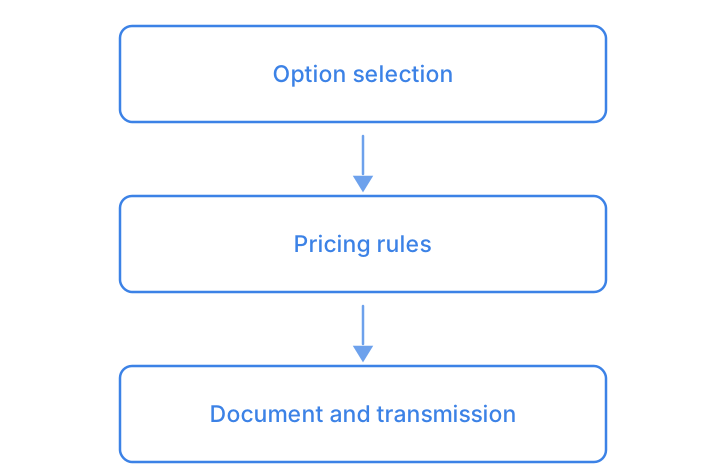
Select options, apply pricing rules, produce the document: Product Configurator & Quoting and Complex Commission Management rest on this sequence.
- High Performance ComputingArchitecture capable of withstanding traffic peaks (TV campaigns, renewals).
- Tariff VersioningAbility to deploy a new pricing schedule whilst maintaining the previous one for quotations in progress.
- Connected EngineA single calculation engine usable by your website, your brokers and your comparison sites.
Smooth and frictionless integration
The engine interfaces via REST API with your existing systems: whether that be an enterprise resource planning system (Activ’Infinite, SIGAL, bespoke solutions) or your web and mobile front-ends. There is no need to replace your policy management system. We connect to your current repositories and expose calculations where you need them. Deployment typically begins with a pilot product or channel, with a gradual switchover.
Your teams retain control over the adoption timeline.
Mapping of tariff flows
Analysis of your current repositories, identification of dispersed rules, documentation of gaps between actuarial models and technical implementation.
Configuration of the pilot engine
Configuration on a defined product or channel, integration with your repositories, implementation of versioning and business access rights.
Cross-validation and scaling
Non-regression testing with your historical cases, volume spike simulation, performance adjustments according to your infrastructure constraints.
Progressive deployment and transfer
Channel-by-channel implementation, training of actuarial and IT teams, operational documentation, run support during the stabilisation period.
Measurable results for your organisation
- Online quotation response time of less than 800ms on average, even during periods of high load
- Pricing update cycle reduced from several weeks to a few days
- Complete traceability of each pricing decision for ACPR audits
- 60% reduction in IT tickets related to pricing anomalies
- Capacity to absorb peaks of 10x nominal volume without degradation
- Guaranteed alignment between the tariff modelled by the actuarial department and the tariff applied in production
Clarifying your decision-making
How do you manage cohabitation with our current management system during the transition?
The engine runs in parallel with your existing systems. A shadow mode calculates without applying, so results can be compared with your current system. Switchover then proceeds channel by channel or product by product, without service interruption.
Our actuaries are not developers. Can they really modify the rules themselves?
The business interface is built for actuaries: they work with rules, tables and formulae, not code. Each change passes through validation before publication, with the impact shown on a sample of real cases. IT retains oversight of production deployments.