
Subscription & Claims Portals
In insurance, the customer journey often remains a major source of frustration. On the underwriting side, your teams spend hours re-entering information that the prospect has already provided by telephone or email. Supporting documents arrive by post, get lost, or are illegible. On the claims side, it’s worse: a stressed policyholder calls three times to find out the status of their file, taking up your case handlers’ time with status enquiries rather than actual case processing.
Call spikes following weather events saturate your call centres. Meanwhile, your competitors - insurtech companies and digitalised mutual insurers - offer seamless journeys in just a few clicks. Your policyholders are making comparisons, and their patience is waning. The problem isn’t a lack of willingness: it’s that your management system (Activ’Infinite, GESPAR, or an ageing in-house development) was never designed to expose self-service functionality.
And every customer portal project launched internally ends up bogged down between IT, legal and the business units.
This solution belongs to the Customer & User Portals family.

Challenges holding back your performance
Traditional attempts encounter the same pitfalls. The portal developed five years ago by a generalist provider? Outdated interface, never updated, policyholders abandon it after two clicks. The client space offered by your management system publisher?Rigid, impossible to customise without substantial budget, and the ergonomics reflect back-office constraints rather than user expectations. The forms cobbled together internally with low-code tools? They work for simple cases, but as soon as specific underwriting rules for each product need to be managed or a claim needs to be routed to the right handler, it breaks down.Result: your policyholders start online and end up on the telephone, your teams bridge the gap manually, and nobody benefits.
Our Technical Approach
Our approach stems from a fundamental observation: an effective client portal is not a web project—it is a business project with a web interface. We begin by mapping your actual customer journeys: not the theoretical pathways from the specification document, but those experienced daily by your policyholders and claims handlers. We identify friction points, the exceptional cases that generate 80% of telephone calls, and the documents that are systematically missing.
Subsequently, we construct an intermediation layer between your management system and the client interface. This layer absorbs the complexity of your business rules and presents straightforward user pathways. Document upload incorporates automatic verification (document legibility, correct format, coherent information) to prevent back-and-forth exchanges.
Real-time tracking integrates with your existing workflows without modification. Mobile-first because 70% of your policyholders will report their claims from their mobile phones, often at the very scene of the incident.
Mobile-First Declaration
Guided step-by-step journey, designed for stressful situations.
Proof Upload
Immediate dispatch of photographs and geolocated statements.
Real-Time Monitoring
Push notifications at each stage of the assessment and reimbursement process.
Technical Architecture
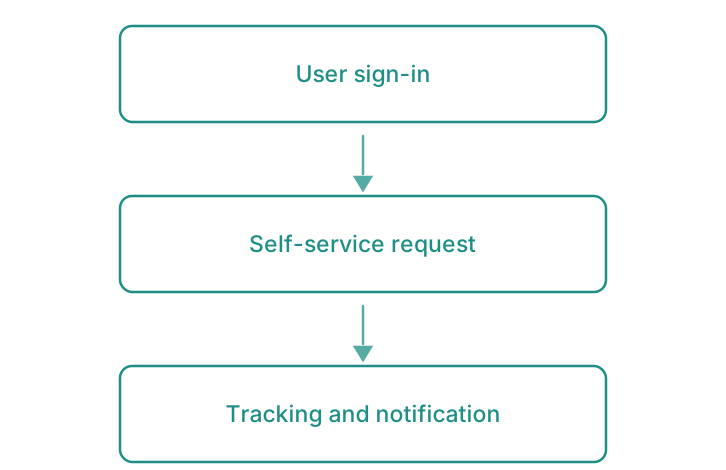
Identify the user, let them act on their own, keep them informed: Concierge Applications and One-Stop Citizen Service Centres work the same way.
- Mobile-First DeclarationGuided step-by-step journey, designed for stressful situations.
- Proof UploadImmediate dispatch of photographs and geolocated statements.
- Real-Time MonitoringPush notifications at each stage of the assessment and reimbursement process.
Smooth and frictionless integration
There is no question of replacing your management system or forcing a big bang migration. We interface via API where these exist, via database connectors when necessary, and sometimes via file exchanges for the oldest systems. Your administrators continue to work with their usual tools: they simply see better qualified cases arriving.
The portal integrates with your existing brand guidelines and can coexist with other client spaces during the transition period.
Audit pathway and IS
Analysis of actual customer journeys, mapping of friction points, technical evaluation of interfacing with your management system. Deliverable: diagnostic assessment and binding quotation.
MVP on a targeted scope
Development of an initial functional portal for a product or type of claim. Implementation into live production with a panel of policyholders to validate adoption.
Extension and automation
Extension to other products and journeys. Integration of automatic controls on documents, connection to management workflows for real-time monitoring.
Continuous optimisation
Analysis of abandoned user journeys, enhancement of user experience based on real data, addition of features according to field feedback. The portal evolves with your requirements.
Measurable results for your organisation
- 40 to 60% reduction in inbound calls relating to status enquiries
- Rate of complete claims files from first submission increasing from 35% to 75%
- Average online subscription time reduced to under 8 minutes for standard products
- 25 to 35% reduction in administrator time for processing straightforward claims
- Portal adoption rate exceeding 60% of active policyholders within 12 months
- Measurable reduction in cost of administration per contract of the order of 15 to 20%
Clarifying your decision-making
Our management system is over 15 years old and has no documented API. Is this really feasible?
Clarendis has already worked on COBOL systems from the 1990s. It is slower and more expensive than with modern interfaces, but it is feasible. An upstream audit of your IT system produces a realistic costing rather than an optimistic estimate corrected mid-project.
How to manage GDPR compliance and ACPR requirements on a self-service portal?
GDPR and ACPR compliance is built into the portal from the design stage: explicit consent is tracked, data is hosted in France, access is logged, and identity verification pathways match the level of risk. Clarendis documents all of it for your compliance teams.