
Direct Booking Engines
OTAs capture between 15% and 25% commission on each booking. For an independent hotel or small group, this often represents the entirety of the net margin on a room. The calculation is simple: on a RevPAR of €85, an OTA takes €12 to €20. Multiply by the number of annual room nights, and you get the renovation budget that won’t happen, the receptionist position that cannot be created, the marketing investment that gets postponed.
Meanwhile, reception spends hours managing extranets, correcting delayed availability updates, handling rate parity disputes. Revenue management teams juggle between 4 or 5 interfaces. And the loyal customer who returns each year? They still book through an OTA because it’s simpler than your website.
The problem isn’t the visibility that OTAs provide: it remains useful for acquisition. The problem is having no credible alternative to capture the customer once they know you.
This solution belongs to the E-commerce & Booking family.

Challenges holding back your performance
The booking engine provided by the PMS often dates back to 2015. Three clicks to select a date, five screens before payment, approximative mobile display.Result: 70% abandonment before confirmation. Some hoteliers have attempted specialised solutions, but integration with the existing PMS becomes a nightmare: delayed availability synchronisation, rates that don’t feed through, rooms sold twice. Others have had a module developed by a local web agency: it works for six months, then the service provider disappears or charges premium rates for each modification.Not to mention PCI-DSS compliance issues on payments, poorly configured gateways, 3D Secure that blocks foreign clients. The website becomes a showcase that redirects to an OTA.
Our Technical Approach
The approach stems from an observation: a customer who arrives on your website has already decided to consider your hotel. One needn’t convince them, but rather ensure they are not lost. The journey is therefore designed to eliminate each friction point identified in hotel analytics: date selection, room choice, payment: three steps, no more. The calendar displays real-time pricing to enable the customer to shift by a day or two if it suits them: behaviour observed extensively on OTAs which must be replicated.
Upselling (breakfast, parking, room upgrades) integrates naturally into the flow without aggressive pop-ups, at the moment when the customer is in purchasing mode. The price comparison tool displayed directly on the engine defuses the reflex to verify prices on an OTA. And all of this must load in under 2 seconds on mobile, because 65% of hotel traffic originates from smartphones.
3 Step Ultra-Fast Journey
Strict optimisation of the booking funnel (Search -> Selection -> Payment) without distraction.
Flexible Pricing Calendar
Display of the cheapest dates to encourage the user to adjust their stay.
Integrated Upselling
Elegant proposition of relevant extras (Breakfast, Bottle of champagne, Spa).
Secure Payment & Guarantee
Integration of Stripe for seamless payments (Apple Pay, bank card imprint).
Perfect Mobile-First Design
Flawless ergonomics on smartphones, where over 60% of bookings are made.
Direct Booking EnginesnnPrice Comparison
Display proving to the client that the price on your official website is the most advantageous.
Technical Architecture
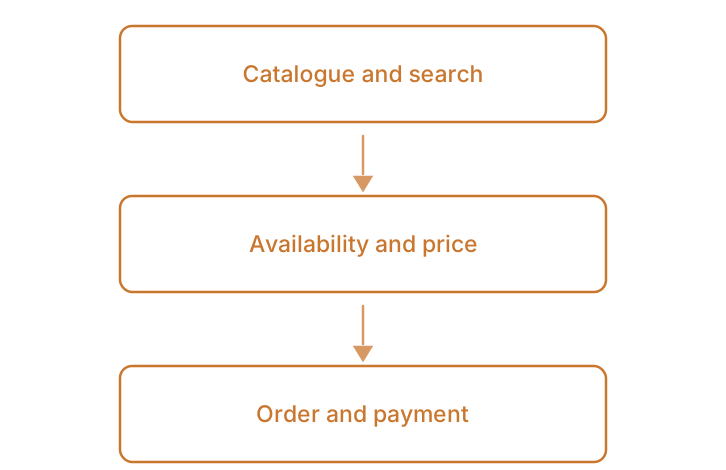
Search, check availability and price, order: these three steps also structure Marketplaces and Online Auction Platform.
- 3 Step Ultra-Fast JourneyStrict optimisation of the booking funnel (Search -> Selection -> Payment) without distraction.
- Flexible Pricing CalendarDisplay of the cheapest dates to encourage the user to adjust their stay.
- Integrated UpsellingElegant proposition of relevant extras (Breakfast, Bottle of champagne, Spa).
- Secure Payment & GuaranteeIntegration of Stripe for seamless payments (Apple Pay, bank card imprint).
- Perfect Mobile-First DesignFlawless ergonomics on smartphones, where over 60% of bookings are made.
- Direct Booking EnginesnnPrice ComparisonDisplay proving to the client that the price on your official website is the most advantageous.
Smooth and frictionless integration
Your PMS remains the single source of truth. The engine connects to it to read availability and rates, and writes to it to push reservations: no duplicate data entry, no risk of overbooking. We adapt to existing APIs (Mews, Opera, Misterbooking, D-Edge, or others). The payment gateway can remain yours if it functions properly, or be replaced if it causes issues.
The design incorporates your existing brand guidelines. Deployment on your current website, without complete redesign.
Direct Booking Engine AuditnnAudit of the existing customer journey
Analysis of current analytics, identification of abandonment points, assessment of PMS and payment integration. Deliverable: quantified diagnosis within 10 days.
Configuration and Integration
Connection to the PMS, configuration of pricing rules and upselling options, implementation of compliant payment gateway. Testing in pre-production environment.
Deployment and training
Implementation on your website, training of reception team on the monitoring interface, configuration of alerts. Active monitoring period of 2 weeks.
Continuous optimisation
Monthly analysis of conversion rates, journey adjustments and upselling offers according to actual data. Quarterly performance review with recommendations.
Measurable results for your organisation
- Increase in direct bookings to OTA ratio of 15 to 25 percentage points within 12 months
- Reduction of booking funnel abandonment rate to below 40%
- Average basket value increased by 12 to 18% through integrated upselling
- Savings of 8 to 15% on commissions redistributable as margin or direct marketing
- Channel management time reduced by 5 to 6 hours per week for the reception team
- PCI-DSS compliance ensured without technical intervention on the hotel side
Clarifying your decision-making
How do you ensure that availability remains synchronised in real-time with my PMS?
The engine uses your PMS webhooks or real-time interfaces where they exist, otherwise polling every two to five minutes depending on system capacity. Reservations are pushed instantly. Across eighteen months of operation with our hotel clients, no overbooking has been linked to the engine.
Will an OTA penalise me if I display lower prices on direct booking?
Wide rate parity clauses have been prohibited in Europe since 2015: you may display a lower price on your own site without contractual risk. Clarendis recommends a differential of 5 to 8%, enough to convert without triggering a conflict with a distribution platform that remains useful for acquisition.