
Warehouse Management Systems (WMS)
A 5,000 m² warehouse means 47 kilometres walked by each picker daily if slotting is poorly conceived. That’s 3 to 8% picking errors which generate returns, credit notes, and lost customers. That’s stock which turns poorly: A-grade references stuck at the back of aisles whilst C-grade items occupy premium locations. The teams know these problems by heart.
The team leader has his tricks, the experienced picker his shortcuts.
But when he goes on holiday, productivity drops by 25%. When the Christmas peak arrives, we hire temporary staff whom we cannot train in two days. When the e-commerce client demands same-day dispatch, every minute of preparation counts. Added to this are regulatory constraints: lot-by-lot traceability for food products, expiry date management, customs compliance for export.
The warehouse is no longer a simple storage facility: it’s the bottleneck of the entire chain.
This solution belongs to the Business Operations & ERP family.
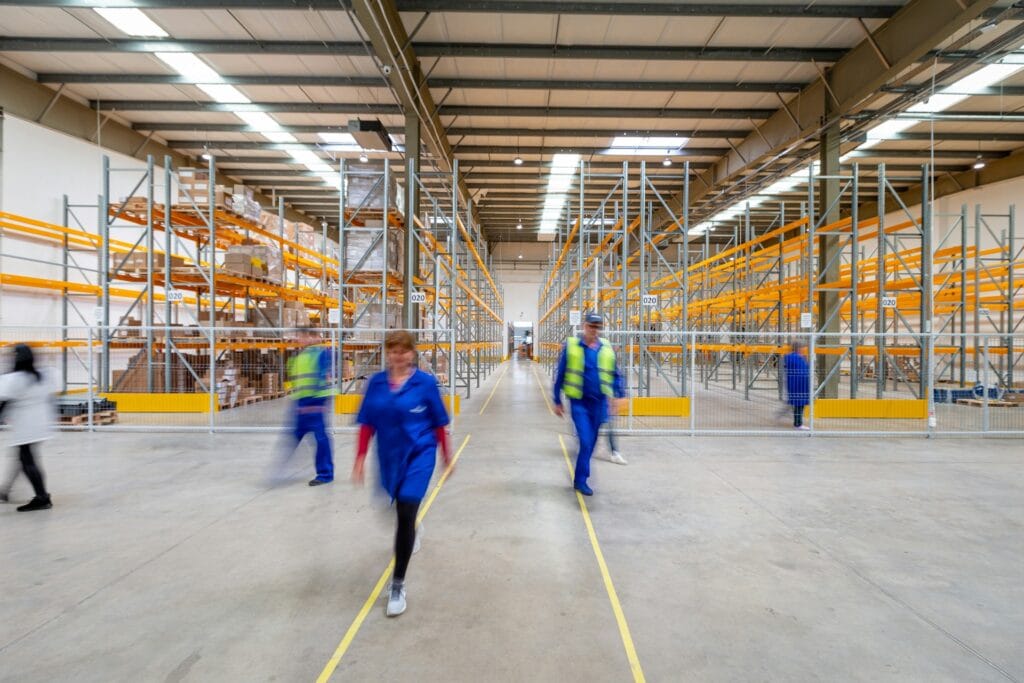
Challenges holding back your performance
Excel and paper picking lists work up to 500 lines per day.Beyond that, it becomes structured improvisation: the logistics manager spends their mornings arbitrating priorities, pickers wait in front of congested aisles, packaging errors multiply at the end of the day when fatigue sets in. WMS solutions exist in the market, but publishers sell licences for €80K with 18 months’ deployment.Standard modules never fit actual workflows: managing piece picking, racking, and kit preparation simultaneously.Result: workarounds, duplicate data entry, a tool that teams endure rather than use. And when the conveyor or new stacker crane needs connecting, it’s the service provider who sets the timescales and rates.
Our Technical Approach
We start from your actual flows, not from a template. First step: mapping current movements, dead times, congestion zones. From there, we design routing algorithms adapted to your configuration: not a simple S-path, but logic that takes into account weights, fragilities, groupings order by order or in waves according to your transport constraints.
Slotting becomes dynamic: locations reorganise themselves according to the actual velocity of references, measured on your data, not on theoretical averages. Packaging control integrates your business rules: maximum weight, product incompatibilities, customs documents to insert. The picker interface is designed to be understood in 15 minutes by a temporary worker, with visual guidance and scan validation.
We dimension preparation waves to smooth the load on dispatch bays and avoid the 5 p.m. bottleneck.
Routing Algorithms
Calculation of the shortest route (Travelling Salesman Problem) for warehouse picking.
Preparation Batches
Intelligent grouping of several similar orders to limit movements.
Storage Strategy
Dynamic placement rules (high-turnover products positioned near docks).
Pack Control (Pack)
Final scanning stage ensuring 100% that the correct item is in the correct carton.
Stock Rotation (FIFO/FEFO)
Strict guidance for consuming the oldest batches or those with short expiry dates first.
Mechanisation Interfacing
Dialogue with sorters, automated conveyors or storage robots (AGV/AMR).
Technical Architecture
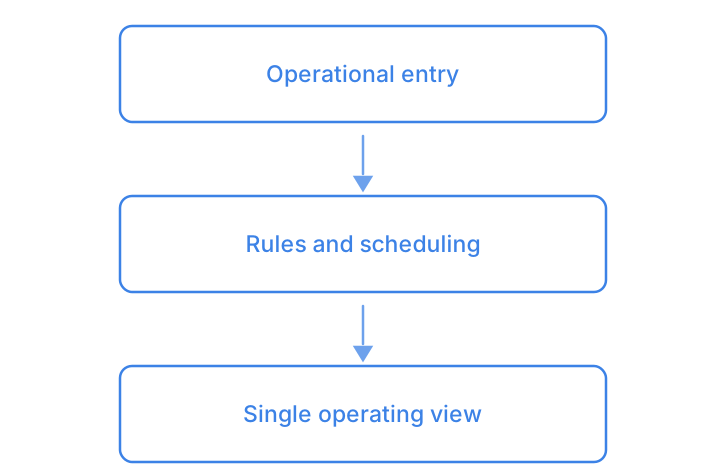
Enter once, let the rules schedule, read a single view: this foundation is shared across the family — you will find it in Workshop & After-Sales Management and in Management Systems (PMS).
- Routing AlgorithmsCalculation of the shortest route (Travelling Salesman Problem) for warehouse picking.
- Preparation BatchesIntelligent grouping of several similar orders to limit movements.
- Storage StrategyDynamic placement rules (high-turnover products positioned near docks).
- Pack Control (Pack)Final scanning stage ensuring 100% that the correct item is in the correct carton.
- Stock Rotation (FIFO/FEFO)Strict guidance for consuming the oldest batches or those with short expiry dates first.
- Mechanisation InterfacingDialogue with sorters, automated conveyors or storage robots (AGV/AMR).
Smooth and frictionless integration
Your ERP remains the master of item and order data: we connect to it in real time or through regular exchanges depending on what it supports. Existing barcode scanners and RF terminals are retained if their firmware permits. For mechanisation: conveyors, sorters, automated storage systems: we develop interfaces with the existing automated systems, without imposing equipment changes.
Deployment is carried out zone by zone or flow by flow, with a period of parallel operation to secure the transition.
Analysis of physical flows
Field observation over 3 to 5 days: timing of routes, identification of congestion points, measurement of actual error rates and mapping of storage areas.
Design of business rules
Definition of slotting logic, wave strategies, packaging controls and rotation rules with your teams — those who understand the specific cases.
Development and interfacing
Construction of the WMS, connection to the ERP and mechanisation equipment. Testing on a pilot perimeter before extension — one zone or one product family.
Deployment and Scaling
On-site team training, support during the first weeks of production, parameter adjustments based on field feedback.
Measurable results for your organisation
- 30 to 40% reduction in picker travel distances through slotting based on actual velocity
- Picking error rate reduced to below 0.3% through scan control and packaging validation
- Temporary staff training time reduced by a factor of three — operational within half a day
- Gain of 15 to 20% storage capacity through dynamic reorganisation of locations
- Strict adherence to FEFO for perishable products — zero wastage due to avoidable best-before date exceedance
- Preparation lead time compatible with same-day despatch for orders received before 14:00
Clarifying your decision-making
Our flows are atypical — piece, parcel and pallet preparation on the same site. Can a WMS handle this without becoming overly complex?
A WMS designed around your flows is precisely what this case calls for. Each type of preparation is modelled with its own rules, within a single interface. Pickers do not juggle three tools: they get guidance matched to the mission in progress.
Our ERP is 12 years old and the publisher no longer develops updates. How do you interface with it?
Clarendis is used to legacy systems. If your ERP exposes tables or flat files, we build the connectors; if it is more locked down, we work through scheduled file exchanges. The aim is to leave the core of your ERP untouched.