
Carrier Portals & Tracking
You work with 8, 12, sometimes 15 different carriers. Each has its own portal, status codes, and information reporting logic. Your operations team spends its mornings juggling between interfaces to answer a simple question: where is this parcel? Meanwhile, customer service receives calls from recipients who have no visibility on their delivery.
Sales representatives follow up internally because a strategic client is awaiting an urgent order. And when a dispute arises, the journey must be reconstructed manually, with screenshots for evidence. Transport outsourcing has become the norm: for obvious economic reasons.
But this delegation has been accompanied by a loss of control over information. Your service providers have the data, not you. You discover delays when the client calls. Delivery anomalies surface at D+3, when it’s too late to act.
This opacity is costly: in processing time, in disputes, in client dissatisfaction.
This solution belongs to the Partner & Network Extranets family.
Challenges holding back your performance
The classic reflex is the consolidated Excel file. A trainee or conscientious operative retrieves the exports from each carrier every morning, attempts to cross-reference the data, and updates your master visualisation tool. This works for three weeks, then formats change, someone goes on holiday, and the file becomes obsolete. Some opt for a TMS that promises multi-carrier integration.In practice, the connectors are limited to the 4-5 major players, and your regional or specialist carriers remain off the radar. Others ask their principal service provider to aggregate everything: you then inherit their partial view and their own consolidation delays. The fundamental problem remains: the data exists, but it is dispersed, heterogeneous, and no one has responsibility for unifying it.
Our Technical Approach
Our approach stems from a straightforward observation: each carrier has its own way of describing an event. ’Delivered’, ’Handed over’, ’Left at collection point’, ’Delivered’: it’s the same reality, expressed differently. At the heart of our portal lies a normalisation engine that translates these disparate languages into a common framework for your business. Above this, we build an integration layer that retrieves data from wherever it resides: APIs where they exist, portal scraping when necessary, EDI file processing for established players.
The real value emerges thereafter: real-time anomaly detection. A parcel with no movement for 48 hours, a delivery scheduled for tomorrow but still in transit 800 kilometres away: the system alerts before the customer becomes aware. Your teams shift from information hunting to exception management. And your customers, via a tracking page in your corporate colours, regain confidence in your ability to keep them informed.
Integration Engines
Multi-protocol connectors to Chronopost, DHL, FedEx, etc. systems.
Normalisation of Statuses
Translation of each carrier’s internal references into a comprehensible universal language.
Anomaly Detection
Proactive escalation of blocked shipments (damage, incorrect address) before customer complaint.
Performance Monitoring (SLA)
Dashboards measuring the punctuality rate of each transport partner.
Page Tracking White Label
Tracking page in your brand colours, retaining customer attention on your website.
Proactive Notifications
Sending automated emails and SMS at key moments (Despatched, Out for delivery).
Technical Architecture
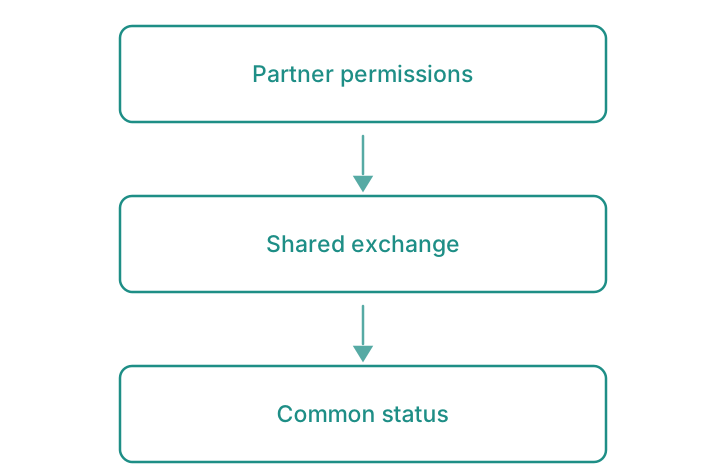
Grant each partner their permissions, exchange the flows, share one common status: that is what Partner Portals & Project Tracking and Dealer & Network Portal do.
- Integration EnginesMulti-protocol connectors to Chronopost, DHL, FedEx, etc. systems.
- Normalisation of StatusesTranslation of each carrier’s internal references into a comprehensible universal language.
- Anomaly DetectionProactive escalation of blocked shipments (damage, incorrect address) before customer complaint.
- Performance Monitoring (SLA)Dashboards measuring the punctuality rate of each transport partner.
- Page Tracking White LabelTracking page in your brand colours, retaining customer attention on your website.
- Proactive NotificationsSending automated emails and SMS at key moments (Despatched, Out for delivery).
Smooth and frictionless integration
No question of replacing your TMS or your WMS. The portal connects to your existing information system to retrieve tracking numbers and enrich them with carrier data. Integration typically begins with 2-3 carriers representing 70% of your flows: the others follow progressively. We work with your IT teams on exchange formats that make sense in your context: REST API, flat files, webhooks.
The portal adapts to your stack, not the other way round.
Flow Mapping
Inventory of your carriers, their technical capabilities (API, portal, EDI) and associated volumes. Identification of the 3-4 priority stakeholders.
Normalisation of the reference framework
Construction of your unified status grid and mapping of each carrier’s codes. Definition of anomaly detection rules.
Deployment of connectors
Implementation of carrier integrations in waves, commencing with the most critical. Real-world testing within a pilot scope.
Activation and scaling up
Opening of the portal to operations teams, followed by deployment of the client tracking page. Training and adjustments during the first weeks of usage.
Measurable results for your organisation
- Customer service response time quartered on tracking enquiries
- Detection of delivery anomalies on Day+0 rather than Day+2 or Day+3
- 60% reduction in inbound calls related to tracking through the client portal
- Consolidation of carrier SLA data for factual tariff renegotiation
- Accelerated dispute processing with complete and timestamped history
- Operations team refocused on exception management rather than information gathering
Clarifying your decision-making
How do you manage carriers who do not have an API?
Many regional and specialist carriers expose no API, and Clarendis has built connectors that read their web portals or process their reporting files. It is not technically elegant, but it works, and the connector is maintained whenever a carrier changes its interface.
What is the realistic timeframe for having a consolidated view of all our carriers?
A first working version covering the three or four main carriers takes 4 to 6 weeks in our deployments. Integrating secondary carriers then spans two to three months depending on their technical maturity, with the order agreed with you according to your volumes.