
Interactive Configurators
In luxury horology, personalisation is no longer a bonus: it is an expectation. Your clients wish to choose their dial, their bracelet, their finishes, sometimes down to the hands. The problem: between the showroom and the workshop, there is a chasm. The sales representative notes the choices on a paper form or an Excel file.
He sends an email to the workshop with a textual description. The horologist interprets, sometimes incorrectly. The client receives a timepiece that does not correspond exactly to what he had envisaged.
Result: costly returns, extended delays, a tarnished brand image. Internally, your teams spend hours manually verifying whether such a combination is technically feasible. The titanium case with this leather strap? One must ask Jean-Pierre, the only one who knows all the compatibilities.
And when Jean-Pierre goes on holiday, everything slows down. Not to mention price calculation: each option has its impact, and quotation errors erode your margins.
This solution belongs to the Billing, Quoting & Configurators family.

Challenges holding back your performance
Generic configurators on the market are designed for automotive or furniture: not for a €15,000 watch where the client zooms in on an index to verify the polishing. The renderings are approximate, the loading times unacceptable on mobile, and integration with your production ERP amounts to makeshift solutions. Some houses have attempted in-house development: six months later, the project is abandoned due to lack of WebGL expertise.Others use interactive PDF catalogues which create an illusion of modernity but generate zero exploitable data for production. The sales representative invariably ends up telephoning the workshop to confirm that the configuration is feasible. The digital promise collapses at first contact with operational reality.
Our Technical Approach
Our approach begins with an oft-overlooked truism: a configurator is only useful if it communicates with your workshops.
We first build the business rules engine: technical incompatibilities, manufacturing constraints, lead times per option—in direct collaboration with your horologists. This engine becomes the single source of truth, accessible by both the client interface and your ERP system. The 3D rendering follows, calibrated to your existing assets (photographs, CAD) to achieve a realism that meets your brand’s exacting standards.
Each configuration automatically generates a production bill of materials readable by your systems, not a PDF requiring manual re-entry. Pricing is calculated in real time according to your commercial rules, including complex scenarios: network discounts, exchange rates for export, seasonal options.
The objective: when the client confirms, the order is immediately actionable, without human interpretation.
WebGL Rendering
Modelling of complex textures (gold, leather, reflections) optimised for the web.
Incompatibility Engine
Business logic preventing the selection of technically unfeasible options.
Dynamic Pricing
Instant price adjustment according to the weight of metals or rarity of gemstones.
Generation of Nomenclature
Automatic translation of the 3D view into a precise component list (BOM).
Mobile Performance
Strict optimisation of 3D models for instantaneous display on smartphone.
PDF Rendering Generation
Automatic creation of a luxury document summarising the client’s choices.
Technical Architecture
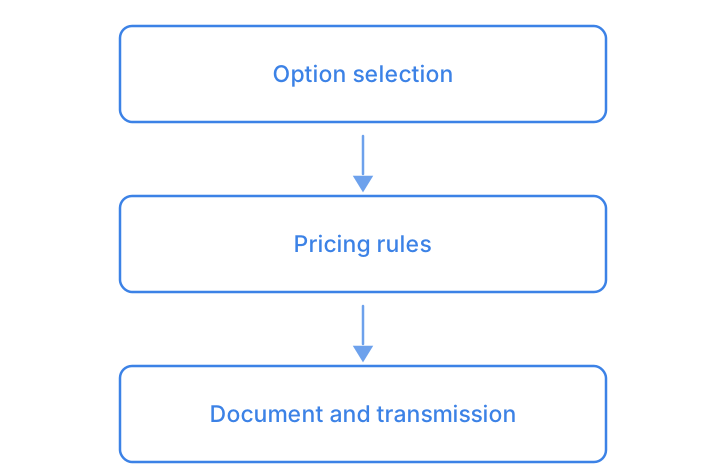
Select options, apply pricing rules, produce the document: Complex Commission Management and Monetisation & Subscriptions rest on this sequence.
- WebGL RenderingModelling of complex textures (gold, leather, reflections) optimised for the web.
- Incompatibility EngineBusiness logic preventing the selection of technically unfeasible options.
- Dynamic PricingInstant price adjustment according to the weight of metals or rarity of gemstones.
- Generation of NomenclatureAutomatic translation of the 3D view into a precise component list (BOM).
- Mobile PerformanceStrict optimisation of 3D models for instantaneous display on smartphone.
- PDF Rendering GenerationAutomatic creation of a luxury document summarising the client’s choices.
Smooth and frictionless integration
We connect to your ERP, whatever it may be — SAP, Odoo, Cegid… — or to your specific business solution: via API or structured files if necessary. No migration, no replacement. The configurator integrates with your current e-commerce site or operates in standalone mode for your points of sale. 3D assets are generated from your CAD files or existing photography.
Your teams retain control over business rules via a simple administration interface, without depending on a developer to add a new bracelet reference.
Business Rules Mapping
Work with your watchmakers and sales staff to document all compatibilities, constraints and exceptions — the real expertise, often unwritten.
Construction of the engine and assets
Development of the rules engine and creation of 3D models from your existing files. Rendering tests on all target media.
Connection to your systems
Integration with your ERP and website. Validation that each configuration generates an exploitable bill of materials without re-entry.
Deployment and transfer
Go-live implementation, training of your teams on rules administration, support period to adjust according to field feedback.
Measurable results for your organisation
- 70% reduction in configuration errors transmitted to the workshop
- Time to create a personalised quotation reduced from 45 minutes to 3 minutes
- In-store conversion rate increased by 25% through immediate visualisation
- Elimination of commercial/workshop email exchanges for technical validation
- 40% reduction in customer returns related to discrepancies between expectations and delivery
- Complete team autonomy to add new options without technical intervention
Clarifying your decision-making
What level of realism can we expect on mobile, where our clients often finalise their choice?
The configurator maintains high-fidelity rendering with loading times under three seconds on a mid-range smartphone. Textures and reflections adapt dynamically to device performance, with no visible compromise for the user.
How to manage exceptional configurations that fall outside standard rules?
The engine identifies out-of-rule configurations and routes them to manual validation rather than blocking them. Your team receives an alert with the technical detail, approves or adjusts, and the response rejoins the customer journey. Frequent exceptions can then be added to the rules.