
Parts Allocation Management
In luxury horology, certain references sell before they even exist. Waiting lists extend over several years, historic clients grow impatient, and your boutique directors find themselves arbiters of a game where each decision may ruffle a long-standing ambassador or fuel parallel resale networks. Head office lacks visibility: who is waiting for what, for how long, and in which boutique?
Attribution criteria vary from one point of sale to another: client seniority here, purchase volume there, salesperson’s instinct elsewhere. When a rare piece finally arrives, it becomes a race of emails and telephone calls to decide within 48 hours. Tensions mount between boutiques within the same network competing for identical references for sometimes the very same clients.
And behind this looms the spectre of the grey market: that timepiece allocated to a good client which reappears on a horological marketplace three weeks later, at 40% above retail price. Your brand suffers, as do your genuine collectors.
This solution belongs to the Business Operations & ERP family.

Challenges holding back your performance
Excel files circulate by email between boutiques and head office, with contradictory versions and updates that cross paths. The standard CRM records past purchases but ignores preferences, relationship history, and weak signals that distinguish a passionate collector from a disguised reseller. Allocation committees are held by telephone, with no record of decisions made or criteria applied.It is impossible to justify a decision to a disgruntled client or to prove network consistency during an internal audit. Generic commercial management tools do not understand the logic of scarcity: they optimise to sell more, not to sell better.Result: opaque decisions, frustration in boutiques, and permanent reputational risk.
Our Technical Approach
Our approach stems from a simple observation: allocation is not a logistics problem, it is a governance problem.
We build a client scoring system that aggregates relevant data: purchase history, tenure, post-purchase behaviour, visit frequency, collection coherence: and weights them according to your own brand criteria. Each boutique enters client requests into a single repository, visible to both the network and head office. When a piece becomes available, a workflow structures the allocation committee: automatic proposal based on scoring, traced discussion, documented decision.
Boutique directors retain their power of recommendation, but within a transparent framework. The system also detects warning signals: multi-boutique clients, rapid resale of a previous piece, inconsistency between declared collection and actual purchases. You manage rarity with explicit rules, not with scattered intuitions.
Advanced Client Scoring
Analysis of past purchases, regularity and article categories.
Centralisation of Preferences
Global aggregation of expressions of interest (Wishlists) from all channels.
Committee Workflows
Multi-level approval process (Shop Manager, Area, Head Office).
Network Transparency
Clear views enabling sellers to justify the wait diplomatically.
Restricted Logistics Tracking
Liaison with the manufacturer to ensure that the allocation becomes a delivery.
Grey Market Avoidance
Detection of suspicious purchasing behaviours suggesting rapid resale.
Technical Architecture
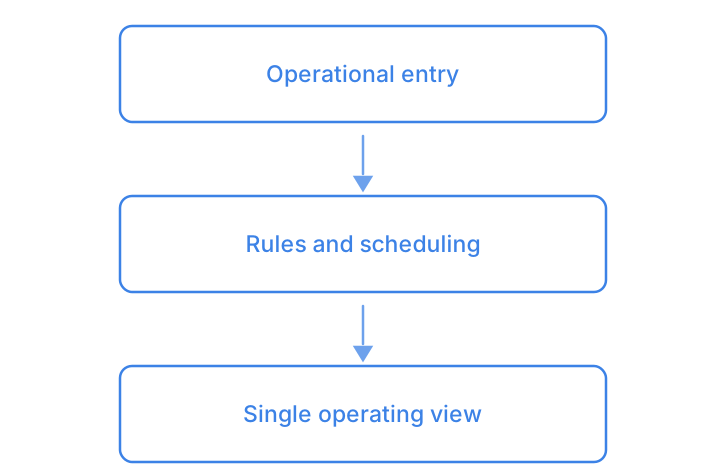
Enter once, let the rules schedule, read a single view: this foundation is shared across the family — you will find it in Order Management System (OMS) and in Workshop & After-Sales Management.
- Advanced Client ScoringAnalysis of past purchases, regularity and article categories.
- Centralisation of PreferencesGlobal aggregation of expressions of interest (Wishlists) from all channels.
- Committee WorkflowsMulti-level approval process (Shop Manager, Area, Head Office).
- Network TransparencyClear views enabling sellers to justify the wait diplomatically.
- Restricted Logistics TrackingLiaison with the manufacturer to ensure that the allocation becomes a delivery.
- Grey Market AvoidanceDetection of suspicious purchasing behaviours suggesting rapid resale.
Smooth and frictionless integration
The system connects to your existing CRM to retrieve customer history without re-entry. Shops access via a lightweight web interface, without installation. The scoring draws upon your current data and progressively refines itself. We begin with one region or product category to validate criteria before expanding.
Your IT teams retain control over hosting of sensitive data. No abrupt replacement of your tools: a coordination layer that structures what already exists.
Mapping of current practices
Audit of allocation criteria used by each shop, identification of available data and decision-making grey areas.
Definition of the scoring model
Collaborative construction of criteria and their weighting with your sales teams and brand management.
Pilot deployment on a restricted scope
Deployment on a region or product family, adjustments based on field feedback over 8 to 12 weeks.
Extension and embedding in routines
Extension to the complete network, team training, integration into existing committee rituals.
Measurable results for your organisation
- 60% reduction in time spent in allocation committees through automated pre-scoring
- Complete traceability of allocation decisions for each rare part
- Upstream detection of 85% of profiles at risk of immediate resale
- Harmonisation of allocation criteria across the entire network within 4 months
- Measurable reduction in customer complaints relating to waiting times perceived as unfair
- Real-time head office visibility on waiting lists by reference and by market
Clarifying your decision-making
Will our store managers lose their decision-making authority?
Store managers retain their decision-making authority: the system proposes, the manager decides. Scoring informs and documents the decision, it does not replace it. The objective is to provide robust arguments, not to bypass anyone.
How do you manage client data confidentiality between competing shops within the same network?
Each shop sees only its own clients in detail, while head office holds a consolidated view. Multi-shop alerts flag duplicates without exposing one shop’s commercial data to another. Access rights are granular and auditable.