
Decoupled Sales Platforms
Your e-commerce team faces a daily paradox. On one hand, management demands more functionality: personalisation, loyalty programmes, new payment methods, marketplace integration. On the other, each addition slows down the site. Your e-commerce platform or online shop accumulates plugins, theme overrides, third-party scripts.
Loading time exceeds 4 seconds on mobile. Google penalises you. Your bounce rate increases by 7% per additional second of waiting time: this is measured, not intuition. Developers spend more time managing conflicts between modules than creating value.
Each update becomes a risk: an incompatible extension can bring down the checkout on a Friday evening. The marketing team waits three weeks to modify a landing page because everything is locked in the back-office. Meanwhile, your competitors display their product pages in under a second. Technical debt accumulates, but completely rebuilding the platform represents 18 months’ work and a budget that no one will approve.
This solution belongs to the E-commerce & Booking family.

Challenges holding back your performance
Most optimisation attempts remain superficial. Image compression, aggressive caching, CDNs in front of a monolith: these patches gain a few hundred milliseconds but fail to address the structural problem. Your front-end remains captive to your back-end. When your e-commerce platform’s server struggles under the load of a traffic spike, the entire user experience collapses.Web agencies propose complete rebuilds on your e-commerce platform or BigCommerce, but you then lose control of your business logic and ERP integrations built up over years. Some attempt bespoke PWAs, but without an architecture designed for resilience, the project drifts: six months later, you have a React front-end as tightly coupled to your back-end as the old PHP theme.
Our Technical Approach
Our approach consists of physically decoupling what your visitors see from what manages your orders. The front-end becomes an autonomous application, pre-generated and distributed across edge servers throughout the world. When a customer in Lyon or Singapore loads your page, it arrives from a point of presence a few kilometres away, not from an overloaded centralised server.
This front layer communicates with your existing e-commerce engine via APIs, but it does not depend on its availability to display a catalogue. If your e-commerce platform goes down, product pages remain accessible: only the ordering process switches to degraded mode. The marketing team can modify content, launch A/B tests, create landing pages without mobilising developers or risking breaking the checkout.
The developers, meanwhile, work on modern front-end code that is testable and deployable several times a day without maintenance windows. SEO improves mechanically: Google measures a display time of under one second, your Core Web Vitals score turns green.
Edge Rendering & CDN
Pre-generated pages served by servers closest to the user.
Orchestration of Tools
Strict decoupling enabling seamless integration of best-in-class software solutions.
Complete Resilience
If the payment engine fails, the catalogue remains perfectly navigable.
Headless Independence
Rapid design updates without risk of breaking order logic.
App-Like Experience
Instantaneous transitions between pages without heavy browser reloading.
Search Engine Optimisation
Perfect structure for Google indexing, boosting your visibility.
Technical Architecture
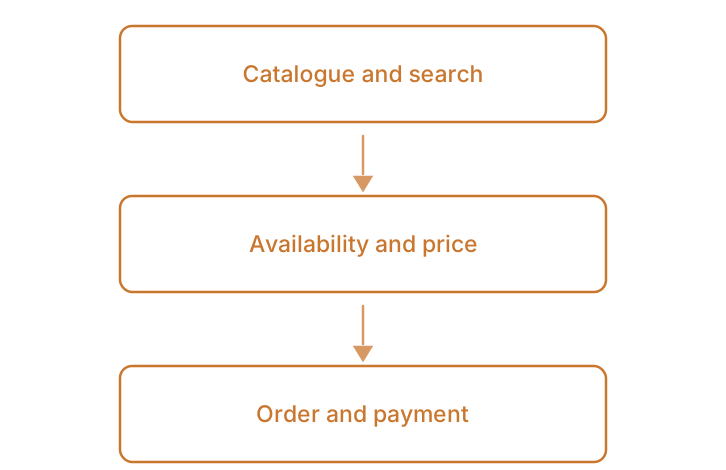
Search, check availability and price, order: these three steps also structure Direct Booking Engines and Marketplaces.
- Edge Rendering & CDNPre-generated pages served by servers closest to the user.
- Orchestration of ToolsStrict decoupling enabling seamless integration of best-in-class software solutions.
- Complete ResilienceIf the payment engine fails, the catalogue remains perfectly navigable.
- Headless IndependenceRapid design updates without risk of breaking order logic.
- App-Like ExperienceInstantaneous transitions between pages without heavy browser reloading.
- Search Engine OptimisationPerfect structure for Google indexing, boosting your visibility.
Smooth and frictionless integration
Your e-commerce platform, your online shop or proprietary system remains in place. It continues to manage the catalogue, pricing, stock, orders, ERP and logistics connections.
We build the front-end layer in parallel, section by section. We often begin with category and product pages: where the impact on performance is immediate. The checkout can remain on the legacy system whilst validating the approach. Your teams retain their usual administration tools.
No extensive training, no risky data migration.
Performance audit and mapping
Measurement of actual loading times, identification of bottlenecks, inventory of dependencies between existing front-end and back-end systems.
Architecture and prototype
Definition of the front stack, implementation of edge infrastructure, development of a pilot scope (typically 20% of the catalogue).
Progressive Migration
Section-by-section deployment with seamless traffic switching, validation of performance and conversion metrics at each stage.
Autonomy and continuous optimisation
Transfer of expertise to your teams, implementation of monitoring tools, documentation of deployment processes.
Measurable results for your organisation
- Mobile loading times reduced from 4-6 seconds to under 1.2 seconds
- Improvement in conversion rate of between 12% and 25% depending on the sector
- Achieve passing Google Core Web Vitals scores in the green zone on 90%+ of pages
- Capacity to absorb 10x traffic spikes without visible degradation
- Reduced front-end modification deployment cycle from 3 weeks to 2 days
- 40% reduction in developer time dedicated to corrective maintenance
Clarifying your decision-making
What is the impact on our current technical team? Do we need to recruit specialised profiles?
Your back-end developers continue to maintain the existing e-commerce engine. The decoupled front-end requires upskilling on modern frameworks, which Clarendis supports over the first months. Most teams then find this way of working more productive than maintaining a monolith.
What happens if our e-commerce back-end fails during a commercial operation?
Catalogue pages, product sheets and static content remain available from the edge cache. Basket and checkout switch to degraded mode with a waiting message, and everything resumes automatically when the back-end returns. Your customers see a slow site for a few minutes, not an error page.