
Fleet Management
Managing a rental property portfolio of 200, 500 or 2000 units means juggling daily with inflexible deadlines: rent receipts to be issued on the 1st of each month, service charge reconciliations to be completed before summer, indexations to be applied without error on each anniversary date. Your property managers spend their days between the management software, Excel for special cases, and manual follow-ups with suppliers for ongoing interventions.
Service charge apportionment errors generate tenant disputes which tie up your teams for weeks. Delayed indexations mean permanently lost revenue. And when a landlord calls to enquire about the leak reported three weeks ago, no one has an immediate answer. Meanwhile, regulations continue to evolve: EPC requirements, rent controls in certain areas, new disclosure obligations.
Your current tools were not designed to absorb this growing complexity, and each new constraint adds another layer of makeshift solutions.
This solution belongs to the Business Operations & ERP family.

Challenges holding back your performance
Property management software on the market is either too rigid—designed for a standard model that doesn’t match your specific requirements—or too lightweight for professional volumes.Result: your property managers maintain parallel Excel files for exceptional cases, atypical leases, and complex leasehold properties. Automatic indexation exists on paper, but someone still needs to manually verify each calculation. Technical intervention tracking lives in emails, sometimes in your shared visualisation tool that no one updates in real time.Data is scattered, re-entry errors are frequent, and reporting for your principals takes two days to consolidate each month. This isn’t a matter of your teams’ competence—it’s a problem of tools that don’t fit your reality.
Our Technical Approach
Our approach starts from your actual processes, not from a theoretical model.
We build a billing engine that integrates your specific rules: management of pro rata temporis, mixed lease cases, particular requirements of certain mandates. Automatic indexation does not simply apply the ICC or IRL: it manages caps, staggered dates, particular clauses of your legacy leases. For service charge apportionment, we model your actual apportionment keys, even the most convoluted ones inherited from 1970s condominium regulations.
Technical intervention tracking becomes a structured workflow: reporting, qualification, contractor assignment, automatic follow-up, validation, accounting allocation. Each piece of information is entered once only and feeds the entire chain. Your property managers regain time for tenant and landlord relations instead of manipulating data.
Billing Engine
Automatic generation of rent due notices and rent receipts.
Automatic Indexation
Application of revision indices (RRI, CRI) on the anniversary date of leases.
Management of Intervention Follow-up
Centralisation of intervention requests, quotations and tradesmen’s work orders.
Technical Architecture
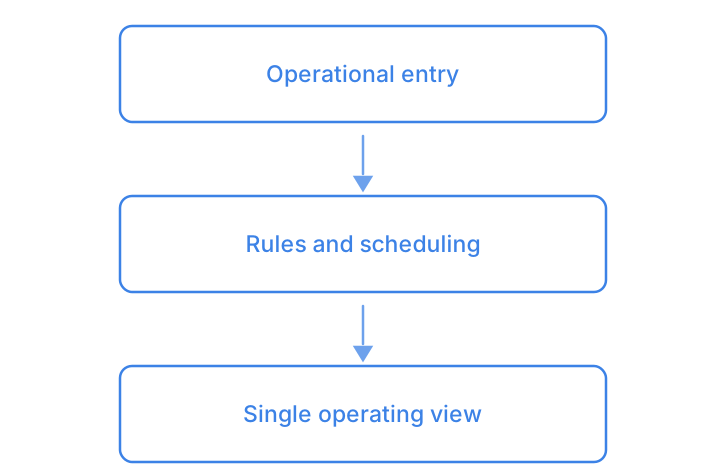
Enter once, let the rules schedule, read a single view: this foundation is shared across the family — you will find it in Management Systems (PMS) and in Order Management System (OMS).
- Billing EngineAutomatic generation of rent due notices and rent receipts.
- Automatic IndexationApplication of revision indices (RRI, CRI) on the anniversary date of leases.
- Management of Intervention Follow-upCentralisation of intervention requests, quotations and tradesmen’s work orders.
Smooth and frictionless integration
We connect the system to your existing accounting: whether it be your accounting software, your business software or a business ERP: without forced migration. The historical data from your leases remains accessible. If you already use a partial management tool, we identify what works and what needs to evolve. The deployment is carried out by portfolio or by property type, never through abrupt changeover.
Your teams continue to work during the transition, with a progressive ramp-up over three to six months depending on the size of the portfolio.
Audit of the property portfolio and processes
Analysis of your tenancy agreements, management rules, current tools and friction points identified by your property managers.
Business Rules Modelling
Construction of the billing engine, allocation keys and intervention workflows tailored to your specific requirements.
Progressive rollout by portfolio
Go-live on a pilot perimeter, validation with your teams, then extension batch by batch.
Transfer of skills and autonomy
Operational training, documentation of your specific rules, responsive support during the first complete cycles.
Measurable results for your organisation
- Receipt generation reduced to 2 hours per month instead of 2 days for a fleet of 800 units
- Error rate on charge adjustments reduced by a factor of 4 from the first year
- 100% of indexations applied to date, without manual verification
- Average technical intervention processing time reduced by 40%
- Consolidated mandate reporting in 15 minutes instead of 2 days
- 60% reduction in tenant disputes relating to charges
Clarifying your decision-making
Our leases have very specific clauses, some dating back 30 years. Can the system really manage them?
A management system tailored to your portfolio, rather than generic software, is precisely what atypical leases call for. Clarendis audits your leases upstream and models their rules into the engine. If a clause is genuinely unclassifiable, it stays in manual processing, but these exceptions are isolated instead of contaminating the whole process.
How long before our managers become autonomous?
Managers become autonomous on standard functions within 4 to 6 weeks in our deployments, with field support. Complex cases, annual reconciliations and data migrations, require a full initial cycle with our support. At six months, the teams we have trained handle the vast majority of situations independently.