
BIM Interoperability & Construction Site Monitoring
On a property development site, the BIM model contains everything: the dimensions, the materials, the services, the openings.
But between the design office and the site, this data is lost. The site manager prints PDF drawings, notes observations on paper, re-enters them into a spreadsheet in the evening. The next day, a modification arrives from the architect: new IFC version: and no one knows whether the site teams are working with the correct information. Snagging items accumulate in emails, technical approvals drag on, and when it comes to justifying a delay to the client, the history is reconstructed from three contradictory sources.
Meanwhile, execution errors: a duct in the wrong location, a suspended ceiling too low: generate remedial works that weigh on the construction budget. This is not a problem with the teams’ competence. It is a continuity problem: the data exists, it is simply inaccessible where it would be useful.
This solution belongs to the Data, Master Records & Reporting family.

Challenges holding back your performance
Spreadsheets and generic monitoring tools do not speak BIM. It is impossible to automatically extract a joinery schedule or link a reservation to a specific object in the model.Result: permanent double entry, risk of error at each transcription. BIM collaborative platforms, meanwhile, are designed for design offices, not for construction sites. Complex interface, internet connection required, extensive training: the site manager returns to his notebook. As for generalist service providers, they offer standard connectors which ignore your naming conventions, your validation workflows, your package constraints.Ultimately, each project reinvents its own monitoring system, impossible to capitalise from one operation to another.
Our Technical Approach
Our approach stems from a simple observation: the BIM model is a database, not merely a 3D drawing.
We construct bridges that extract structured information: specifications, locations, technical attributes: and render it exploitable on-site, within interfaces for each use case. A works manager accesses quantities for a package without opening the modelling software. A reservation raised on tablet automatically geolocates within the model.
A technical visa modifies the status of a BIM object without manual intervention. The intelligence lies in the mapping: we model your business conventions, your construction phases, your approval workflows. This is not blind synchronisation between two software applications, it is contextual translation that respects your teams’ logic. The model becomes the single source of truth, fed by the field as much as it informs it.
Automated extraction of BIM schedules
Management of snagging clearances
Technical approval traceability
Technical Architecture
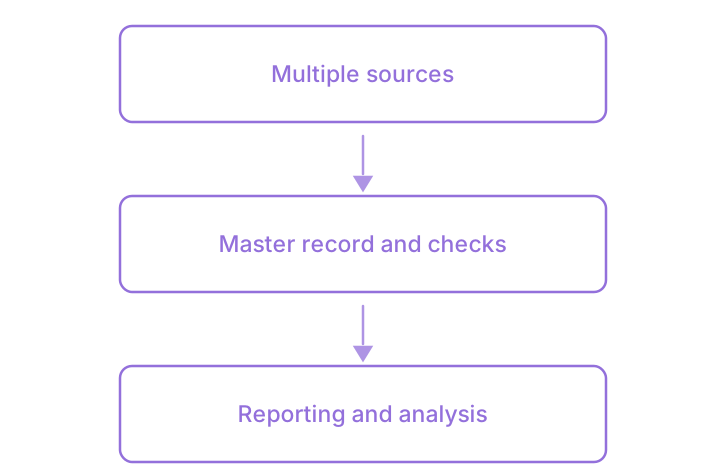
Several sources, one master record to arbitrate between them, then analysis: Core HR & Single Employee Record and Local Government Open Data stem from this same chain.
- Automated extraction of BIM schedules
- Management of snagging clearances
- Technical approval traceability
Smooth and frictionless integration
We work with your existing modelling tools, or any standard IFC export. The existing site monitoring system, even a simple file-sharing space, can serve as an entry point. No need to replace your document management system or project management software.
We deploy by batch or by phase, on a pilot operation, with the teams who will operate the system. Practices change progressively, historical data remains accessible.
Audit of current workflows
Analysis of your standard models, your field tools and your validation processes on a representative operation.
Business mapping design
Definition of BIM extraction rules, correspondences with your internal nomenclatures and approval workflows.
Pilot deployment
Implementation on a specific package or construction phase, including training for site users and adjustments under actual conditions.
Generalisation and Capitalisation
Extension to other packages, documentation of parameters for replication on your future operations.
Measurable results for your organisation
- Construction site meeting preparation markedly shortened
- Less rework related to drawing interpretation errors
- Complete traceability of approvals: who validated what, when, on which version
- Schedules extracted from the model rather than re-entered by hand
- Geolocated snagging clearances within the model, with history accessible to all stakeholders
- Cross-project capitalisation: consistent data structure from one operation to another
Clarifying your decision-making
Our subcontractors do not use BIM, how does it work with them?
Subcontractors do not need access to the model. Clarendis generates simplified views — annotated PDF drawings, task lists, snagging forms — that synchronise with the central model. Their input feeds back without any change to their working practices.
What configuration effort is required to adapt the system to our internal conventions?
Initial configuration is carried out with your methods teams, mapping your BIM attributes, phases and validation workflows. That work is reusable on subsequent operations and pays for itself from the second project onwards.