
Subcontracting Monitoring Portals
In the tech industry, the reality is that 40 to 60% of the value of your products is manufactured elsewhere. Electronic boards subcontracted, precision machining at a contract manufacturer, partial assembly at an EMS. Your supply chain is fragmented, sometimes across three time zones. The daily challenge for your procurement teams: knowing where production actually stands.
Today, it’s a discontinuous flow of emails, Excel files sent on Friday evenings, phone calls to chase up. Your planners spend their mornings consolidating heterogeneous data to feed the MPS. Meanwhile, an unreported delay at a tier-2 subcontractor silently pushes back your customer delivery by three weeks.
Quality audits reveal batches without complete traceability. Non-conformities arrive by email, without structured workflow, and get lost in inboxes. Your buyers are flying blind, unable to challenge a supplier on their actual delivery times versus their commitments.
This solution belongs to the Partner & Network Extranets family.

Challenges holding back your performance
Excel remains the default tool: each subcontractor sends their file in their own format, with their columns and date logic. Your teams reprocess, consolidate and correct data entry errors. EDI systems exist but are expensive to maintain and only cover your largest suppliers. The supplier portals of major ERP systems are often over-engineered, inflexible, and your 15-person subcontractors refuse to connect to them.As for generic collaborative tools such as SharePoint or Google Drive, they lack any business intelligence: no link to your works orders, no alerts on deviations, no integration with your bill of materials documentation tool.Result: the information exists somewhere, but never at the right time, never in the right format for decision-making.
Our Technical Approach
Our approach stems from a straightforward observation: your subcontractors will only use a portal if it simplifies their work. We design streamlined interfaces where an operator can declare their progress in three clicks, from a smartphone on the workshop floor. Behind this simplicity lies robust business logic. Each declaration is linked to your works orders, your bills of materials, your contractual milestones.
The system automatically detects variances between planned and actual schedules, calculates the impact on your requirement dates, and alerts your procurement teams before delays become critical. Document sharing is compartmentalised: each supplier sees only what concerns them, with precise version and revision control. Non-conformances follow a structured workflow with photographs, analyses, corrective actions: no more email ping-pong.
The entire system feeds your MRP with reliable data, not optimistic estimates.
Traceability of Physical Flows
Precise monitoring of raw material responsibility transfer between your premises and theirs.
Declaration of Progress
Streamlined interfaces enabling the subcontractor to report the completion of an operation.
Document Sharing (PLM)
Automatic provision of the latest version of drawings (CAD) and bills of materials.
Non-Conformance Management
Digitalised process enabling the subcontractor to report a defect on your supplied components.
Recomputation of the Schedule (MRP)
The deadlines announced by the partner automatically update your assembly dates.
Compartmentalisation of Data
Each partner sees strictly only the manufacturing orders assigned to them.
Technical Architecture
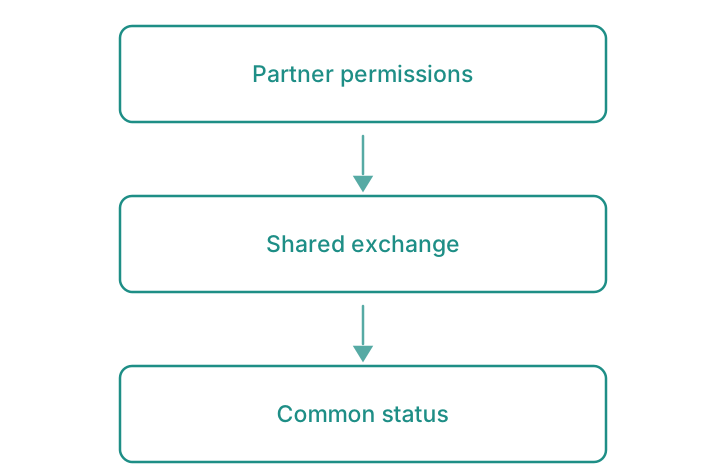
Grant each partner their permissions, exchange the flows, share one common status: that is what Partner Portals & Project Tracking and Dealer & Network Portal do.
- Traceability of Physical FlowsPrecise monitoring of raw material responsibility transfer between your premises and theirs.
- Declaration of ProgressStreamlined interfaces enabling the subcontractor to report the completion of an operation.
- Document Sharing (PLM)Automatic provision of the latest version of drawings (CAD) and bills of materials.
- Non-Conformance ManagementDigitalised process enabling the subcontractor to report a defect on your supplied components.
- Recomputation of the Schedule (MRP)The deadlines announced by the partner automatically update your assembly dates.
- Compartmentalisation of DataEach partner sees strictly only the manufacturing orders assigned to them.
Smooth and frictionless integration
The portal connects to your ERP, whatever it may be — Sage X3, Sylob, SAP, Odoo… — via API or scheduled file exchanges. No migration, no double entry for your internal teams. Your article, supplier and order reference systems remain master. We adapt the data model to your reality: your article codes, your units, your validation workflows.
Deployment is carried out supplier by supplier, starting with those that cost you the most in follow-ups.
Mapping of flows
Analysis of your 10-15 critical suppliers, their current reporting practices, and friction points on the procurement and quality side.
Configuration and ERP Integration
Configuration of the portal based on your reference systems, establishment of exchanges with your system, definition of alerts and thresholds.
Pilot with 3 suppliers
Live deployment on a limited scope, support for subcontractors, adjustments based on field usage.
Progressive deployment
Supplier-by-supplier extension according to your priorities, training of your procurement and quality teams.
Measurable results for your organisation
- Planning consolidation time reduced from 6 hours to 45 minutes per week
- Visibility of supplier delays improved from D+5 to D+0
- Subcontractor response rate to progress requests exceeding 90%
- 35% reduction in telephone follow-ups by procurement staff
- Complete batch traceability for 100% of outsourced components
- Average non-conformity processing time halved
Clarifying your decision-making
Our subcontractors are small organisations; they will never use an additional tool.
The portal interface is designed for field use rather than desk work: a declaration takes thirty seconds from a mobile phone. Across our deployments, adoption exceeds 85% from the second month, because the supplier gains as well: fewer chase-ups, fewer disputes over deadlines.
How do you manage confidentiality between competing suppliers?
Partitioning is native: each supplier sees only their own orders, documents and exchanges. No cross-visibility is possible, even on identical parts. Rights are managed at work-order level, not at the level of the portal as a whole.