
Production Management & Workshop Interfaces
In a factory, the reality on the shop floor never quite corresponds to what the ERP displays. Operators record quantities produced on loose sheets, declarations are reported at the end of the shift—sometimes the following day—and the production manager navigates by sight with data that is already 8 hours behind. Machine stoppages? No one really knows how long they last or why they recur.
The OEE displayed in the management committee is an optimistic estimate, reconstructed after the fact. Meanwhile, quality teams chase missing traceabilities, maintenance technicians intervene on weak signals they detect too late, and team leaders spend more time re-entering data than managing their line.
The gap between what actually happens at the machines and what the central systems see creates permanent blind spots: on yields, on causes of non-conformity, on the actual utilisation of equipment.
This solution belongs to the Business Operations & ERP family.
Challenges holding back your performance
Excel remains the tool of choice because it is flexible and everyone knows how to use it.But it doesn’t connect anything: data remains in scattered files, re-entered three times, with copy-paste errors that skew analyses. Market MES solutions promise Industry 4.0, but their deployment takes 18 months, costs six times the initial budget and requires overhauling all processes. Operators end up circumventing a system designed by people who have never set foot on the shop floor.As for internal developments, they work as long as the developer who created them is still with the company. The day they leave, no one dares touch the code: and the tool becomes yet another legacy system to maintain.
Our Technical Approach
Our approach begins with the operator workstation, not the IT architecture. We start by observing what teams actually do: what information they handle, when, and under what time constraints. The interfaces we build are designed for gloved hands, noisy environments, and operators who change stations.
Machine telemetry complements human input rather than replacing it: to ensure reliable cycle times, detect micro-stoppages invisible to the naked eye, and feed OEE calculations that reflect reality. Offline degraded mode is not an option: it is a prerequisite, because a production line cannot stop when the network fails.
Digital andon and integrated operating procedures transform the interface into a genuine management tool, not simply a data entry form. Data flows in real time to your systems: ERP, CMMS, BI: without double entry.
Ergonomic Interfaces
Wide buttons, high contrast, designed for challenging industrial environments.
Machine Telemetry (IoT)
Automatic ingestion of piece counters via industrial protocols (OPC-UA).
Degraded Mode (Offline)
Maintenance of production and asynchronous synchronisation in the event of Wi-Fi network loss.
Standard Operating Procedures (SOP)
Display of 3D plans and instruction sheets directly at the workstation.
Production Control & Workshop Interfaces CalculationnnReal-Time OEE Calculation
Algorithmic engine qualifying stoppages instantaneously (Availability, Performance, Quality).
Digital Andon
Triggering of visual alerts and notifications to supervisors in the event of anomalies.
Technical Architecture
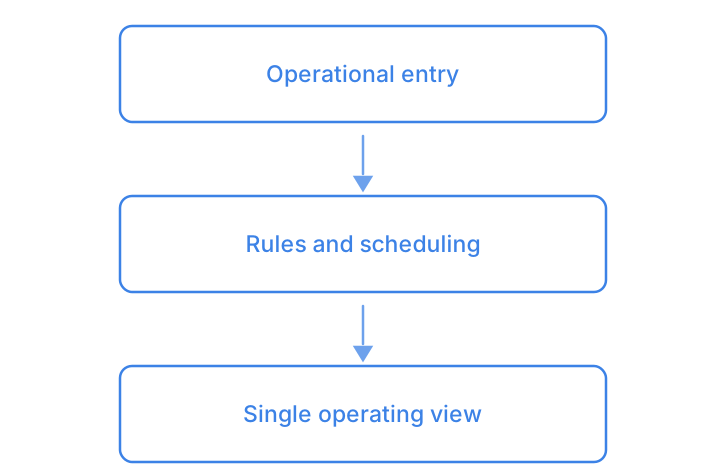
Enter once, let the rules schedule, read a single view: this foundation is shared across the family — you will find it in Workshop & After-Sales Management and in Management Systems (PMS).
- Ergonomic InterfacesWide buttons, high contrast, designed for challenging industrial environments.
- Machine Telemetry (IoT)Automatic ingestion of piece counters via industrial protocols (OPC-UA).
- Degraded Mode (Offline)Maintenance of production and asynchronous synchronisation in the event of Wi-Fi network loss.
- Standard Operating Procedures (SOP)Display of 3D plans and instruction sheets directly at the workstation.
- Production Control & Workshop Interfaces CalculationnnReal-Time OEE CalculationAlgorithmic engine qualifying stoppages instantaneously (Availability, Performance, Quality).
- Digital AndonTriggering of visual alerts and notifications to supervisors in the event of anomalies.
Smooth and frictionless integration
We do not replace your ERP; we feed it with reliable data. Integration is carried out via API or exchange files according to what your IS actually supports. We deploy line by line, beginning with a pilot cell which enables validation of usage before extending. Operators are trained at their workstations, not in a meeting room.
Your IT teams retain control of the infrastructure: we document everything and transfer the expertise.
Workshop observation
One week on the shop floor to map actual flows, data entry points, and daily pain points experienced by the teams.
Prototype on pilot line
Deployment of a first functional interface on a production cell, with actual operators.
Machine and IT System Connectivity
Integration of IoT telemetry and data flows to the ERP/CMMS, validation of data under real-world conditions.
Deployment and autonomy
Extension to other lines, team training, transfer of maintenance to internal resources.
Measurable results for your organisation
- Production data available in real-time, and also at D+1
- 70% reduction in time spent by team leaders on administrative re-entry tasks
- OEE calculated automatically with ±2% accuracy, compared to ±15% with manual reporting
- Complete batch traceability for quality and client audits
- Identification of recurring downtime causes within 2 weeks of deployment
- Operator adoption exceeding 90% through interfaces designed for the shop floor
Clarifying your decision-making
We already have an ERP with a production module that we don’t really use - why not start from there?
ERP production modules are designed for management, not for the shop floor: too many clicks, no offline operation, no capture of machine data. A shop-floor system can feed them automatically instead, which is often the best way to make them finally useful.
Our operators are not comfortable with IT systems, how can we ensure they will use the system?
Workshop interfaces are designed with operators, not for them: large buttons, touchscreens usable with gloves, text input kept to a minimum. Clarendis has deployed in foundries where the average age exceeds 50. The adoption rate depends on the quality of the ergonomics, not on the users’ profile.