
Digital Learning Platforms (LMS)
Training organisations are experiencing unprecedented pressure. On one hand, Qualiopi requires rigorous traceability of learning pathways, assessments and attendance. On the other, learners – accustomed to Netflix and YouTube – disengage after 8 minutes on a poorly designed platform. Caught between the two, teaching teams juggle tools that were never designed to work together: an ageing LMS here, videos stored on Vimeo there, quizzes on Google Forms, certificates generated manually in Word.
The result: completion rates that plateau at 15-20%, stressful Qualiopi audits where evidence is hastily compiled, and trainers who spend more time on administration than on teaching. For organisations that sell their training – either B2C or B2B to companies – the complexity of monetisation is added: access management, billing, client reporting.
All this with often non-existent IT budgets and an IT department overwhelmed by other priorities.
This solution belongs to the Customer & User Portals family.

Challenges holding back your performance
LMS platforms on the market fall into two camps. The behemoths (Moodle, 360Learning, Cornerstone) require months of configuration, highly specialised technical skills and six-figure budgets. Lightweight tools (Teachable, Podia) are suitable for selling an online course, but collapse as soon as one needs to manage 200 employees from a corporate client with differentiated learning pathways and consolidated reporting.Result: many organisations resort to makeshift solutions. Videos fail to play properly on mobile, assessments don’t feed back in the correct format for Qualiopi, certificates are generated one by one. Teams spend their Friday afternoons exporting CSVs, cross-referencing data and preparing reports that no one will read. The learner experience suffers, dropout rates soar, and the initial pedagogical promise becomes diluted in administrative burden.
Our Technical Approach
Our approach stems from an observation: an effective training platform is first and foremost a media platform. Video must load instantaneously, adapt to the learner’s connection (4G on the underground or fibre in the office), and resume where they left off.
We build upon this solid technical foundation: adaptive streaming, intelligent caching, mobile-optimised player: before layering on the pedagogical functions. Assessments are not bolted-on forms: they integrate into the video stream, enable conditional branching based on responses, and automatically populate monitoring dashboards.
Qualiopi traceability is native, not retrofitted: every action generates a timestamped and signed trace. For monetisation, we clearly separate access logic (who can view what, until when) from commercial logic (subscription, unit purchase, enterprise licence), which allows the offering to evolve without rewiring everything. The administration interface is designed for trainers, not system administrators.
Adaptive Video Streaming
The video quality adapts in real time to the pupil’s internet connection.
Assessment Engines
Creation of complex quizzes, assignments to upload and peer assessments.
Learning Monitoring
Precise recording of time spent, essential for compliance and certifications.
Certificate Generation
Automatic issuing of an unforgeable PDF certificate upon successful completion of the course.
B2C/B2B Monetisation
Integration of purchasing funnels (Stripe) to sell courses individually or by subscription.
Perfect Mobile Accessibility
Interface designed for taking a course whilst travelling without needing to download an application.
Technical Architecture
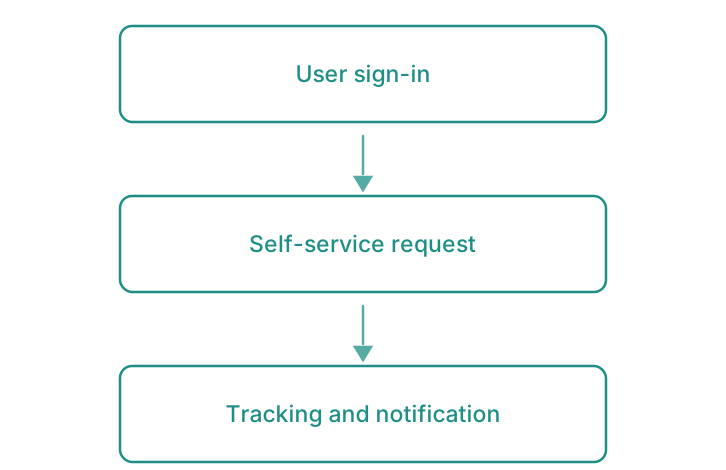
Identify the user, let them act on their own, keep them informed: VIP Member Portal and Concierge Applications work the same way.
- Adaptive Video StreamingThe video quality adapts in real time to the pupil’s internet connection.
- Assessment EnginesCreation of complex quizzes, assignments to upload and peer assessments.
- Learning MonitoringPrecise recording of time spent, essential for compliance and certifications.
- Certificate GenerationAutomatic issuing of an unforgeable PDF certificate upon successful completion of the course.
- B2C/B2B MonetisationIntegration of purchasing funnels (Stripe) to sell courses individually or by subscription.
- Perfect Mobile AccessibilityInterface designed for taking a course whilst travelling without needing to download an application.
Smooth and frictionless integration
We do not ask you to discard what already exists. Your current SCORM content can be imported. Your company directory (Active Directory, Google Workspace) synchronises accounts. Your CRM or ERP receives completion data via standard API.
Deployment begins with a pilot on an existing programme: often the most problematic one: to validate the approach before expanding. Trainers maintain their content creation habits; we add a publication layer, not a complete overhaul of their working methods.
Audit of existing pathways
Analysis of your current content, your Qualiopi constraints and your sales flows. Identification of the pilot pathway.
Construction of the technical foundation
Deployment of video infrastructure, configuration of access rules and connection to your existing directory.
Migration and pilot
Import of pilot pathway content, training of initial trainers, launch with a test cohort.
Deployment and autonomy
Extension to other pathways, activation of monetisation modules where relevant, complete transfer to internal teams.
Measurable results for your organisation
- Course completion rates increasing from 18% to 65% on average over 6 months
- Qualiopi audit preparation time reduced from 3 days to 2 hours
- Video loading under 2 seconds, including on poor mobile connections
- Automated generation of 100% of attestations and certificates without manual intervention
- 70% reduction in administrative time for teaching teams
- Capability to simultaneously manage B2C sales and multi-enterprise B2B contracts on a single platform
Clarifying your decision-making
How do you manage large video volumes without causing hosting costs to skyrocket?
Delivery runs through a content network billed on actual usage, with adaptive encoding that generates multiple qualities automatically. For an organisation with 500 hours of content and 2,000 active learners, budget between €200 and €400 per month for infrastructure, considerably less than a traditional LMS licence.
Our trainers are not technical. How long will it take for them to become autonomous?
Two half-day sessions are enough for trainers to handle routine operations: publishing a module, tracking a cohort, exporting a summary. The interface is modelled on tools they already know. Complex cases, new pathway types or specific integrations, stay with a trained lead or our support team.