
Skills Management
In most companies, skills management remains a blind spot. Managers conduct their annual reviews with a Word form sent by email, HR consolidates as best they can in a spreadsheet, and six months later no one knows who expressed which career development aspirations.
Result: talent leaves because we failed to see they were stagnating, internal vacancies are filled by default rather than by competence, and training plans are built on impressions rather than data. HR teams spend their days chasing information instead of analysing it. Managers, meanwhile, experience the annual review as an administrative chore with no follow-up.
And when senior management requests a mapping of critical skills to anticipate a retirement or new business activity, it’s panic stations. This isn’t a problem of willingness. It’s a problem of tools and methodology.
This solution belongs to the Business Operations & ERP family.

Challenges holding back your performance
Excel remains the default tool. Each HR department has their version, each manager their file. Data is scattered, inconsistent, and rarely up to date. Market HRIS solutions offer competency modules, but they are often rigid: imposed nomenclatures which don’t correspond to your professions, interfaces designed for groups of 10,000 employees, prohibitive configuration costs.As for free or low-cost tools, they manage appraisals as an isolated form, with no link to training or mobility. These makeshift solutions work up to 50 employees.Beyond that, or as soon as one genuinely wishes to manage career paths, enormous time is wasted reconstructing a colleague’s history or identifying who could develop competencies for a key position.
Our Technical Approach
Our approach stems from a simple observation: a competency management tool is only valuable if it is actually used.
We therefore build interfaces that managers genuinely want to open: not yet another form, but a space where they visualise their team, its strengths, its areas for development. The appraisal becomes a natural input moment, not an additional constraint. On the HR side, we structure a living competency map that updates throughout appraisals, training completed, and internal moves.
No rigid framework: we adapt the grids to your actual roles, with the granularity that is useful to you. The link with the training plan is native: a need expressed in an appraisal can trigger a traceable development action. Management accesses consolidated views to anticipate risks (departures, rare competencies) and identify potential.
Everything remains simple to maintain, without an army of consultants.
Clear monitoring of appraisals
Internal talent mapping
Support for training plans
Technical Architecture
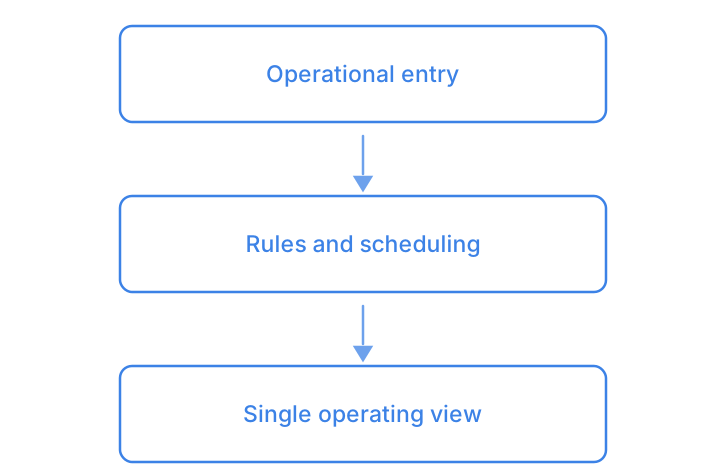
Enter once, let the rules schedule, read a single view: this foundation is shared across the family — you will find it in Workshop & After-Sales Management and in Management Systems (PMS).
- Clear monitoring of appraisals
- Internal talent mapping
- Support for training plans
Smooth and frictionless integration
We connect to your existing HRIS to retrieve employee data: no duplicate entry or risky migration. If you have a training tool, we establish a link so that actions decided during interviews are automatically fed back. Deployment is carried out in waves: a pilot directorate, then progressive extension. Your current HR processes are respected and digitised, not reinvented overnight.
Site assessment
Interviews with HR, managers and senior leadership to understand your current processes, pain points and actual priorities.
Construction of the skills framework
Co-design of competency frameworks tailored to your roles, with the appropriate level of detail — neither over-engineered, nor oversimplified.
Pilot deployment
Implementation on a limited scope, adjustments based on field feedback, training of initial users.
Generalisation and autonomy
Progressive extension across the entire organisation, transfer of expertise to your HR teams for autonomous management.
Measurable results for your organisation
- Annual appraisal completion rate increased from 60% to 95% on average after 12 months
- HR consolidation time reduced by 75% — from 3 weeks to 3 days for a company with 200 employees
- Real-time identification of critical skills held by fewer than 2 individuals
- 30% of internal mobility now anticipated rather than reactive
- 25% reduction in turnover amongst profiles identified as high-potential talent
- Training programmes aligned with expressed requirements, with complete traceability
Clarifying your decision-making
Our managers will never fill in another tool. How do you manage that?
The interface is designed so that a review can be prepared and documented in under fifteen minutes. Clarendis tests it systematically with your most reluctant managers before any wider rollout: if they use it, the others follow.
We already have an HRIS with a competencies module that we don’t use. Why would this be any different?
The difference lies in the starting point: your actual working practices rather than a standard configuration. Clarendis audits why the current module never took hold, often ergonomics or an unsuitable framework, then builds what is missing, as a complement or a replacement depending on what makes economic sense.