
Financial Modelling and Business Plans
In property development, each transaction is a financial wager where margins depend on assumptions. A developer launching a programme of 40 residential units commits €15 to €25 million over 3 to 5 years. Between land acquisition, feasibility studies, construction works, marketing and financing, variables accumulate. The finance director must answer seemingly simple questions: what IRR should we expect based on the sales rate?
What happens if interest rates rise by 50 basis points? If the construction project is delayed by 4 months? Banks require detailed business plans. Investors want exit simulations.
The internal investment committee demands three scenarios. Teams spend their days juggling between files, recalculating cash flows, checking formulae. Meanwhile, the real decisions: negotiating for land, choosing between two programmes, wait. Financial modelling is not an academic exercise: it is the daily management tool for a profession where a calculation error can turn profit into dead loss.
This solution belongs to the Data, Master Records & Reporting family.

Challenges holding back your performance
The programme director’s Excel file was created six years ago by someone who is no longer with us. It contains 47 worksheets, macros that no one dares touch, and links to other files that are sometimes impossible to locate. Each new transaction begins with a copy of this file, complete with its catalogue of referencing errors. The assumptions are buried within scattered cells.Comparing two financing scenarios takes half a day. When an investor requests a construction cost sensitivity analysis, one improvises. Market tools do exist, but they are either too rigid for your specific structures, or so complex that they require three days of training.Result: decisions are made with approximate data, and errors are discovered too late—sometimes at closing.
Our Technical Approach
Our approach begins by mapping your actual structures, not theoretical models. Each developer, each property company has its specificities: off-plan sales, property investment companies, SCCV structures, joint development, bare ownership arrangements.
We build a calculation engine that reflects your business logic, with your conventions for recognising income and expenditure. Assumptions are centralised and explicit: selling price per square metre, construction cost, forecast schedule, financing terms. Modifying one variable instantly recalculates the IRR, NPV, monthly cash flow.
Scenarios are no longer file copies but comparable sets of assumptions available at the click of a button. Expenditure commitment tracking integrates with the model: the variance between forecast and actual feeds directly into projections. Reports for banks and investors are generated in a consistent, auditable format.
The objective is not to replace the expertise of your finance teams, but to provide them with a reliable tool to simulate quickly and make better decisions.
Profitability calculation engines (IRR, NPV)
Simulation of financing scenarios
Monitoring of expenditure commitments
Technical Architecture
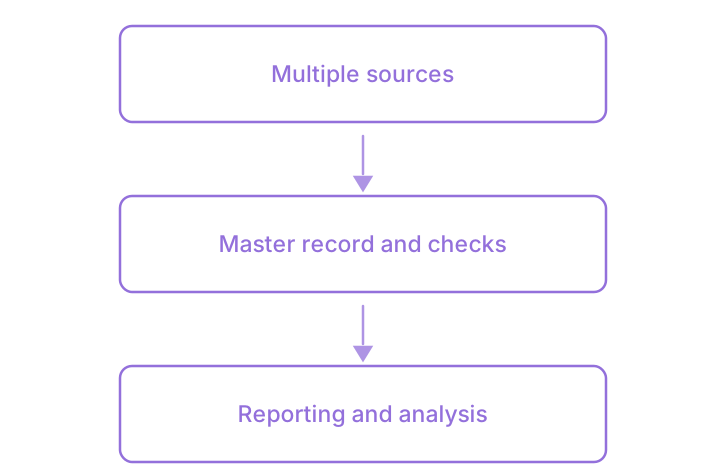
Several sources, one master record to arbitrate between them, then analysis: Observatories & Open Data and Batch Traceability & Genealogy stem from this same chain.
- Profitability calculation engines (IRR, NPV)
- Simulation of financing scenarios
- Monitoring of expenditure commitments
Smooth and frictionless integration
Your accounting ERP, your project management tool, your commercial monitoring dashboards: they remain in place. We connect the modelling engine to these sources to retrieve actual data: work progress, contracts signed, capital calls. Teams continue to work within their usual tools. Excel exports remain available for those who require them.
Deployment is carried out operation by operation, beginning with a pilot programme to validate calculation rules with your teams.
Audit of existing models
Analysis of your current files, identification of implicit business rules, mapping of data sources utilised.
Construction of the calculation engine
Development of IRR/NPV calculation rules, structuring of assumptions, validation with your finance teams on real-world cases.
Pilot on a transaction
Deployment on an ongoing programme, comparison of results with your current models, adjustments based on field feedback.
Deployment and connection to sources
Extension to other operations, integration with ERP and monitoring tools, training of key users.
Measurable results for your organisation
- Time required to produce a business plan reduced from 2 days to 3 hours
- Comparison of 5 Financing Scenarios in Under 15 Minutes
- Real-time budget variance detection, not at quarterly close
- 80% reduction in formula and reference errors in models
- Investor presentation generated in 30 minutes with updated data
- Complete history of assumptions used for each version of business plan
Clarifying your decision-making
Our structures are highly specific—how can we be certain that the tool will adapt accordingly?
The engine models your actual operations, not textbook cases. The first phase dissects three or four of your representative structures with your finance director. If your business logic does not fit the framework, the engine adapts rather than the reverse.
How long before having a tool usable in production?
A first pilot programme is operational within 6 to 10 weeks in our deployments. Full deployment depends on the number of operation types to model, the aim being concrete results quickly rather than a project that drags on.