
One-Stop Citizen Service Centres
French local authorities are overwhelmed with requests: school registrations, civil status matters, planning, social benefits, parking. Each service has historically developed its own form, its own database, its own workflow.
The result: citizens must re-enter their address fifteen times per year, reception staff juggle between six business software systems that do not communicate with each other, and the IT Director manages a fragmented application portfolio with accumulating maintenance contracts. Regulatory obligations add constant pressure: RGAA for accessibility, GDPR for data, FranceConnect for digital identity, Tell Us Once to avoid redundancies.
Technical teams are reduced: often two or three people for an intercommunal authority of 50,000 inhabitants. Budgets are voted annually, elected officials want visible results quickly, and each failed project leaves lasting traces in the trust of residents. The telephone rings just as much, queues at the town hall do not get shorter.
This solution belongs to the Customer & User Portals family.

Challenges holding back your performance
Current attempts encounter the same pitfalls. The portals provided by specialist software vendors only cover their own scope: one for early childhood services, another for planning, a third for civil registration procedures. Citizens end up with three different accounts. Internal development projects become bogged down: IT teams are tied up with routine maintenance, and staff turnover takes away functional knowledge.General service providers deliver showcase portals that do not interface with existing specialist software: officers must manually re-enter requests received online. As for shared spreadsheets for tracking, these quickly become unmanageable once volumes exceed a few dozen requests per week.
Our Technical Approach
Our approach is based on an orchestration layer that positions itself above existing business software without replacing it. The citizen portal becomes the single entry interface: authentication via FranceConnect, intelligent forms that pre-populate data already known to the administration, real-time tracking of each request.
Behind the scenes, standardised connectors communicate with your applications: whether they be Berger-Levrault, Arpège, JVS or in-house developments. RGAA accessibility is native, tested by users with disabilities, not simply validated by an automatic audit. The integrated secure messaging system avoids untraced email exchanges.
Data remains hosted in France, on SecNumCloud-qualified infrastructures when sensitivity requires it. The citizen dashboard visualisation tool displays the complete history of exchanges with the local authority, reducing follow-up calls that congest reception services.
FranceConnect Integration
Standardised authentication preventing the creation of new passwords.
Strict Accessibility (WCAG)
Legal compliance ensuring use by persons with disabilities.
Tell us once
Secure storage of supporting documents to avoid requesting them again for the next procedure.
Citizen Dashboard
Immediate visualisation of the status (In progress, Awaiting documentation, Validated) of each file.
Secure Messaging
Exchange of information or missing documents directly with the processing officer.
Data Sovereignty
Hosting on certified cloud infrastructures (SecNumCloud) located within the territory.
Technical Architecture
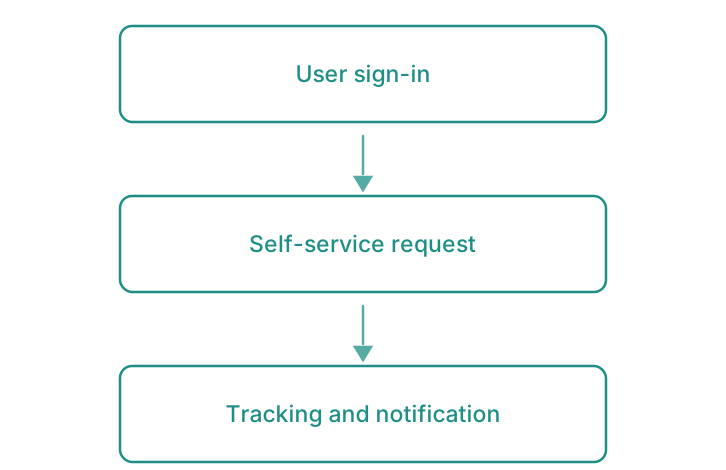
Identify the user, let them act on their own, keep them informed: Concierge Applications and VIP Member Portal work the same way.
- FranceConnect IntegrationStandardised authentication preventing the creation of new passwords.
- Strict Accessibility (WCAG)Legal compliance ensuring use by persons with disabilities.
- Tell us onceSecure storage of supporting documents to avoid requesting them again for the next procedure.
- Citizen DashboardImmediate visualisation of the status (In progress, Awaiting documentation, Validated) of each file.
- Secure MessagingExchange of information or missing documents directly with the processing officer.
- Data SovereigntyHosting on certified cloud infrastructures (SecNumCloud) located within the territory.
Smooth and frictionless integration
We connect the portal to your business software via API where available, or through standardised file exchanges otherwise. No forced migration, no replacement of your current tools. Staff continue to work in their usual applications: they simply receive pre-qualified requests and documents that have already been verified. Deployment is carried out in functional blocks: we often begin with two or three high-volume procedures before gradually expanding.
Mapping of processes
Audit of existing procedures, volumes, relevant business software and current friction points for citizens and staff.
Technical Foundation and Initial Procedures
Deployment of the portal with FranceConnect, implementation of two or three high-impact procedures, connection to initial business software systems.
Progressive expansion
Addition of new procedures in quarterly waves, training of relevant services, adjustments according to field feedback.
Autonomy and continuous improvement
Transfer of competencies to internal teams for the creation of new forms, your dashboard visualisation tool for monitoring usage and identifying optimisations.
Measurable results for your organisation
- 40-60% reduction in follow-up telephone calls through your citizen dashboard visualisation tool
- Online application completion rate exceeding 85% compared to an average of 50% for PDF forms
- WCAG Level AA compliance verified and maintained with each update
- Average request processing time reduced by 30% through the elimination of re-keying
- A single citizen account for all local authority procedures
- Staff training time limited to half a day per service
Clarifying your decision-making
How do you manage business software that does not have an API?
Business software without an API accounts for the majority of cases. Clarendis works through structured file exports and imports, or develops specific connectors where volume justifies it. Council officers keep their existing working practices.
What is the actual cost for a local authority with 30,000 inhabitants?
For an authority of 30,000 inhabitants, budget between 40,000 and 80,000 euros for the initial platform with five to ten integrated procedures, then annual maintenance of 15 to 20% of that amount. Return on investment is calculated on staff time freed up and the reduction in telephone enquiries.