
Agricultural Cooperatives Portals
In an agricultural cooperative, the relationship with producers is based upon constant exchanges: contribution declarations, analysis results, quota monitoring, and traceability documents.
In practice, these flows often still pass through fragmented channels: telephone calls to the technician, faxes for delivery notes, post for laboratory results, Excel spreadsheets shared by email for volume monitoring. At head office, the administrative assistant spends her mornings re-entering data. In the field, the cooperative member sometimes waits a week to know whether his lot is compliant.
Collection technicians juggle between notebooks and management software to reconcile figures. When the CAP declaration period arrives or a quality audit takes place, it’s a race to reconstruct the history. This fragmentation erodes trust: the producer has the impression of delivering into a black box, whilst the cooperative struggles to valorise the quality efforts of its members.
The human connection remains strong, but the tools do not keep pace.
This solution belongs to the Customer & User Portals family.

Challenges holding back your performance
The generalist tools: standard CRMs, market GEDs, supplier portals designed for industry: do not understand agricultural specificities: seasonality of deliveries, batch variability, quality standards specific to each sector (protein levels, calibration, residues). Excel remains the default recourse, with its known limitations: multiple versions, input errors, zero traceability.Internal development attempts become bogged down due to lack of time on the IT department’s side, already mobilised on ERP and regulation. As for the large agricultural publishers, their portals are often secondary modules, poorly ergonomic, designed for technicians and not for a farmer who consults his telephone between two work sites.Result: digital remains an irritant rather than a facilitator.
Our Technical Approach
Our approach stems from a simple observation: the cooperative member is not a captive user, but rather a partner whom one must convince to utilise the tool. Therefore, we design mobile-first, with user journeys that require only three clicks from a smartphone at the field’s edge. Delivery declarations are made by photographing the delivery note or scanning a QR code on the collection lorry.
Analysis results arrive via push notification, with immediate colour coding: compliant, alert, rejection: before the technical detail for those who wish to delve deeper. Quota monitoring displays like a personal dashboard visualisation tool, updated in real-time with each delivery. On the cooperative side, the portal integrates with your existing management system: whether it be Isagri, a sector-specific ERP or an in-house database: via APIs or file imports if necessary.
No double entry, no parallel database. The news area enables targeted dissemination of technical advice and sector alerts, without overwhelming the producer with information.
Mobile-First Experience
Streamlined interface, large buttons, requiring minimal bandwidth (3G/Edge network).
Restitution of Analyses
Graphical display of quality results (Germs, Cells, Fat content).
Dematerialisation of Vouchers
Instant access to official weighing slips and payment invoices (Statements).
Declaration of Contributions
Form for the farmer to declare their anticipated volumes for the forthcoming harvest.
News and Advisory Services
Broadcasting of agronomic advice, weather information or health alerts by the cooperative.
Quota Management
Clear visualisation of production progress against the annual contract commitment.
Technical Architecture
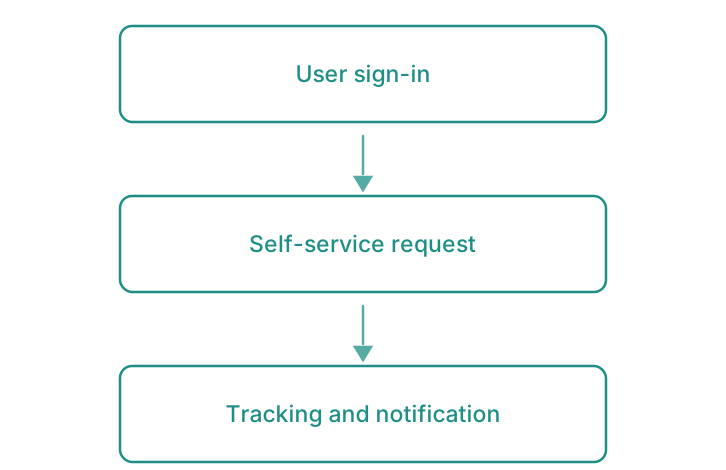
Identify the user, let them act on their own, keep them informed: One-Stop Citizen Service Centres and VIP Member Portal work the same way.
- Mobile-First ExperienceStreamlined interface, large buttons, requiring minimal bandwidth (3G/Edge network).
- Restitution of AnalysesGraphical display of quality results (Germs, Cells, Fat content).
- Dematerialisation of VouchersInstant access to official weighing slips and payment invoices (Statements).
- Declaration of ContributionsForm for the farmer to declare their anticipated volumes for the forthcoming harvest.
- News and Advisory ServicesBroadcasting of agronomic advice, weather information or health alerts by the cooperative.
- Quota ManagementClear visualisation of production progress against the annual contract commitment.
Smooth and frictionless integration
We do not replace your IT system; we add a user-friendly interface for your members. The portal interfaces with your collection management tools, your LIMS for analyses, and your invoicing software. Standard connectors exist for the main agricultural software providers. For older systems, we work through scheduled file exchanges.
Deployment is carried out by sector or by site, at your pace. Existing cooperators migrate progressively, whilst new members start directly on the portal.
Mapping of Member Flows
Analysis of current exchanges with your cooperative members: declarations, documents, analyses, quotas. Identification of priority friction points in the field and at head office.
Mock-up and field test
Prototyping of key screens, tested with a panel of representative agricultural cooperators. Adjustments prior to development to ensure proper ergonomics.
Connection to existing IT system
Implementation of interfaces with your collection management, LIMS and invoicing tools. Validation of synchronisations on actual data.
Progressive rollout
Launch on a pilot supply chain, support for initial users, then extension at the pace of your organisation and your campaigns.
Measurable results for your organisation
- 70% reduction in incoming calls for analysis result requests
- Analysis turnaround time reduced from 5-7 days to less than 24 hours following laboratory validation
- Cooperative adoption rate exceeding 60% from the first season
- Elimination of manual re-entry of contribution declarations
- Complete traceability of documentary exchanges for quality audits
- Estimated gain of 0.5 FTE on administrative tasks related to members
Clarifying your decision-making
Our cooperative members are aged between 25 and 70, some are not comfortable with digital technology. How can we ensure adoption?
The cooperative portal is tested with real farmers before deployment, not with technical profiles. Critical user journeys work within three taps. An alternative channel is always maintained — SMS notification or PDF export by email — for those who prefer it. Adoption is built, it cannot be decreed.
Our industry-specific ERP system is 15 years old and the publisher does not offer a modern API. Is this a blocking issue?
An industry ERP without a modern interface is not a blocking issue. Clarendis works with scheduled file exports, intermediate databases, and direct database reading where necessary. It is not elegant on paper, but it works, and agricultural information systems often carry history.