
Quality & Allergen Repositories
In the food industry, each ingredient that goes into a recipe brings with it a cascade of information: origin, composition, allergens, nutritional values, certifications. Multiply by hundreds of references, add constant reformulations (raw material costs, supplier shortages, INCO regulatory changes), and you have a daily headache for R&D and Quality teams.
Supplier technical data sheets arrive in heterogeneous formats: scanned PDFs, approximate Excel spreadsheets, unstructured emails. Quality managers spend hours copying, recalculating, verifying. And when marketing requests labelling for a new product in three weeks’ time, it’s a race against time. Not to mention IFS/BRC audits where one must prove the traceability of each piece of data.
The risk is not abstract: an allergen error on packaging means a product recall, a potential health crisis, costs running into hundreds of thousands of euros.
This solution belongs to the Data, Master Records & Reporting family.

Challenges holding back your performance
Excel remains the default tool: one file per ingredient family, nutritional calculation formulae that are copied and pasted with origins unknown to anyone, versions circulated by email. When a supplier modifies an ingredient’s composition, it takes weeks for the information to propagate through all affected recipes: if it propagates at all.Traditional ERPs manage flows, not the complexity of quality specifications. Market formulation software is often oversized, rigid, with licence costs that spiral out of control.Result: teams cobble together solutions, maintain duplicate data entry, and the quality manager becomes the bottleneck for every product launch.
Our Technical Approach
Our approach stems from a simple observation: the technical specification of an ingredient is live data which feeds dozens of downstream calculations.
We build a single repository where each ingredient is documented once only, with its detailed composition, its allergens (present, traces, cross-contamination), its nutritional values per 100g. Recipes are constructed through assembly: when you modify an ingredient, all relevant finished products are recalculated automatically.
The calculation engine applies INCO rules: regulatory rounding, allergen order, mandatory declarations: without manual intervention. A workflow connects R&D to marketing: when a formula is validated, labelling is generated in the requested format. The supplier portal enables the collection of technical specifications in a structured format, directly exploitable.
Each modification is versioned, timestamped, traceable for your audits.
Quality & Allergen StandardsnnIngredients Standard
Database centralising the specifications (microbiological, physicochemical) of each raw material.
Automatic Nutritional Calculation
Generation of the macro table (Carbohydrates, Lipids, Proteins) by proportional summation.
Quality & Allergen StandardsnnAllergen Declaration
Automatic reporting of voluntary presence or fortuitous traces (Tree nut traces).
Management of Versions (Versioning)
Maintain accurate records of the label (V1, V2) according to the production date.
Workflows R&D to Marketing
Process validating claims (Gluten Free, Organic) before dispatch to the packaging agency.
Supplier Portal
Interface enabling suppliers to input their own technical specification sheets.
Technical Architecture
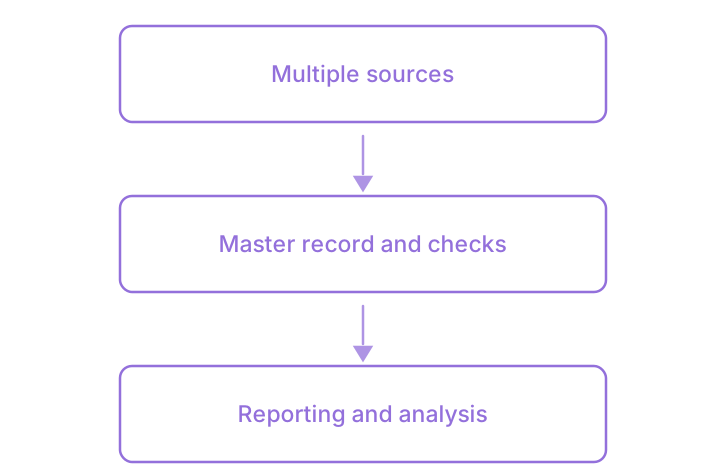
Several sources, one master record to arbitrate between them, then analysis: Observatories & Open Data and Batch Traceability & Genealogy stem from this same chain.
- Quality & Allergen StandardsnnIngredients StandardDatabase centralising the specifications (microbiological, physicochemical) of each raw material.
- Automatic Nutritional CalculationGeneration of the macro table (Carbohydrates, Lipids, Proteins) by proportional summation.
- Quality & Allergen StandardsnnAllergen DeclarationAutomatic reporting of voluntary presence or fortuitous traces (Tree nut traces).
- Management of Versions (Versioning)Maintain accurate records of the label (V1, V2) according to the production date.
- Workflows R&D to MarketingProcess validating claims (Gluten Free, Organic) before dispatch to the packaging agency.
- Supplier PortalInterface enabling suppliers to input their own technical specification sheets.
Smooth and frictionless integration
The reference system connects to your existing ERP to retrieve nomenclatures and synchronise article codes. No re-entry, no forced migration. Teams continue to work in their usual tools during the scaling-up process. The import of historical data: your current Excel files: is carried out in stages, validating quality progressively.
Allow three to four months for a scope of 500 ingredients and 200 recipes.
Audit of existing data
Inventory of your files, ERP nomenclatures, supplier records. Identification of gaps and inconsistencies to be corrected.
Construction of the ingredients framework
Import and structuring of your data. Definition of nutritional calculation rules and allergen management according to your markets.
Deployment of workflows
R&D-Quality-Marketing connection. Configuration of validations, access rights, notifications. Training of key teams.
Go-live and suppliers portal
Progressive switchover to the new system. Opening of the supplier data collection portal. Enhanced support during the initial weeks.
Measurable results for your organisation
- Time to create compliant labelling reduced from 4 hours to 15 minutes
- Elimination of duplicate entries between R&D, Quality and Marketing
- Complete traceability for IFS/BRC audits: history accessible in under 2 minutes
- Automatic detection of impacts when supplier composition changes
- 80% reduction in risk of error on allergen declarations
- Centralised regulatory update, deployed across the entire catalogue in a single operation
Clarifying your decision-making
How do you manage supplier technical data sheets that arrive in every conceivable format?
The supplier portal offers a structured form, knowing that not every supplier will use it. For PDFs and unstructured documents, an assisted entry stage with consistency checks takes over. The aim is to improve incoming data quality progressively, not to impede your procurement.
Our recipes are confidential. Where is the data stored?
Your formulations are hosted in France, on certified infrastructure, and never leave your dedicated environment. Clarendis signs strict confidentiality clauses, and access is limited to the profiles you define, including for our support teams.