
Energy Billing & Pricing Engines
In the energy sector, billing is no longer an accounting operation: it is an industrial puzzle. You manage thousands of contracts with tariff structures that change according to time, season, consumption profile, indexation clauses, and excess charges. Meter readings arrive from smart meters, industrial sub-meters, and sometimes still from manual readings.
Your teams spend days reconciling heterogeneous data, tracking discrepancies between what has been consumed and what should be billed. Each error triggers a customer complaint, a regularisation to manage, and a risk of litigation. Regulators impose complete traceability: the audit trail is not optional. And when a contract is renegotiated retroactively, six months of invoices must be recalculated without breaking everything.
Your management controllers manually verify samples, being unable to audit everything. The Finance Director demands reliable accounting exports, the sales team wants to simulate new offers, and your IT system is held together by scripts developed eight years ago by someone who is no longer there.
This solution belongs to the Billing, Quoting & Configurators family.

Challenges holding back your performance
Excel remains the universal fallback tool: files containing 50,000 rows with nested formulae that three people understand. When a tariff changes, twenty workbooks need modifying whilst praying that none are forgotten. Standard ERPs offer billing modules, but they are designed for conventional commerce: not for cross-referencing an ARENH index with a quarter-hourly load curve and a network loss coefficient.The result: your teams develop bridges, macros, and parallel Access databases. Month-end closure times lengthen, audits become anxiety-inducing, and no one can guarantee that two bills calculated differently for the same client are both correct. The workaround holds, until the day it doesn’t.
Our Technical Approach
Our approach begins by modelling your pricing reality as it actually exists, not as standard software would have it be.
We build a rating engine that clearly separates three layers: raw consumption data, contractual rules, and calculation logic. This separation enables tariff modifications without touching the code, recalculation of past periods without corrupting already-issued invoices, and simulation of new commercial offering impacts within minutes.
Every calculation is timestamped and traced: you know exactly which version of which rule produced which amount. PDF generation derives from the same data as accounting exports: a single source of truth, no manual reconciliation. Retroactive recalculation natively handles regularisation cases, with automatic generation of credit notes and corresponding entries.
This is not just another tool: it is the foundation that makes your billing auditable and maintainable over time.
Complex Billing EnginesnnRating Engines
Application of complex mathematical formulae to large volumes of data.
Complex Billing EnginesnnTariff Structures
Management of Peak/Off-Peak tariffs, fixed subscriptions, and local taxes (TCFE, CSPE).
PDF Invoice Editing
Generation of millions of clear PDF documents, complying with legal display standards.
Retrospective Recalculation
Ability to generate adjustment invoices where an actual reading replaces an estimate.
Accounting Export
Automatic generation of journal entries (Sales, VAT) to your accounting software.
Reliable Audit Trail (RAT)
Absolute traceability enabling explanation of how each penny has been calculated.
Technical Architecture
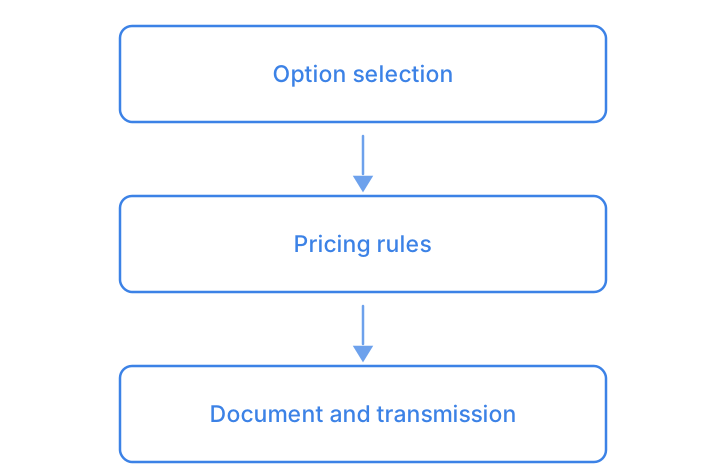
Select options, apply pricing rules, produce the document: Monetisation & Subscriptions and Product Configurator & Quoting rest on this sequence.
- Complex Billing EnginesnnRating EnginesApplication of complex mathematical formulae to large volumes of data.
- Complex Billing EnginesnnTariff StructuresManagement of Peak/Off-Peak tariffs, fixed subscriptions, and local taxes (TCFE, CSPE).
- PDF Invoice EditingGeneration of millions of clear PDF documents, complying with legal display standards.
- Retrospective RecalculationAbility to generate adjustment invoices where an actual reading replaces an estimate.
- Accounting ExportAutomatic generation of journal entries (Sales, VAT) to your accounting software.
- Reliable Audit Trail (RAT)Absolute traceability enabling explanation of how each penny has been calculated.
Smooth and frictionless integration
We connect to your existing sources: remote reading systems, data concentrators, ERP, customer repositories. No forced migration, no duplicate data entry. The engine interfaces via API or flat files according to what your IT system supports today. We often begin with a restricted scope: one contract type, one customer segment: to validate the rules under real conditions before expanding.
Your teams retain their usual management tools during the transition.
Tariff Mapping
Analysis of your contracts, pricing schedules and special cases to model all existing calculation rules.
Construction of the Engine
Development of the rating engine with your business rules, connected to your consumption data sources and customer reference systems.
Parallel validation
Execution on real historical data to compare results with your existing invoices and adjust rules if necessary.
Phased Production Release
Deployment by customer segment with team training and supervision of initial billing cycles.
Measurable results for your organisation
- Invoice production time reduced by 60% on complex pricing structures
- Customer complaint rate relating to billing errors reduced by two-thirds
- Accounting close period shortened by 4 days on average
- 100% of calculations traced and auditable for regulatory compliance
- Capability for retrospective recalculation over 24 months in under 2 hours
- Simulation of new tariff offerings achievable in half a day rather than a fortnight
Clarifying your decision-making
How do you handle cases where our pricing rules do not fit into any standard model?
Pricing rules outside any standard model are the engine’s starting point: Clarendis models your actual rules, including exceptions negotiated client by client. The engine accommodates specific business logic without heavy development for each new case.
What happens if our consumption data is incomplete or inconsistent?
The engine identifies missing or aberrant data before calculation and applies the substitution rules you define. You retain control over those decisions, with full traceability of estimated versus recorded values.