
Search Engines & Filtering
An e-commerce catalogue with 50,000 references means 50,000 ways to lose a sale. The customer types ’white Nike trainers size 8’ and receives sports socks and black Adidas trainers. They leave the site within 8 seconds. Your merchandising teams spend their days creating manual redirect rules to compensate for a search engine that understands nothing.
Meanwhile, the conversion rate for internal search stagnates at 2% when it should be three times higher than standard navigation. The filters? They display impossible combinations: size 8 in blue when stock is zero, or worse, hide available products due to poorly indexed attributes. Your PIM is clean, your ERP up to date, but between these systems and the customer, search destroys value.
Each day of delay means revenue going to competitors whose sites ’guess’ what the user is looking for.
This solution belongs to the E-commerce & Booking family.

Challenges holding back your performance
Your e-commerce CMS’s native search functionality was designed as a secondary feature, not as a conversion tool. Elasticsearch internally? Your teams spend more time maintaining infrastructure than optimising relevance. Mainstream SaaS solutions work on simple catalogues: they collapse when you have 200 attributes per product, variants in 15 languages and business rules that change according to season, stock or margin.The makeshift approach of managing synonyms in a CSV file cannot cope with reality: your customers type ’American fridge’, ’US refrigerator’, ’double-door fridge-freezer’ for the same product. And nobody has the time to maintain these lists manually across 50,000 SKUs.
Our Technical Approach
Our approach stems from a fundamental observation: e-commerce search is not a technical problem, it is a business understanding problem.
We build an indexation layer that truly reflects your catalogue: not a flat copy of your database, but an enriched structure where each product carries its context: sector-specific synonyms, category hierarchies, popularity signals, stock constraints. The engine learns from your existing search data: queries with no results, clicks following reformulation, abandoned filters.
Typo-tolerance and natural language processing (NLP) are not gimmicks: they absorb the 23% of misspelt queries that currently return zero results. Facets are calculated in real time on available stock, not on the theoretical catalogue. Merchandising integrates directly: your teams can boost a product on promotion or bury end-of-line stock without touching the code.
Search As-You-Type
Display of relevant results and thumbnails from the first letters typed.
Typo-Tolerance
Algorithms for distance correction that automatically rectify common input errors.
Dynamic Facets
Instant recalculation of attributes (colours, remaining sizes) following filter selection.
Active Merchandising
Business rules to push certain products to the top of search results.
Asynchronous Indexing
Invisible index update as soon as a price or stock level is modified.
Synonyms & NLP
Natural language comprehension to link ’basket’ and ’sneaker’ automatically.
Technical Architecture
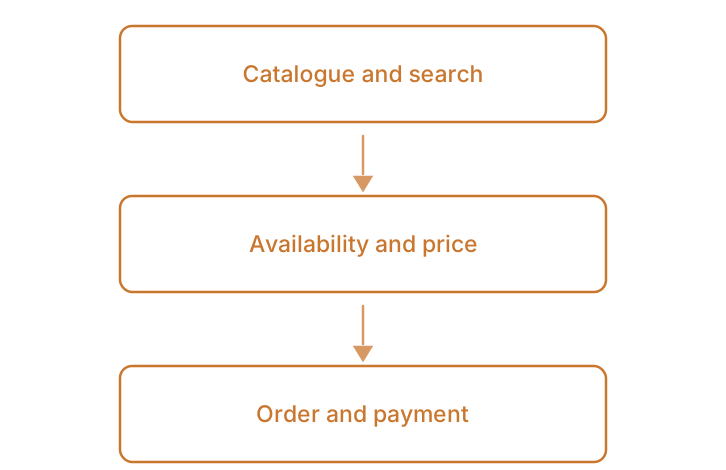
Search, check availability and price, order: these three steps also structure Online Auction Platform and Direct Booking Engines.
- Search As-You-TypeDisplay of relevant results and thumbnails from the first letters typed.
- Typo-ToleranceAlgorithms for distance correction that automatically rectify common input errors.
- Dynamic FacetsInstant recalculation of attributes (colours, remaining sizes) following filter selection.
- Active MerchandisingBusiness rules to push certain products to the top of search results.
- Asynchronous IndexingInvisible index update as soon as a price or stock level is modified.
- Synonyms & NLPNatural language comprehension to link ’basket’ and ’sneaker’ automatically.
Smooth and frictionless integration
We connect to your existing PIM or catalogue feed via API or scheduled import. Indexing runs in parallel with your current site: no interruption. You can switch search functionality page by page: first the product listing, then the homepage, then the category filters. Your front-end remains yours, we provide the results.
Merchandising teams maintain their usual practices, with a dedicated interface that doesn’t require an IT ticket for each modification.
Search Engines & Filtering Audit of Catalogue and Search
Analysis of your product structure, existing search logs and zero-result queries. Identification of the 50 critical queries which concentrate 40% of traffic.
Search Engines & FilteringnnPilot modelling and indexing
Construction of enriched index schema on a catalogue segment. Configuration of synonyms, typo-tolerance and initial relevance rules.
Front-End Integration & Merchandising
API connection to your existing site, deployment of the merchandising interface for your teams. A/B testing on a portion of the traffic.
Toggle and continuous optimisation
Production deployment across 100% of search traffic. Your dashboard visualisation tool for performance monitoring and monthly adjustments based on actual data.
Measurable results for your organisation
- Internal search conversion rate: increase from 2-3% to 6-8% observed on catalogues with 30,000+ references
- Zero-result queries reduced from 15% to less than 2% through typo-tolerance and automatic synonyms
- Search response times under 50ms even on catalogues of 500,000 SKUs
- Autonomous merchandising: boost modifications and business rules applied in under 5 minutes, without technical intervention
- 60% reduction in team time devoted to maintenance of manual redirection rules
- Incremental indexing: new products available for search within 2 minutes of PIM publication
Clarifying your decision-making
We already have Elasticsearch internally, why change?
Elasticsearch is an excellent engine, but it is a low-level component. What is missing is the e-commerce business layer: sector-specific synonyms, visual merchandising, dynamic facets on live stock. Clarendis can build on your existing cluster where the infrastructure is sound.
What impact on site performance during indexation?
Indexation has no impact on site performance: it runs asynchronously on separate infrastructure. Your site sees only an optimised query interface. Even a full reindex of 100,000 products generates no client-side latency.