
Off-Plan Sales Platforms
A VEFA property development programme involves 18 to 36 months between signing the reservation contract and completion. During this period, each purchaser generates between 40 and 80 documents: contracts, evolving plans, descriptive notices, choice records, quarterly calls for funds, TMA amendments, various attestations. Multiply this by 60 units in an average development, and you achieve a volume of documentation that no one has truly anticipated.
From the purchaser’s perspective, it is a source of constant anxiety: what stage has my flat reached? Has my latest payment been taken into account? Why does the plan received in March differ from that of November? Sales staff spend their days answering the same questions, sending PDFs by email, searching for the correct version of a plan on a poorly organised server.
Programme assistants juggle between three spreadsheets to track TMAs and their deadlines. The accounts department manually chases outstanding calls for funds. Everyone is working, yet no one is efficient.
This solution belongs to the E-commerce & Booking family.

Challenges holding back your performance
The traditional approach: one shared folder per programme, emails for correspondence, Excel for managing completion payments and transactions. This works for a small operation. As soon as you’re managing three programmes in parallel with different teams, the system breaks down. Document versions multiply, emails go missing, follow-ups are sent twice or not at all.Some developers attempt to use general-purpose CRM systems or market-available document management solutions.Result: tools designed for other industries, which don’t understand the logic of an off-plan payment schedule, the documentation tool for completion payments with deadlines, or the connection between a unit, its purchaser and its documentary history. The team works around the tool, maintains its spreadsheets in parallel, and the end client continues to call to find out the status of their file.
Our Technical Approach
Our approach is based upon a simple observation: the purchaser and your teams require the same information, presented differently.
We build a single space where each unit is linked to its purchaser, its documentary history and its financial schedule. The purchaser accesses a clear portal where they can find their up-to-date plans, view their past and future stage payments, make their finishing and fixture selections within the allotted timeframes with a time-stamped record. Your teams, meanwhile, have a consolidated view by development: who has not validated their tiling choices before Friday’s deadline, which stage payments are more than 15 days overdue, which documents have not been downloaded.
Alerts are automatic, follow-ups are traceable. Each purchaser action feeds into the file without re-entry on the developer’s side. We do not digitise your existing processes, we eliminate the back-and-forth exchanges that add no value.
Documentary Area
Safe containing reservation contracts, plans and notarial certificates.
FREEHOLD SALES PLATFORM MANAGEMENTnnTMA Management
VEFA Marketing Platforms Workflows for Purchaser Modification Works Requests with quotation validation.
Calls for Funds
Automated triggering of invoicing according to construction site progress.
Technical Architecture
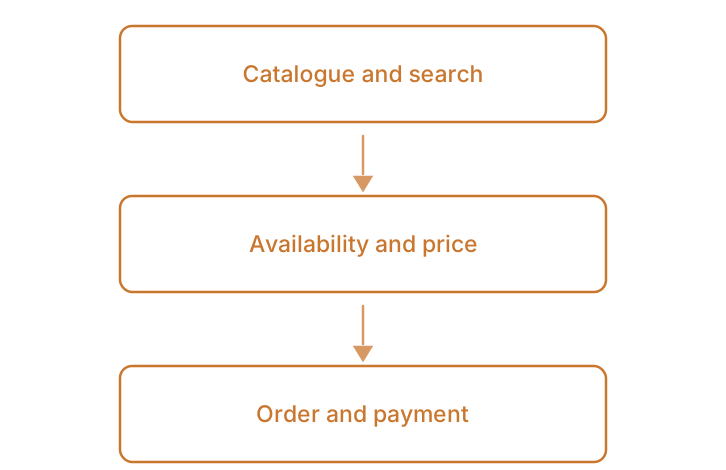
Search, check availability and price, order: these three steps also structure Marketplaces and Online Auction Platform.
- Documentary AreaSafe containing reservation contracts, plans and notarial certificates.
- FREEHOLD SALES PLATFORM MANAGEMENTnnTMA ManagementVEFA Marketing Platforms Workflows for Purchaser Modification Works Requests with quotation validation.
- Calls for FundsAutomated triggering of invoicing according to construction site progress.
Smooth and frictionless integration
Your business ERP system remains the source of truth for financial and contractual data. We synchronise with it to retrieve payment schedules and receipts, without migration or double entry. Existing documents: AutoCAD plans exported as PDF, Word notices, Excel spreadsheets for TMA: are integrated as is initially. The purchaser space can be launched on a pilot programme within 4 weeks, the time required to structure the data for a single project.
Your teams retain their document production habits; only the distribution changes.
Audit of an existing programme
Analysis of document flows, purchaser friction points and tools in place on a representative operation.
Structuring and initial import
Organisation of the document tree structure, configuration of TMA schedules and synchronisation with your ERP for financial data.
Pilot Deployment
Opening of the purchaser portal on a programme, internal team training within 2 hours, close monitoring over 4 weeks.
Rollout and adjustments
Extension to other active programmes, refinement of follow-up automations based on your field feedback.
Measurable results for your organisation
- 70% reduction in inbound purchaser calls regarding documentation and financial follow-up enquiries
- Average validation timeframe for TMA selections reduced from 3 follow-ups to 1.2 follow-ups per purchaser
- Overdue payment rates at 30 days on capital calls reduced by 25% through automated notifications
- Time saving of 6 hours per week for a programme assistant managing 80 units
- Zero disputes relating to contradictory plan versions since implementation
- Purchaser satisfaction score up 15 points on post-completion surveys
Clarifying your decision-making
Our purchasers are not all comfortable with digital technology, how do you manage that?
The purchaser space is designed to be usable without training: a maximum of three tabs, explicit headings, no password to remember thanks to an SMS-secured link. For purchasers who prefer paper, your teams generate a PDF summary in one click.
We already have a Promogim/Altaix/other ERP system, will this create duplicates?
Your ERP remains in control of contractual and accounting data: Clarendis reads it without ever writing to it. Purchaser documents and validations feed back to your teams through the interface or by structured export if you wish to reintegrate them. No re-entry, no version conflicts.