
Wealth Management Portals
A family office manages on average 15 to 40 asset lines per client: securities accounts with three different custodians, REITs subscribed directly, shareholdings in family holding companies, physical property spread across several countries, Luxembourg life assurance. The wealth management adviser spends Monday mornings compiling PDF statements, converting currencies, recalculating approximate property valuations.
The high-net-worth client receives quarterly reporting in PowerPoint format assembled manually: when they do not have to telephone to ascertain their actual position. Teams juggle between GDPR requirements, Swiss banking secrecy, MiFID II regulations on transparency, and clients who want secure access from Singapore at 11pm.
Meanwhile, custodians are modernising their APIs at different rates, some remain stuck on SWIFT MT flows, others are moving to ISO 20022 format. Wealth consolidation remains a manual, time-consuming and error-prone exercise which ties up senior profiles on tasks without added value.
This solution belongs to the Customer & User Portals family.

Challenges holding back your performance
Excel remains the dominant consolidation tool in 70% of private wealth management firms. Formulae break when a custodian changes its export format. Copy-paste errors on a €2 million line go unnoticed until the client complaint. Generic financial reporting tools ignore property, unlisted assets, and artworks.Mass-market aggregators such as Linxo or Finary meet neither confidentiality requirements nor the complexity of ownership structures (life interests, property splitting, holdings). As for portals provided by custodians, they only display their own assets. The adviser therefore reconstructs the global view manually, with the attendant risks of error and delays.
Our Technical Approach
Our approach stems from an observation: each wealth structure is unique, but the underlying data flows follow identifiable patterns.
We build an aggregation layer that connects to custodians via their existing channels: APIs where they exist, secure parsing of statements where there is no alternative. Each asset is normalised within a common repository, with its base currency, its valuation method (market price, appraisal, latest NAV), its holding structure.
Compartmentalisation is not an option but a founding principle: each client has an isolated space, with granular access rights for the adviser, the client, the external family officer. Reporting is generated on demand, not once per quarter. The associated document vault links each asset to its supporting documents: notarial deeds, certificates, source statements.
The interface adapts to the desired level of detail: consolidated view for the client, complete drill-down for the manager.
Automated Aggregation
Connection to custodian bank feeds to centralise all asset classes.
Hermetic Compartmentalisation
Bank-level security ensuring that data can never cross over.
Dynamic Reporting
Interactive performance charts, sectoral allocation and risk analysis.
Digital Safe
Secure exchange space for tax statements, mandates and legal documents.
Adviser-Client Sharing
Co-piloted view enabling the manager to comment on performance in real time with their client.
Technical Architecture
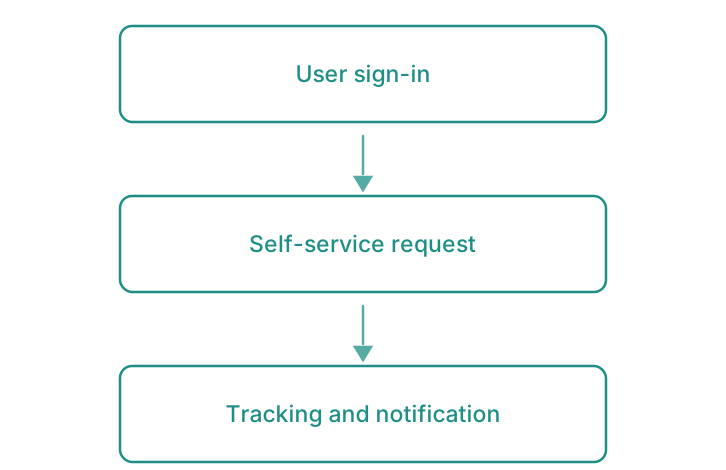
Identify the user, let them act on their own, keep them informed: Concierge Applications and One-Stop Citizen Service Centres work the same way.
- Automated AggregationConnection to custodian bank feeds to centralise all asset classes.
- Hermetic CompartmentalisationBank-level security ensuring that data can never cross over.
- Dynamic ReportingInteractive performance charts, sectoral allocation and risk analysis.
- Digital SafeSecure exchange space for tax statements, mandates and legal documents.
- Adviser-Client SharingCo-piloted view enabling the manager to comment on performance in real time with their client.
Smooth and frictionless integration
We do not ask you to replace your CRM or portfolio management tool. The portal interfaces with your existing systems: whether Advent, a proprietary tool or structured files. Implementation begins with two or three pilot clients, with their principal custodians. Data flows are added progressively according to actual priorities, not according to a theoretical schedule.
Your teams retain their daily working tools; the portal becomes the client reporting layer.
Mapping of flows
Inventory of your custodians, available data formats, typical holding structures and regulatory requirements by jurisdiction.
Restricted pilot
Deployment across 3 to 5 representative clients with their actual assets. Validation of aggregations, access rights and user experience with your teams.
Industrialisation
Progressive extension to other clients and custodians. Training of advisers in portal administration and reporting configuration.
Continuous operation
Maintenance of connectors, addition of new feeds according to your requirements, functional developments based on field feedback.
Measurable results for your organisation
- Reporting production time reduced from 4 hours to 15 minutes per client
- Elimination of manual re-entry errors on multi-custodian consolidations
- Client access 24/7 with strong authentication compliant with FINMA and AMF requirements
- 60% reduction in client calls for position or document requests
- Complete traceability of access and modifications for compliance audits
- Capability to integrate a new custodian within 2 to 4 weeks depending upon the quality of their data feeds
Clarifying your decision-making
How do you manage assets without automated flows, such as property or unlisted holdings?
Assets without automated flows are entered manually or imported by file, at a suitable frequency: often annually for property, quarterly for private equity. The portal clearly separates real-time valuations from estimates, so the client knows what they are looking at.
Our clients are in Switzerland, France and Singapore. How do you ensure regulatory compliance across these three jurisdictions?
Data hosting can be segmented by jurisdiction. Clarendis works with certified datacentres in Switzerland and France, and access rules adapt to local requirements: Swiss FADP, European GDPR, Singaporean PDPA. Each configuration is documented for your audits.