
Risk & Fraud Detection
In financial services, every transaction represents a trade-off between speed and security. Your fraud management teams are juggling exploding volumes: instant payments, online account openings, SEPA transfers that must be processed within seconds. Meanwhile, fraudsters are professionalising their attacks: identity theft, account takeover, supplier payment fraud.
The regulator expects evidence of constant vigilance: traceability, reporting, justification of every decision. Your analysts spend their days sorting through alerts, 85% of which are false positives. Genuine suspicious cases are lost in the noise. Static rules inherited from five years ago no longer detect current patterns.
And when you block too many legitimate transactions, customer service bears the brunt: complaints, lost clients, damaged reputation. Pressure comes from all directions: senior management wanting to limit losses, business units wanting to streamline the customer journey, compliance demanding enhanced controls. Three contradictory imperatives, one system expected to deliver all.
This solution belongs to the Data, Master Records & Reporting family.

Challenges holding back your performance
The tools in place are showing their limitations. The legacy rules engine, maintained by one person who knows its operation inside out, generates too many alerts to be workable. Teams supplement this with Excel extractions to cross-reference data manually: time-consuming and a source of errors. Packaged solutions from major vendors promise miraculous AI, but require 18 months of integration and perfectly clean data that you do not have.Generalist service providers deploy standard rules that do not align with your client typology or your specific products.Result: you detect fraud after it has occurred, during accounting reconciliation. Reaction time is measured in days, not milliseconds. Losses accumulate, and each incident adds weight to the file for the next audit.
Our Technical Approach
Our approach relies on three levels of detection that work together.
The first assesses each transaction in real time: less than 50 milliseconds: against a set of business rules that your analysts can modify without touching the code. The second level builds a behavioural profile per customer: connection habits, spending patterns, consistent geolocation. A significant deviation triggers a contextual alert, not a blind rule.
The third level correlates weak signals across multiple accounts or multiple days to detect organised schemes: mule networks, serial fraud. Automatic isolation quarantines suspicious transactions without blocking the overall flow: the legitimate customer continues to operate, only the questionable transaction awaits validation. Analysts receive enriched alerts with the complete context: history, risk score, triggering elements: to decide quickly and well.
The system learns from their decisions to refine its thresholds.
Low Latency Analysis
Risk assessment in under 50 milliseconds to never slow down payment.
Adjustable Rules Engine
Interface allowing your experts to modify detection rules autonomously.
Behavioural Detection
Identification of data entry speed anomalies or device changes (Device Fingerprinting).
Automatic Isolation
Blocking or strong authentication request (3D Secure) only when the score justifies it.
Technical Architecture
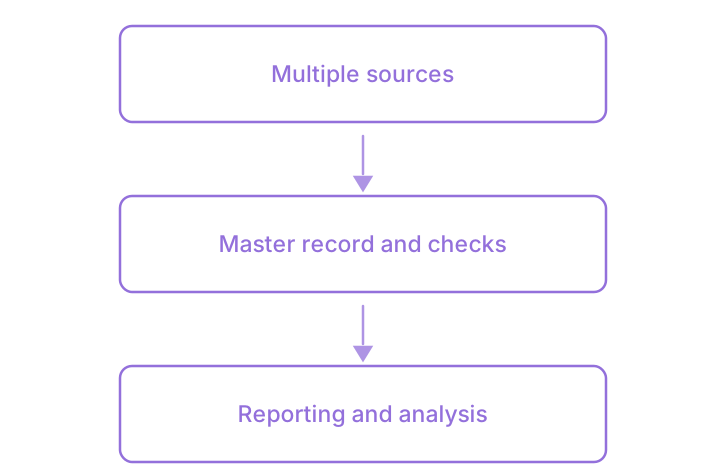
Several sources, one master record to arbitrate between them, then analysis: Core HR & Unified Repository and Observatories & Open Data stem from this same chain.
- Low Latency AnalysisRisk assessment in under 50 milliseconds to never slow down payment.
- Adjustable Rules EngineInterface allowing your experts to modify detection rules autonomously.
- Behavioural DetectionIdentification of data entry speed anomalies or device changes (Device Fingerprinting).
- Automatic IsolationBlocking or strong authentication request (3D Secure) only when the score justifies it.
Smooth and frictionless integration
Your core banking, your payment system, your KYC tools: they remain in place. We connect by listening to your existing flows, without modifying your validated processing chains. Integration is achieved through standard connectors (REST APIs, MQ queues, Kafka events according to your architecture). The initial rules operate in observation mode: they score without blocking, allowing time to calibrate thresholds with your teams.
No migration, no brutal replacement. Your application estate is respected; we add a layer of intelligence without rebuilding everything.
Risk and Fraud Mapping
Analysis of your payment channels, fraud history, existing rules and current friction points with your business and IT teams.
Deployment in observation
The engine runs in parallel with your current system, scores transactions without blocking them. We measure the relevance of alerts over 4 to 6 weeks.
Calibration and progressive activation
Threshold adjustment with your analysts, activation of automatic blocking by transaction type, from least risky to most sensitive.
Transfer and autonomy
Training of your teams in rule adjustment, documentation of procedures, support during the first three months of nominal operation.
Measurable results for your organisation
- 60 to 70% reduction in false positives handled by analysts
- Detection time reduced from several days to under 200 milliseconds
- Legitimate transaction block rate below 0.3%
- Complete traceability of decisions for regulatory audits
- Analysts’ capacity to process 3 times more genuine cases per day
- Fraud-related losses reduced by 40% over 12 months
Clarifying your decision-making
How do your rules adapt to our specific products without months of configuration?
Calibration of fraud rules starts from your historical data: confirmed fraud and legitimate transactions. Initial thresholds are set on your real cases within two to three weeks. Your analysts then adjust the rules through a business interface, without depending on IT for each modification.
What happens if the system goes down? Do we block all payments?
The detection layer operates in a configurable fail-open mode: if detection is unavailable, transactions proceed with a flag for later review rather than being blocked. You select the behaviour by operation type, according to your risk tolerance.