
KYC & Onboarding Workflows
Opening an account, taking out a life assurance policy, granting credit: each client relationship triggers a cascade of regulatory obligations. Your compliance teams juggle identity verification, sanctions list screening, document analysis and signature collection—often using systems that don’t communicate with each other.
From the client’s perspective, the experience is fragmented: documents to be returned by email, opaque validation timeframes, manual follow-ups. The abandonment rate on subscription journeys regularly exceeds 40% in the sector. Meanwhile, AML-CFT requirements are tightening, the ACPR and AMF are increasing their oversight, and each incomplete file represents a risk of sanctions.
Your analysts spend their days re-contacting prospects for missing or illegible documents, rather than handling complex cases that truly require their expertise. The paradox: the more you strengthen your controls to ensure compliance, the more you degrade the client experience and extend your onboarding timescales—sometimes up to several weeks for otherwise standard files.
This solution belongs to the Business Operations & ERP family.

Challenges holding back your performance
Current setups often rely on a heterogeneous assembly: an electronic signature tool on one side, a KYC provider on the other, manual verifications in Excel files for monitoring, and emails for follow-ups. Each component operates in silos.Result: data is re-entered multiple times, supporting documents are lost between systems, and no one has a consolidated view of a file’s actual status. Generic workflow tools do not understand the regulatory specificities of the financial sector: they do not know that a proof of address older than three months is invalid, or that a PEP requires an enhanced validation process.As for internal developments, they often end up frozen, unable to keep pace with the constant evolution of regulatory requirements.
Our Technical Approach
Our approach stems from a simple observation: a subscription journey is not linear, and your obligations vary according to the client’s profile.
We build adaptive workflows that adjust the steps based on the responses collected: a French tax resident does not have the same supporting documents to provide as a non-resident, a legal entity triggers ultimate beneficial owner verifications. Documentary analysis by OCR automatically extracts data from identity documents and supporting documents, detects inconsistencies and expired documents before an analyst wastes time on them.
AML-CFT checks: sanctions lists, PEPs, asset freezing: are executed in real time and feed into a risk scoring system. eIDAS qualified electronic signature closes the journey seamlessly. Everything is designed mobile-first because your clients start on their phone. The back-office provides your teams with a consolidated view: file status, alerts on sensitive cases, conversion and timing metrics.
Adaptive Pathways
Forms that only display the relevant questions according to the profile and risk level.
Document Analysis (OCR)
Automatic extraction of data from identity cards, passports or Kbis to avoid manual entry.
AML-CFT Checks
Connection to external databases (Politically Exposed Persons, sanctions lists).
Signature eIDAS
Seamless integration of qualified electronic signature to seal the contract instantaneously.
Mobile-First Experience
A journey designed to be completed from a smartphone (direct photo capture of supporting documents).
Back-Office Dashboard
A clear interface for compliance teams to rapidly approve complex cases.
Technical Architecture
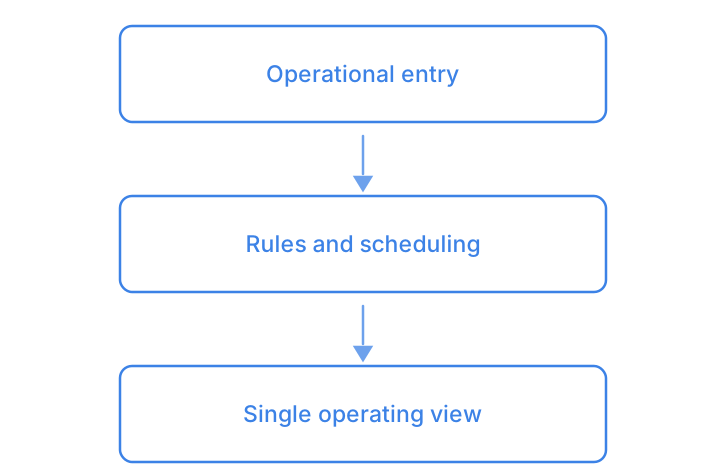
Enter once, let the rules schedule, read a single view: this foundation is shared across the family — you will find it in Management Systems (PMS) and in Order Management System (OMS).
- Adaptive PathwaysForms that only display the relevant questions according to the profile and risk level.
- Document Analysis (OCR)Automatic extraction of data from identity cards, passports or Kbis to avoid manual entry.
- AML-CFT ChecksConnection to external databases (Politically Exposed Persons, sanctions lists).
- Signature eIDASSeamless integration of qualified electronic signature to seal the contract instantaneously.
- Mobile-First ExperienceA journey designed to be completed from a smartphone (direct photo capture of supporting documents).
- Back-Office DashboardA clear interface for compliance teams to rapidly approve complex cases.
Smooth and frictionless integration
We connect the workflow to the existing building blocks: your CRM, your core banking system, your existing signature tools if you wish to retain them. No brutal replacement. We generally begin with one product or client segment: personal account openings, for example: to validate functionality before extending. The APIs interface with your client repositories and document management systems.
Your compliance teams retain their validation processes, but with a unified interface and pre-qualified files.
Mapping of existing pathways
We analyse your current funnels, your abandonment rates by stage, and your specific regulatory constraints by product and customer segment.
Configuration of the pilot workflow
Configuration of business rules, connection to your sanctions databases and to your document management system. Testing on a restricted scope.
Deployment and Training
Progressive rollout to production, training of your compliance teams in the back office, adjustments based on initial operational feedback.
Extension and continuous optimisation
Expansion to other products or segments, refinement of scoring thresholds, improvement of conversion rates on real data.
Measurable results for your organisation
- Journey abandonment rate reduced by 35 to 45% through mobile fluidity and automated follow-ups
- Average processing time for a standard file reduced from 5 days to under 24 hours
- 80% of document verification checks processed without human intervention
- Zero manual re-entry between client collection and core banking
- Complete traceability for ACPR controls: each step timestamped and archived
- Reallocation of 2 to 3 FTE compliance staff to the analysis of complex cases rather than chasing missing documents
Clarifying your decision-making
What happens if regulations evolve — who maintains the control rules?
The KYC workflow’s business rules are configurable by your compliance teams, not hard-coded. When the ACPR issues a new requirement, you adjust the workflow without waiting for development. Clarendis monitors regulatory change and alerts you to major shifts, but you keep control.
Do our professional clients have complex structures — does the system handle ultimate beneficial owners and multi-tier arrangements?
The workflow detects corporate entities automatically and triggers collection of articles of association, company registration documents and identification of ultimate beneficial owners up to the regulatory threshold. Multi-tiered ownership structures are supported, with graphical visualisation for your analysts.