
Onboarding Journey
A successful recruitment is costly: between €15,000 and €25,000 depending on the profiles.
Yet, 20% of new recruits consider leaving from the first week when the welcome process fails. The problem is not a lack of goodwill. It is coordination. The manager informs IT three days before arrival.
IT orders the PC, but no one has thought about application access. HR are still waiting for the diploma copy and the bank details. The badge is not ready. Neither is the office.
The newcomer arrives, smiles politely, and spends their first day waiting. Meanwhile, five different people are exchanging emails to work out who was supposed to do what. In organisations of 50 to 500 employees, there is no department dedicated to onboarding. It is a collective effort, often led by people who already have a full-time job.
Without a structured process, each arrival becomes an improvised mini-project.
This solution belongs to the Customer & User Portals family.

Challenges holding back your performance
Most companies manage onboarding with a shared Excel file: or worse still, Post-it notes and Marie from HR’s memory. Information circulates by email, gets lost in discussion threads, arrives too late. Existing HR tools sometimes offer an onboarding module, but it remains siloed: it doesn’t communicate with IT, doesn’t trigger anything on the facilities management side, doesn’t send documents for signing at the right time.The result: duplicate data entry, manual follow-ups, systematic oversights on the same points. The HR manager spends two hours per recruitment coordinating what should be automatic. And when there are three new starters in the same month, overload is guaranteed.
Our Technical Approach
Our approach stems from a simple observation: onboarding is not an HR process, it is a cross-functional process that involves four or five departments.
We build a journey that triggers as soon as recruitment is validated and automatically orchestrates the actions of each stakeholder. The manager receives a checklist with their responsibilities. IT is notified with hardware specifications according to the role. General services prepare the badge and office.
The future colleague receives a personal space to upload their documents, sign their contract, discover the company even before their first day. Each stage has an owner, a deadline, automatic reminders. HR manages the whole process from a single dashboard, without chasing information. The journey adapts to the type of role: a field sales representative does not have the same requirements as a developer or an accountant.
Digitalised Onboarding Journey
Automatic equipment requests
Collection of documents prior to arrival
Technical Architecture
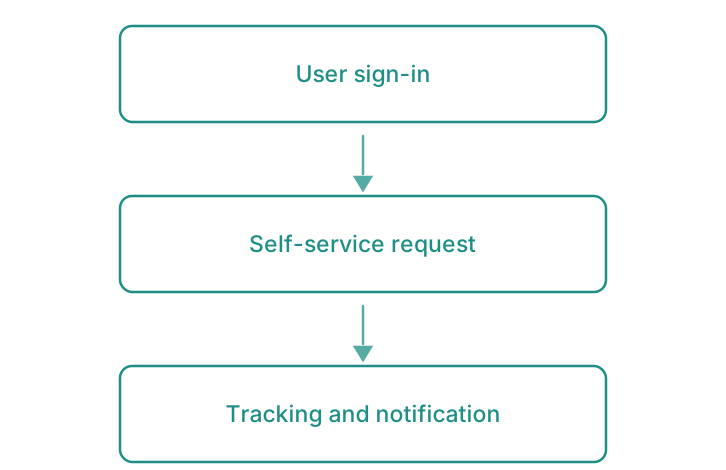
Identify the user, let them act on their own, keep them informed: Concierge Applications and One-Stop Citizen Service Centres work the same way.
- Digitalised Onboarding Journey
- Automatic equipment requests
- Collection of documents prior to arrival
Smooth and frictionless integration
The pathway integrates with your existing HRIS: whether it’s Lucca, PayFit, Silae or an in-house system. IT requests can be routed to your ticketing tool (GLPI, ServiceNow, Jira). Electronic signature goes through your current provider or we can propose one. No need to change your tools: we create the coordination layer they’re missing.
Deployment is carried out service by service, often starting with the HR-IT partnership.
Current process mapping
We identify with you who does what today, where the friction points are, what tools are already in place.
Design of pathways by profile
We define the stages, those responsible, timelines and automations for each type of recruitment.
Deployment and connection to tools
We establish the pathway, we connect it to your HRIS and IT tools, we train the key users.
Monitoring and adjustments
We analyse the first real onboardings and adjust the timeframes and notifications based on field feedback.
Measurable results for your organisation
- HR preparation time reduced from 2 hours to 20 minutes per recruitment
- 100% of IT equipment ready on day one (compared to 60% average observed)
- Administrative documents collected prior to arrival in 90% of cases
- Zero manual reminder emails for missing documents
- New employee satisfaction measurable from the first week
- Complete visibility on ongoing onboardings for HR and managers
Clarifying your decision-making
Our managers are not comfortable with digital tools, how does it work for them?
The manager receives a simple email with their task list and validation buttons. No new interface to learn, no login to yet another tool. If they prefer, they can even reply by email.
We have very different profiles (permanent contracts, apprentices, contractors) — can a single journey manage this?
A single journey would not fit, and that is precisely the point. Clarendis builds distinct pathways by contract type, department and seniority. An apprentice does not need the same access as a director.