
Medical File Processing
In personal insurance, the processing of medical files remains a structural bottleneck. Each application for membership or benefits generates a health questionnaire which passes between the insured, the administrator, and the medical advisor. The volumes are considerable: a medium-sized insurer processes several thousand files per month.
Processing times directly impact customer satisfaction and commercial conversion rates. On the compliance side, pressure remains unrelenting: GDPR, ACPR requirements, mandatory HDS certification for any hosting of health data. Medical advisors, often part-time or shared between entities, are overwhelmed by poorly structured paper files or PDFs.
They spend more time searching for information than analysing it. Management teams, meanwhile, juggle between manual follow-ups, re-entry and opaque validation processes. The risk of error is constant, traceability approximate. And during this time, delays lengthen, complaints accumulate, and management demands reports that no one can produce properly.
This solution belongs to the Business Operations & ERP family.

Challenges holding back your performance
The tools in place were never designed for this workflow. The questionnaire arrives by post, email or secure portal: rarely in the same format. It is re-entered into the management system, sometimes partially, often with errors. Supporting documents are stored in shared directories without reliable indexing.The medical adviser receives an incomplete file, requests additional information, the case manager follows up with the insured manually. Three weeks pass. Excel tracking spreadsheets explode in complexity. Some insurers have attempted generic document management systems, but without integrated business workflow or native HDS compliance, the result is yet another tool to maintain.Health data, meanwhile, remains exposed to uncontrolled access, which poses a genuine regulatory risk.
Our Technical Approach
Our approach is based on an observation: the medical adviser must receive a complete, structured and anonymised file, without any compilation effort.
We build a collection flow that captures questionnaires at source: web form, PDF import, API from the insured’s portal: and normalises them automatically. Data is hosted on HDS-certified infrastructure, with end-to-end encryption. Anonymisation occurs before transmission to the medical adviser: they see medical history, medical responses, supporting documents, but not the insured’s identity.
This strict separation between identification data and health data drastically simplifies compliance. In parallel, a rules engine pre-qualifies files: straightforward cases (questionnaires without declarations, standard profiles) are directed towards automatic acceptance or rapid validation. Complex cases are prioritised and enhanced for the medical adviser.
The result: less volume to process manually, faster decisions, complete traceability.
Health Data Hosting (HDH)
Anonymisation of questionnaires
Decision support based on strict rules
Technical Architecture
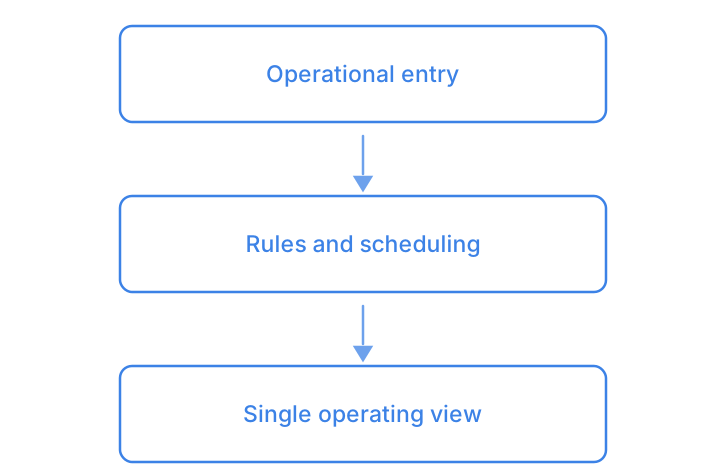
Enter once, let the rules schedule, read a single view: this foundation is shared across the family — you will find it in Order Management System (OMS) and in Workshop & After-Sales Management.
- Health Data Hosting (HDH)
- Anonymisation of questionnaires
- Decision support based on strict rules
Smooth and frictionless integration
We connect to your existing management system: whether it be enterprise software, a CRM or an in-house tool. The questionnaires collected are synchronised with policyholder files via API or secure file exchanges. Medical advisers access files from a dedicated interface, without changing their usual practices. Decisions are automatically fed back into your IT system.
No data migration, no tool replacement: a workflow layer that structures what already exists.
Current workflow mapping
Analysis of collection pathways, questionnaire formats, data re-entry points and access to existing health data.
Implementation of the secure collection channel
Deployment of forms or connectors, HDS hosting, configuration of anonymisation and pre-qualification rules.
Integration with the Management IS
API connection or files with your business tool, synchronisation of records, escalation of medical decisions.
Training and implementation
Handling by case managers and medical advisors, adjustment of routing rules, monitoring of the first months in production.
Measurable results for your organisation
- Average processing time reduced by 40% for standard files
- 70% of questionnaires without declaration processed without intervention from the medical adviser
- No identifiable health data accessible outside HDS perimeter
- Complete traceability of access and decisions for ACPR audits
- 60% reduction in manual follow-ups with policyholders
- Real-time reporting on volumes, processing times and acceptance rates
Clarifying your decision-making
How do you guarantee HDS compliance if our data is processed via your platform?
Hosting is provided by an HDS-certified supplier with whom Clarendis has worked for several years. Contracts, audits and certifications are available. No health data is ever stored on non-certified infrastructure, and the architecture is audited annually.
Our medical advisers are external locums, how do we manage their access?
Each physician has named access with enhanced authentication and sees only the files assigned to them, already anonymised. Sessions are logged and access can be revoked immediately, which is often cleaner than sending encrypted email.