
Allocation and Benefits Management
Social services, CAF, MDPH, local authorities and charitable organisations manage thousands of benefit applications each month. RSA, APL, disability allowances, emergency assistance, bursaries: each scheme has its own eligibility criteria, income thresholds, and family compositions to be taken into account. These rules change regularly: sometimes several times per year: according to finance acts and statutory instruments.
Case officers spend hours manually verifying supporting documents, cross-referencing data between systems that do not communicate with one another, and recalculating entitlements on spreadsheets. The risk of error is ever-present: an oversight in applying a scale, a family situation that is misinterpreted, an expired document that slips through the net.
From the users’ perspective, waiting times lengthen and complaints accumulate. From the officers’ perspective, the mental burden becomes overwhelming. And above them, the political pressure to reduce overpayments and fraud does not abate, without additional resources.
This solution belongs to the Business Operations & ERP family.

Challenges holding back your performance
The Excel spreadsheets circulated between departments to calculate entitlements quickly become unmanageable: formulae broken following a tariff update, multiple versions, no traceability. Existing specialist software, often outdated, does not integrate new regulations quickly enough: one must wait months for a publisher update, sometimes chargeable.Officers develop their own parallel systems, which creates disparities in treatment between service points. Anti-fraud controls rely on time-consuming manual verifications or crude alerts that generate too many false positives.Result: cases that drag on, payment errors detected too late, painful regularisations for beneficiaries, and reports from the Court of Audit that highlight the same dysfunctions year after year.
Our Technical Approach
Our approach is based on a business rules engine decoupled from your existing applications. This engine encodes regulations in the form of rules that are readable and modifiable by your business experts: no need for a developer to adjust a resource ceiling or add an exception. When a decree changes, the update is completed in hours, not months.
The engine automatically evaluates each case: it collects the necessary data (income, household composition, employment status), applies the eligibility criteria in the order prescribed by law, and produces a traceable and explicable decision. An online simulator allows users to test their entitlements before submitting a case, which reduces applications destined for rejection.
In parallel, a document analysis module detects inconsistencies and suspicious documents: modified dates, documents already used elsewhere, incompatible amounts: to focus human checks where they are useful.
Automated eligibility engine
Online entitlements simulation
Prevention of documentary fraud
Technical Architecture
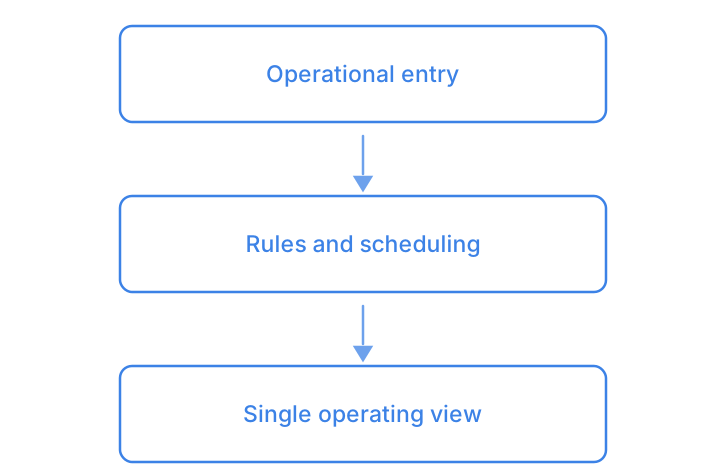
Enter once, let the rules schedule, read a single view: this foundation is shared across the family — you will find it in Management Systems (PMS) and in Order Management System (OMS).
- Automated eligibility engine
- Online entitlements simulation
- Prevention of documentary fraud
Smooth and frictionless integration
The rules engine interfaces with your current business applications via API or structured file exchanges. No replacement of your existing IS: we connect to your beneficiary databases, your repositories, your document management tools. Staff continue to work in their usual interfaces, with the engine results displayed directly in their environment.
Deployment is carried out by benefit scheme, starting with the one that poses the most problems.
Regulatory audit and mapping
We dissect with your lawyers and agents the exact rules of each scheme, their exceptions, their grey areas. We identify the necessary data sources.
Modelling and testing on historical data
The rules are encoded within the engine and then validated against your historical cases. Each discrepancy with past decisions is analysed and corrected.
Deployment on a first device
Implementation into production on a targeted benefit, in parallel with the existing process. Officers compare the results over a period of 4 to 6 weeks.
Extension and transfer of powers
Progressive addition of other schemes. Training of your teams in rule maintenance to gain autonomy.
Measurable results for your organisation
- Average instruction time reduced by 40% on standard files
- Regulatory update implemented within 48 hours instead of 3 to 6 months
- Calculation error rate has fallen below the 2% threshold
- Early detection of 15 to 20% of cases at risk of documentary fraud
- 60% reduction in claims related to payment errors
- Online simulator that prevents 25% of incomplete or ineligible applications
Clarifying your decision-making
How can we ensure that the engine properly applies such complex regulations?
Every rule is tested against real anonymised cases drawn from your records. The engine’s decisions are compared with those taken manually by your staff on a representative sample, and discrepancies are analysed one by one before go-live.
Will our staff lose control over the decisions?
Your staff retain control: the engine proposes a decision and explains it, the officer decides. On complex or atypical cases, the system flags that human validation is required. The objective is to free up time on straightforward cases, not to replace professional judgement.