
Grant Management
Associations operate on life support from multiple funding sources: the State, local authorities, foundations, European funds. Each funder imposes its own forms, supporting documents, submission deadlines and reporting requirements. A medium-sized organisation easily manages 15 to 30 grant applications per year, with deadlines spanning 12 to 18 months per application.
Administrative teams—often comprising 1 to 3 people—juggle between preparing applications, monitoring payments, justifying expenditure and producing final reports. A poorly documented ESF application can result in a clawback of 30% of the amount received. Missing a reporting deadline with a foundation sometimes means the end of a partnership spanning several years.
Meanwhile, programme managers await their budgets to launch field activities. The pressure is daily, margins for error non-existent, and institutional memory often rests with a single person.
This solution belongs to the Business Operations & ERP family.

Challenges holding back your performance
Most associations operate using a mixture of Excel spreadsheets, shared folders on an ageing server, and reminders in the administrative manager’s Outlook calendar. When this person goes on sick leave or leaves the organisation, panic ensues. The Excel files become illegible after 3 years: columns added without logic, broken formulas, multiple versions.Standard project management tools (Trello, Monday) do not understand the logic of a grant application: the links between initial application, agreements, amendments, staged payments and supporting documents.Result: hours wasted reconstructing the history of a file, missing documents discovered the day before a deadline, approximative reporting which undermines the association’s credibility with its funders.
Our Technical Approach
Our approach stems from an observation: a grant application is not a project like any other. It is an administrative object with its own logic: application, processing, agreement, payments, justification, closure: and strong links with the association’s analytical accounting.
We are building a portal that structures this reality: each file exists as a complete entity, with its lifecycle, its attached documents, its deadlines calculated automatically from the agreement dates. The calendar is not a gimmick: it anticipates alerts 30, 15 and 7 days before each deadline, with escalation to the director if necessary.
Document centralisation requires strict nomenclature: no more files named ’budget_v3_final_ok.xlsx’. Budget monitoring connects funding lines to actual expenditure, to produce reliable progress reports in just a few clicks.
The objective: that anyone in the team can pick up a file within 10 minutes.
Automated deadline schedule
Centralisation of documentation
Grant Management Monitoring
Technical Architecture
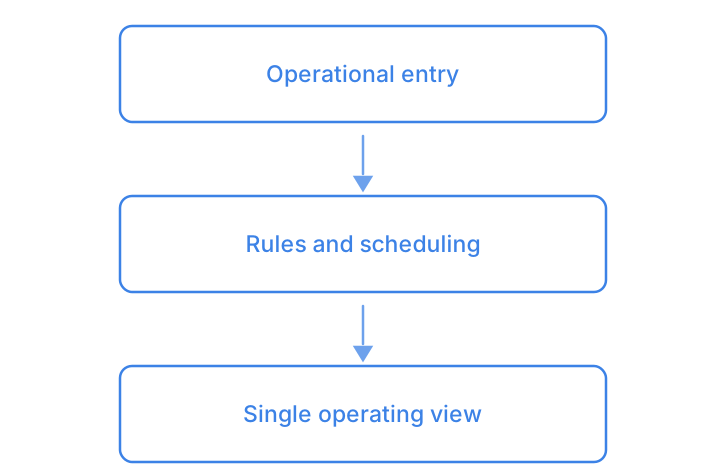
Enter once, let the rules schedule, read a single view: this foundation is shared across the family — you will find it in Order Management System (OMS) and in Workshop & After-Sales Management.
- Automated deadline schedule
- Centralisation of documentation
- Grant Management Monitoring
Smooth and frictionless integration
The portal connects to your existing accounting system (your accounting software, EBP, Quadra) to retrieve entries by analytical code, without re-entry. Documents can be imported from your current file server, then gradually reorganised. We do not require everything to be migrated at once: old closed files remain where they are, new ones are created in the portal.
Authentication relies on your accounts from your Office 365 or Google Workspace suite if you have one. Allow 2 to 3 weeks for operational deployment, including training.
Mapping of funding
Inventory of your funding sources, your current processes and friction points identified by your teams.
Configuration of the portal
Configuration of grant types, life cycles, alerts and documentary templates tailored to your funders.
Migration and training
Import of ongoing files, accounting connection, and practical training on your real cases — not on generic examples.
Monitoring and adjustments
Monthly review over 3 months to adjust alerts, enhance models and address particular cases that emerge.
Measurable results for your organisation
- Time required to compile an application dossier reduced by 40% through templates and reuse of recurring documents
- Zero missed deadlines over 12 months for structures deployed for more than one year
- File history reconstruction in under 10 minutes compared to 2 to 3 hours previously
- 60% reduction in time spent on interim financial reports
- Ability to produce a consolidated statement of current funding within 5 minutes
- Continuity assured during role transitions: handover of a portfolio of cases within half a day
Clarifying your decision-making
Our funders require very specific reporting formats. Can the portal adapt to these requirements?
The portal produces exports that comply with each funder’s matrices: CERFA, ESF forms, foundation tables. If a funder changes format, the template is adjusted, with no manual reformatting on your side.
Our administrative team is already overstretched. How long does it take to get to grips with the system?
A single day of training covers routine use of the portal. The interface is streamlined, help is contextual, and no superfluous functionality is added. Field feedback from our deployments shows full autonomy within a fortnight.