
Donor CRM & Tax Receipts
An association that grows is a donor database that becomes increasingly complex. Those initial Excel files were sufficient when you had 200 contacts. Today, you manage 3,000, 10,000, sometimes 50,000 donors with gift histories spanning 15 years, monthly direct debits, one-off donations, bequests, corporate sponsors. Every January, it’s the same rush: producing tax receipts before the deadline, verifying amounts tally, managing undelivered mail returns, address changes, duplicates.
Your administrative manager spends three weeks full-time on this. Errors on the Cerfa tax receipts generate complaints from loyal donors: and sometimes tax investigations. Meanwhile, your field teams would like to know whom to contact for the next campaign, who hasn’t renewed their donation for two years, which segment responds best to email fundraising appeals.
This information exists, scattered across three files, two software systems and the memory of Marie who retires in June.
This solution belongs to the CRM & Customer Relations family.

Challenges holding back your performance
Generic tools such as commercial CRMs do not understand the associative logic: a donor is not a customer, a donation is not a sale, a tax receipt is not an invoice.Result: misappropriated fields, makeshift exports, fragile Excel formulae for calculating annual totals. Specialised software exists, but charges per licence or per number of contacts: €3 per donor per annum represents €30,000 for a database of 10,000 people. Not to mention the additional paid modules for SEPA direct debits or emailing.Some associations make do with three tools that do not communicate with each other: one for online donations, one for accounts, one for mailings. Re-entry errors are inevitable. Duplicates accumulate.
Our Technical Approach
Our approach stems from a simple observation: your donor database is a strategic asset, not a by-product of your accounting.
We build a unified view of each donor: complete donation history, contact preferences, event participation, exchanges with your teams: accessible to all who need it. The generation of tax receipts becomes an automatic process: as soon as a donation is recorded, the system calculates the annual total, applies the current Cerfa rules (the French tax-receipt form), and prepares the document.
In January, you validate and send. Deduplication is not a function one runs once a year whilst crossing one’s fingers: it is integrated logic that detects name variations, old addresses, multiple entries before they pollute your statistics. SEPA direct debits are managed natively, with rejection tracking and automated follow-ups.
Your fundraising campaigns rely on reliable segments, not approximations.
Donor 360° View
Complete history of donations, memberships, and interactions by email or telephone.
Automated Generation (Cerfa)
Instantaneous creation of the legal PDF (Tax receipt) and dispatch via email to the donor.
Management of Direct Debits
Orchestration of SEPA mandates to ensure monitoring of regular monthly donations.
Campaign Tracking
Dashboards measuring the ROI of your various fundraising appeals (Mailings, Gala).
Intelligent Deduplication
Algorithms detecting donors created in duplicate (typing error, change of address).
No charge per licence
Unlimited access for all your volunteers handling data, unlike SaaS tools.
Technical Architecture
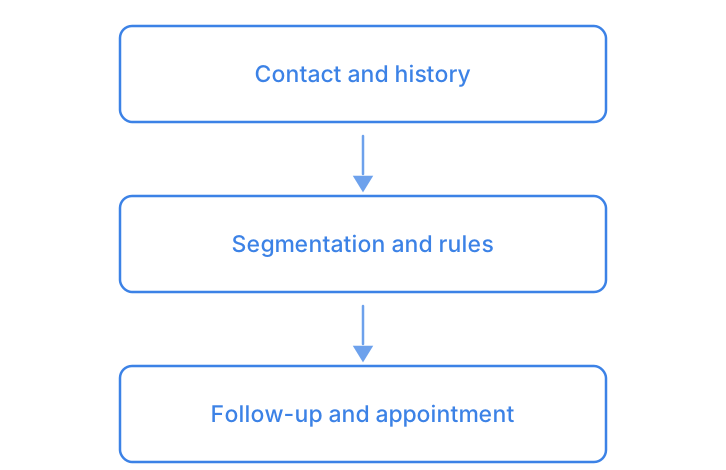
A complete history, segmentation rules, a follow-up at the right moment: Automotive CRM & Lead Management and Clienteling Applications follow this logic.
- Donor 360° ViewComplete history of donations, memberships, and interactions by email or telephone.
- Automated Generation (Cerfa)Instantaneous creation of the legal PDF (Tax receipt) and dispatch via email to the donor.
- Management of Direct DebitsOrchestration of SEPA mandates to ensure monitoring of regular monthly donations.
- Campaign TrackingDashboards measuring the ROI of your various fundraising appeals (Mailings, Gala).
- Intelligent DeduplicationAlgorithms detecting donors created in duplicate (typing error, change of address).
- No charge per licenceUnlimited access for all your volunteers handling data, unlike SaaS tools.
Smooth and frictionless integration
We take over your existing history: even if it is fragmented between Excel, legacy software and bank exports. The migration is carried out in stages, beginning with active donors from the past three years. Your current online payment tools (HelloAsso, your payment solution, bank transfer) are connected to automatically feed the database.
No need to change your accounting software: we generate entries in the format it expects. Your teams continue working during the transition.
Audit of the existing system
Analysis of your current files, identification of donation sources, mapping of tax receipt issuance processes and friction points.
Migration and cleansing
Import of historical data, deduplication, data normalisation. You validate the quality before switching over.
Connection of flows
Integration of payment platforms, configuration of SEPA direct debits, linking with your accounting system.
Team autonomy
Training of your users on practical cases: donor research, campaign launch, Cerfa generation. Support available for particular cases.
Measurable results for your organisation
- Generation of annual tax receipts in 2 hours instead of 3 weeks
- 95% reduction in errors on Cerfa amounts
- Automatic identification of duplicates: on average 8 to 12% of the cleansed database
- Zero cost per licence or per contact, regardless of volume
- SEPA direct debit rejection rate reduced by a third through proactive monitoring
- Reliable segmentation for campaigns: +15 to 25% response rate observed
Clarifying your decision-making
How do you manage tax compliance when Cerfa rules change?
Clarendis handles the regulatory maintenance of tax receipts. When the Cerfa format changes, as it did in 2022 with the new mandatory information, the templates are updated before the issuing period. You do not need to monitor the BOFIP.
Our current database is in quite poor condition, with years of inaccurate data entry. Is this retrievable?
A degraded donor database is the most common scenario, and it remains retrievable. Clarendis applies proven cleansing routines: address normalisation, detection of deaths through INSEE files, and merging of duplicates with history preserved. Allow two to four weeks depending on volume.