
Humanitarian Logistics & Distribution
A crisis erupts, donations pour in, and your logistics team must transport 40 tonnes of supplies to three intervention zones in under 72 hours. On paper, you have the resources. On the ground, it’s another matter entirely: the transit warehouse doesn’t know what’s arriving, local teams are double-ordering due to lack of visibility, and no one can say with certainty what has been distributed to whom, when.
Donors demand lot-by-lot traceability. Your logistics manager is juggling between WhatsApp, Excel files sent by email and photographed paper delivery notes. When an audit arrives, it takes three weeks to reconstruct the flows. Intervention zones often have intermittent or non-existent connectivity.
Your field coordinators spend their evenings re-entering data instead of preparing the next day’s distributions. And when a batch of medicines approaches its expiry date in a secondary warehouse, you discover it too late. This isn’t a problem of willingness: it’s a problem of tooling.
This solution belongs to the Business Operations & ERP family.

Challenges holding back your performance
Excel remains the default tool because it is free and everyone knows how to use it.However, a spreadsheet cannot manage synchronisation between a warehouse in Geneva, a hub in Nairobi and four distribution points without network connectivity. Traditional ERPs assume permanent connectivity and trained users: two rare luxuries in humanitarian contexts. Consumer logistics tools ignore specific constraints: beneficiary traceability for donors, management of critical expiry dates, multi-currency and multi-language reporting.As for internal developments, they mobilise IT resources that you do not have, and each staff rotation takes away part of the knowledge.The result: fragmented data, decisions made blindly, and hours lost in manual reconciliation.
Our Technical Approach
Our approach stems from a field reality: your teams often work without network coverage, using basic smartphones, in contexts where every minute counts. The mobile application functions entirely offline: recording entries/exits, batch scanning, beneficiary signatures: and automatically synchronises as soon as a connection appears, even weak.
On the back-office side, each warehouse has a real-time view of its stock with alerts on critical thresholds and expiry dates. Traceability is built-in: each batch is tracked from receipt to final distribution, with time stamps, geolocation and beneficiary identifier. Field coordinators access a dashboard visualisation tool which aggregates data from all zones.
Donor reports are generated with just a few clicks, with the level of detail required by ECHO, USAID or the ICRC. The architecture is designed to function on limited infrastructure: lightweight servers, minimal bandwidth, entry-level devices.
Traceability of distributed batches
Multi-warehouse management
Field application offline
Technical Architecture
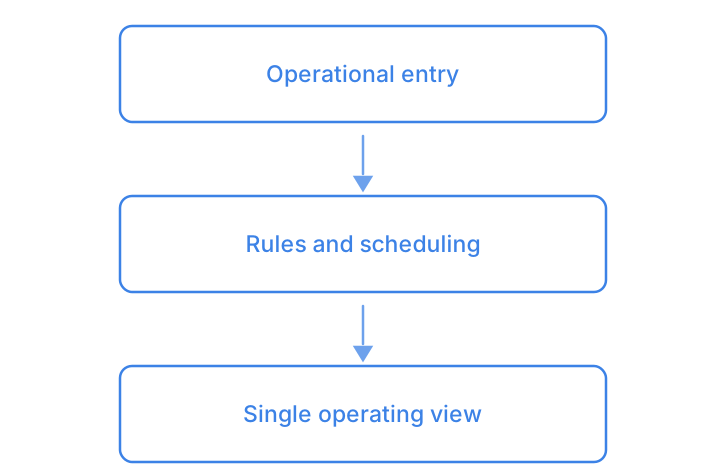
Enter once, let the rules schedule, read a single view: this foundation is shared across the family — you will find it in Management Systems (PMS) and in Order Management System (OMS).
- Traceability of distributed batches
- Multi-warehouse management
- Field application offline
Smooth and frictionless integration
Your organisation already has tools in place: a headquarters ERP, perhaps a beneficiary management system, proven validation processes. We don’t replace everything. Our platform interfaces with your existing systems via API or structured imports. Field data automatically feeds back to your consolidated reporting tools.
We respect your validation workflows and your authorisation levels. Deployment is carried out by zone, beginning with a pilot on one mission, without disrupting ongoing operations.
Mapping of existing flows
Analysis of your current logistics circuits, identification of friction points and donor-specific requirements for your organisation.
Configuration and field pilot
Configuration of the platform on a pilot mission, training of local teams, testing under real conditions for 4 to 6 weeks.
Integration of headquarters systems
Connection with your ERP and reporting tools, automation of data feeds, validation of donor report formats.
Deployment and autonomy
Progressive extension to other missions, training of local focal points, skills transfer for day-to-day administration.
Measurable results for your organisation
- 70% reduction in donor reporting preparation time
- Real-time stock visibility across all distribution points, including whilst offline
- Complete batch-by-batch traceability compliant with ECHO and USAID requirements
- Reduction in spoilage losses by 35% through early warning alerts
- Field data capture time reduced by a factor of 4 for distribution teams
- Inter-warehouse flow reconciliation reduced from 3 weeks to 48 hours
Clarifying your decision-making
How does it work when our teams have no network connectivity for several days?
The application stores every transaction locally, with timestamps and GPS coordinates. On reconnection, even a brief one, data synchronises with conflict management. Clarendis has tested it on missions with ten days without connectivity, without data loss.
Our field teams change frequently and do not have time for lengthy training programmes.
The interface is designed to be mastered in under thirty minutes. One focal point is trained per area, who then trains the others. Screens follow the natural flow of a distribution — scan, validation, signature — without complex menus.